
 Egypt
Egypt  UAE
UAE  USA
USA Is a Solar Water Heater Worth It in Saudi Arabia?
A solar water heater cuts your electricity bill thanks to Saudi Arabia's strong sun, but upfront cost runs far higher than a standard tank. Here's when it's actually worth it.
We may earn a commission from purchases through our links, at no extra cost to you. Full disclosure.
No, not for most Saudi households. A solar water heater cuts your electricity bill thanks to the Kingdom’s strong sun, but upfront cost runs far higher than a standard electric tank, and it usually still needs a backup heating element for nights and cloudy days. For most homes, an electric tank like the Nilson NT5000 covers daily needs immediately at a much lower cost. Solar pays off mainly for villas with high, steady hot water demand and a long stay.
The quick answer
A solar water heater cuts long-term running cost thanks to Saudi Arabia’s strong sun, but it’s only worth its high upfront cost for homes with high, steady hot water demand and a long-term stay, typically villas rather than rented apartments. For most homes, a standard electric tank or a tankless unit covers the need immediately at a much lower upfront cost, with no roof space or backup heating element required.
Key takeaways
- A solar water heater pairs a solar collector with a storage tank that heats water directly from the sun rather than electricity (solar water heating background from ENERGY STAR).
- It usually still needs a backup electric heating element for cloudy days and nights, so electricity doesn’t disappear from the bill entirely.
- Upfront cost runs far higher than a standard electric tank, which is the biggest barrier for most households.
- Payback period varies sharply by household size and usage, so there’s no single fixed number that applies to everyone.
- It needs dedicated roof space for installation, which makes it a more realistic fit for villas than for rented apartments.
How a solar water heater works
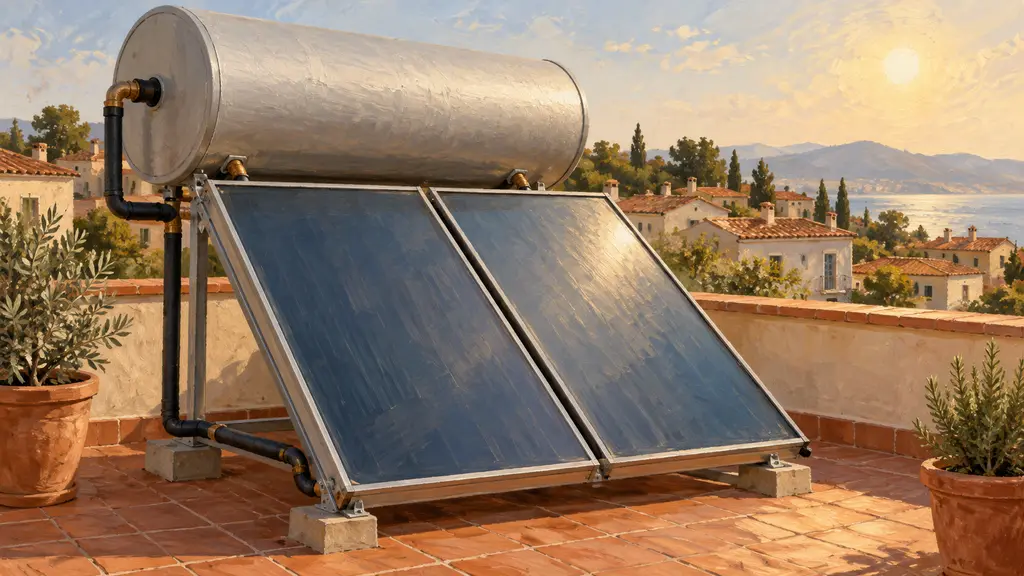
A solar water heater pairs a collector installed on the roof, which absorbs direct sunlight, with a storage tank that holds the resulting hot water ready for use, and sometimes a small pump that circulates water between the collector and the tank (background on the principle from ENERGY STAR). The principle is simple: the stronger and longer the sun, the hotter the resulting water and the less it depends on any additional electrical source. That makes Saudi Arabia, with its strong, near-daily sun, technically a good fit for this kind of heating, but technical fit and actual financial payoff for your specific household are two different questions.
The real benefits of solar water heating in Saudi Arabia
The core benefit is clear: cutting the electricity used specifically for water heating across nearly the whole year, thanks to the high number of sun hours in most parts of the Kingdom. For a household with high daily hot water demand, several bathrooms in constant use, the running-cost difference becomes genuinely noticeable over the years. The investment also reduces reliance on the grid for this specific consumption, which may matter to anyone looking for more independence in their monthly bill.
The costs and downsides you should know before deciding
The upfront cost is the real barrier: collector, tank, and installation cost several times more than a standard electric tank or even a tankless unit, and that difference is paid up front before any later savings kick in. The system also almost always needs a backup electric heating element that runs on cloudy days, at night, and during shorter winter daylight, so the electricity bill doesn’t vanish, it just drops. Add to that the roof space a collector and tank require, which makes the system a better fit for a villa with its own independent roof than for an apartment or a multi-unit building. Routine maintenance on the collector is also a factor to weigh in, since it isn’t as maintenance-free as a simple electric tank.
When the investment is actually worth it
The investment clearly pays off for a villa with high, steady hot water demand, several bathrooms in daily use, an independently owned roof rather than a rented one, and a long-term stay long enough for the running-cost savings to offset the higher upfront price over the years. The higher the daily consumption and the longer the stay, the more the balance tips toward solar.
When the electric option remains the better fit
For a small or moderate household, or a renter who doesn’t own the roof or isn’t sure how long they’ll stay, a standard electric tank like the Nilson NT5000, or a tankless unit like the AEG DDLE Basis (which needs a 400V three-phase supply and installation by a qualified electrician, and whose listing states German country approval, not Saudi approval), covers the daily need at a much lower upfront cost, with no years-long wait to recover the difference. For most homes in Saudi Arabia today, that’s the more financially sensible pick, not because solar is a bad system, but because the upfront cost and roof dependency don’t suit every situation.
Solar vs electric water heater: quick comparison
| Criterion | Solar water heater | Electric heater (tank or tankless) |
|---|---|---|
| Upfront cost | Much higher, equipment and installation | Much lower, ready to install immediately |
| Running cost | Lower over the long term | Relatively higher month to month |
| Backup heating needed | Yes, in most cases | Not needed, electricity is the source already |
| Installation space | Dedicated roof space for collector and tank | Standard utility space inside the home |
| Fit for renters | Poor, a long-term investment | Good, easy to install and move |
| Payback period | Varies sharply with usage | Not applicable, upfront cost is already low |
Our practical pick right now: Nilson NT5000 50L Vertical
If your home is like most, where daily usage or length of stay doesn’t justify solar’s higher upfront cost, a balanced electric tank solves the problem immediately. The Nilson NT5000 50L Vertical carries hundreds of reviews on Amazon.sa and its 50-liter capacity comfortably covers a single bathroom, at a price that sits in the middle of this category rather than at either extreme. We didn’t pick it for being the cheapest, we picked it because its 50-liter capacity and mid-range price suit most single-bathroom homes, which is why it tops our guide to the best water heater in Saudi Arabia.
See the Nilson NT5000 50L Vertical price on Amazon.sa ↗
Bottom line
A solar water heater is technically well suited to Saudi Arabia’s strong sun, but it’s an investment that actually pays off only for a villa with high, steady hot water demand, a long-term stay, and its own roof. For most homes, especially rented apartments and small-to-moderate usage, a standard electric tank or a tankless unit covers the need immediately at a much lower upfront cost, with no years-long wait to recover the difference. To work out the right size for your home before you buy, see what size water heater do you need, and for the full buying criteria read how to choose a water heater. If your trip needs hot water away from home rather than inside it, see the best portable water heater for camping and desert trips. To browse every option in this category in one place, head back to water heaters.
Sources
- ENERGY STAR, “Solar water heaters”, background on how solar water heaters, collectors, and storage tanks work: https://www.energystar.gov/products/solar_water_heaters
- ENERGY STAR, “Residential water heater types”, general background on domestic water heating technologies: https://www.energystar.gov/products/water_heaters/residential_water_heaters_key_product_criteria
About this guide
- Editing
- Mizaan Home editorial team
- Last updated
Research based on published specifications, without hands-on testing. How we choose
Prices are checked per product; the oldest check on this page:
This analysis is based on published information from ENERGY STAR (Solar water heaters), ENERGY STAR (Residential water heater types).
Frequently asked questions
Is a solar water heater actually worth the extra cost in Saudi Arabia?
It clearly pays off in one scenario: a villa with high, steady hot water demand and a long-term stay long enough for the running-cost savings to offset the higher upfront price. For a small or moderate household, or anyone unsure how long they'll stay in the property, a standard electric tank or a tankless unit covers the need immediately at a far lower upfront cost, which is the more sensible pick for most homes.
Does a solar water heater still need a backup electric heater?
Usually, yes. Cloudy days, nighttime use, and shorter winter daylight give less sun than full heating needs, so most solar systems are installed with a backup electric element that kicks in automatically when needed. That means your electricity bill doesn't drop to zero, but it does drop meaningfully compared to a purely electric setup.
How long does a solar water heater take to pay for itself?
There's no single number that applies to everyone. Payback depends on household size and daily hot water use, your electricity rate, and how long you'll stay in the property. A large villa with high daily demand recovers the cost far faster than a small apartment with sporadic use, which is why the decision should be based on your actual usage pattern, not a general average.
Does a solar water heater make sense for renters or apartments?
Usually not. A solar water heater needs dedicated roof space for the panels or collector tank, it's a long-term investment that doesn't suit someone who might move within a few years, and it typically requires landlord or building approval in the first place. For a renter or apartment dweller, a compact electric tank or a tankless unit is far easier to install and makes more financial sense.