
 Egypt
Egypt  UAE
UAE  USA
USA Is a Misting Fan Worth It in Saudi Arabia?
We may earn a commission from purchases through our links, at no extra cost to you. How we choose · Disclosure.
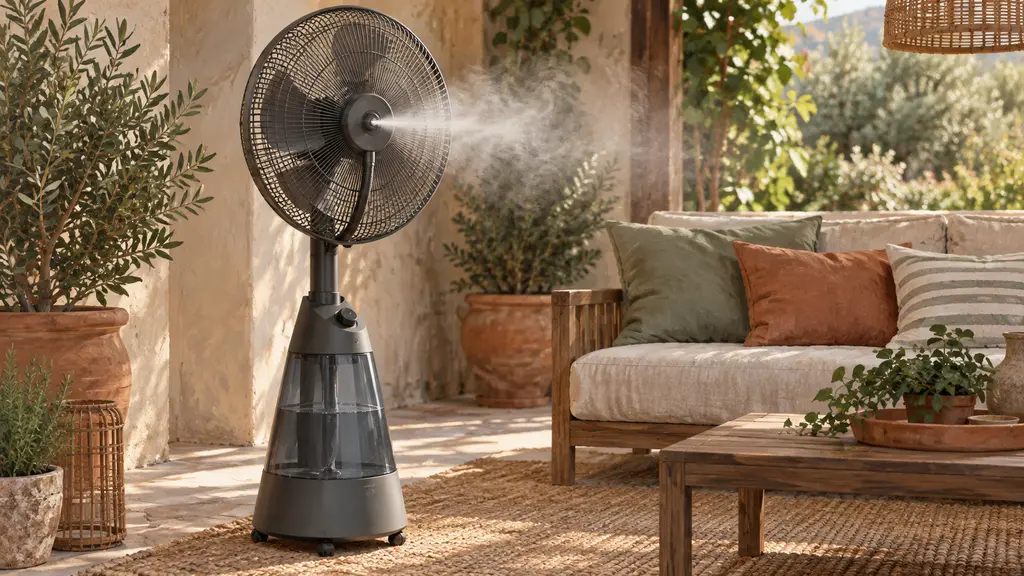
A misting fan is worth buying if its main job is a shaded outdoor sitting in dry heat, such as a majlis, terrace, or garden in Riyadh or a similar inland city, because evaporating water adds real cooling that a regular fan in the same spot simply can’t provide. But if you’re shopping for a fan for indoor use, or you live in a humid coastal city, the extra cost and the recurring upkeep of a misting system usually aren’t worth it next to a plain tower or pedestal fan.
The quick answer
A misting fan is worth it for a shaded outdoor sitting in dry heat only, not as a general fan for the home or coastal humidity. Its cooling depends on water evaporation, a mechanism that’s highly effective in dry air and weak in humid air. The added costs, frequent tank refills and hard-water mineral buildup, mean a plain fan that’s simpler and cheaper to maintain remains the smarter choice for most indoor uses.
Key takeaways
- A misting fan combines a fine water mist with moving air, and when that water evaporates, it pulls heat directly out of the surrounding air, the same evaporative cooling principle used in desert-style air coolers (evaporative cooler definition from Britannica).
- How well evaporative cooling works is tied directly to the air’s relative humidity: the drier the air, the faster mist evaporates and the more heat it pulls out (relative humidity background from US EPA).
- In humid air, the air is already close to saturated with water vapor, so extra mist evaporates very slowly, and you may end up feeling damp rather than genuinely cool.
- The water tank needs refilling far more often than a regular fan that uses no water at all, which is a real maintenance cost worth weighing against the benefit.
- Hard tap water leaves mineral deposits on the mist nozzles, so they need periodic cleaning to stop clogging or weakening spray over time.
How a misting fan actually works
A misting fan is a regular fan at heart, with a small pump added that pushes water through fine nozzles in front of the blades, turning droplets into a very fine mist that mixes with the moving air. As that mist evaporates, it draws heat directly out of the surrounding air, cooling the air itself before it reaches you, not just moving it the way a plain fan does. That’s the evaporative cooling principle exactly, the same one behind the desert-style air coolers common in dry regions.
The catch is that this entire mechanism depends on how much extra water vapor the air can absorb. Dry air has plenty of room to take on more moisture, so the mist evaporates quickly and pulls out noticeable heat. Humid air is already close to its saturation point, so it can’t easily absorb more moisture, and the mist evaporates very slowly or barely at all, leaving damp water on your skin rather than cooler air.
When a misting fan is genuinely worth it
A misting fan earns its keep in a specific set of situations:
- A shaded majlis or terrace sitting in dry heat. Summer evenings in Riyadh or similarly dry inland cities are exactly the environment this category is built for.
- A home garden or outdoor space with no AC at all. In these spaces, a misting fan is the only meaningful cooling option beyond shade and natural airflow.
- Short outdoor gatherings or events. The difference between a plain fan and a misting fan in that specific setting is often worth the extra purchase cost.
When it isn’t worth the hassle
On the other hand, some situations make a misting fan a poor fit:
- Indoor use in a bedroom or living room. The extra humidity from misting inside an enclosed space does more harm than good, leaving the air feeling heavier rather than cooler, while a regular tower or pedestal fan does the job with no such side effect.
- Humid coastal cities, as we cover in do fans help in dry heat?, where the air is already humid and extra mist evaporates slowly and ineffectively.
- If you don’t want the recurring maintenance. Refilling the tank and cleaning nozzles clogged with hard-water deposits is a repeated task a plain fan with no misting system never asks of you.
Misting fan versus a regular fan
| Factor | Misting fan | Regular tower or pedestal fan |
|---|---|---|
| Cooling in dry heat | Genuine extra cooling through evaporation | Moves air with no real cooling of the air itself |
| Cooling in humid heat | Weak, can even feel damper | Roughly the same performance regardless of humidity |
| Indoor use | Not well suited, raises room humidity | Well suited, this is its core use case |
| Maintenance | Frequent refills and periodic nozzle cleaning | No water needed, occasional dust wipe only |
| Overall cost | Higher, due to the misting system and its upkeep | Lower, one unit with no extra consumables |
Which one should you actually get
If your main use case is a shaded outdoor sitting in dry heat, and the tank refills and periodic nozzle cleaning don’t bother you, a misting fan is a sound investment that gives you cooling no plain fan can match in that same spot. But for most people, especially anyone who wants a fan that works both indoors and out without humidity limits or water upkeep, a reliable regular fan stays the more flexible, lower-maintenance choice long term. A practical example from our shortlist: the DREO Quiet Tower Fan (DC Motor), with its quiet motor and oscillation that covers a full room, runs with no maintenance beyond an occasional dust wipe, which is part of why it tops our guide to the best fan in Saudi Arabia. We didn’t pick it to replace a misting fan outdoors, we picked it as the smarter default when indoor use is your main need. You’ll find its current price and the Amazon.sa link in the card below.
Bottom line
A misting fan is worth buying for one specific purpose: a shaded outdoor sitting in dry heat, where water evaporation adds real cooling no regular fan can match. In coastal humidity or for indoor use, that advantage disappears and turns into an extra maintenance burden with little benefit. If you’re not sure which fan type suits your use case, our guide to choosing a fan breaks down the trade-offs in detail, and to compare prices across fan types, see fan prices in Saudi Arabia. Remember that all prices are approximate at publication and change, so double-check on Amazon.sa before you buy.
For everything in this category in one place, browse our fans section.
Sources
- Britannica, “Wet-bulb temperature and evaporative cooling”, the evaporative cooling principle and how evaporating water pulls heat from the air: https://www.britannica.com/science/wet-bulb-temperature
- US EPA, “Controlling moisture and relative humidity at home”, background on relative humidity and its effect on evaporation speed: https://www.epa.gov/mold/what-are-main-ways-control-moisture-your-home
This analysis is based on published information from Britannica (Wet-bulb temperature and evaporative cooling), US EPA (Controlling moisture and relative humidity at home).
Frequently asked questions
Is a misting fan actually worth buying?
Yes, if its main job is a shaded outdoor sitting in dry heat, like a majlis, terrace, or garden in Riyadh or a similar inland city. Evaporating water mist pulls extra heat out of the surrounding air, giving you real cooling that a regular fan in the same spot can't match. For indoor use or coastal humidity, a regular fan or AC is still the better call.
Does a misting fan work as well in humid coastal cities?
No. Mist cooling depends on how fast water evaporates into the air, and humid air is already close to saturated with water vapor, so extra mist evaporates very slowly and the cooling effect drops sharply, sometimes leaving your skin feeling damp rather than cool. In Jeddah or Dammam, a plain fan without misting is the more sensible pick for most outdoor uses.
How often do I need to refill the water tank and maintain the fan?
It depends on tank size and how long you run it, but continuous misting means more frequent refills than a regular fan that uses no water at all. Hard tap water also leaves mineral deposits on the mist nozzles over time, so they need periodic cleaning to stop clogging or weak spray.
Do I need a misting fan if I already have AC at home?
Usually not. AC solves indoor cooling more efficiently than any fan. A misting fan earns its real value in outdoor spaces AC can't reach at all: a garden, terrace, or summer majlis sitting, where it's the only meaningful cooling option besides shade.