
 Egypt
Egypt  Saudi Arabia
  USA
USA Air Fryer vs Deep Fryer: Which Should You Choose?
We may earn a commission from purchases through our links, at no extra cost to you. How we choose · Disclosure.
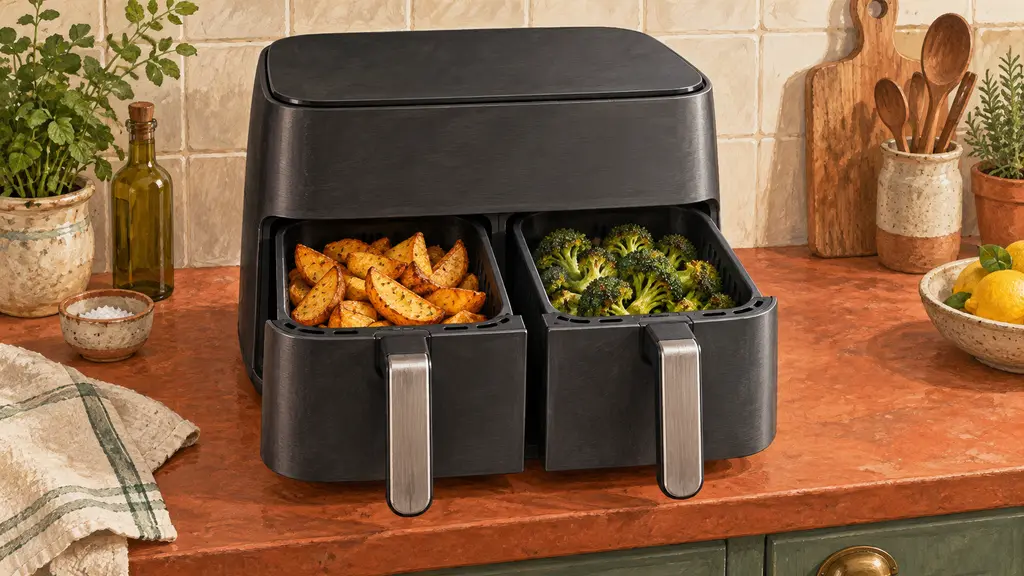
An air fryer wins in most home-cooking situations: significantly less oil, easier cleanup, and less risk from exposed hot oil. But traditional deep frying still delivers a crispiness and texture an air fryer can’t quite match for wet-batter foods like donuts or battered fish, and it stays the more practical option for cooking large quantities for a crowd in one go. The right choice comes down to which priority matters more for your kitchen: health and convenience, or deep crispiness and big batches.
The quick answer
For most UAE homes, the air fryer is the smarter pick: far less oil than deep frying, easier cleanup with no hot oil bath, and more safety around kids. Choose deep frying only if you want genuine deep-fry crispiness for wet-batter foods like donuts, or you’re cooking large quantities for a gathering in one batch. Both methods produce good food, they’re just not identical substitutes for every dish.
Key points
- Deep frying fully submerges food in hot oil, while an air fryer relies on fast-circulating hot air around a thin coat of oil or no oil at all (air fryer definition from University of Nebraska-Lincoln Extension).
- An air fryer uses far less oil, often just one to two teaspoons versus a large volume of oil for deep frying.
- Traditional deep frying (deep frying from Britannica) produces more consistent crispiness for wet-batter foods like donuts and British-style battered fish, because oil surrounding the food transfers heat more evenly than air alone.
- Cleaning an air fryer is faster and easier, with no hot oil bath to dispose of or strain for reuse.
- Burn and spill risks are much lower with an air fryer, since it doesn’t hold a large volume of exposed hot oil.
How each method actually works
Deep frying fully submerges food in hot oil, usually between 175 and 190 degrees Celsius, so heat transfers from the oil to every surface of the food at once, which is what gives that even, golden restaurant-style crispiness. An air fryer, by contrast, is a compact convection appliance: a powerful fan rapidly circulates hot air around food sitting in a perforated basket, so the outer surface dries out and crisps from heat and moving air rather than oil immersion. The result is very close to traditional frying for most foods, though not physically identical.
Oil use and nutrition
The clearest difference between the two methods is oil volume. Deep frying needs enough oil to fully cover the food, and some of that oil gets absorbed during cooking. An air fryer only needs the food brushed or lightly misted with a teaspoon or two of oil, and some naturally fatty foods like skin-on chicken pieces need no added oil at all. Less absorbed oil usually means less fat in the finished dish, though the exact difference depends on the food and how it’s prepared, not one fixed number that applies to every dish.
Crispiness and taste: where each one wins
For seasoned or breaded foods like chicken pieces, fries, and vegetables, an air fryer produces a genuinely convincing crisp exterior that’s hard to tell apart from deep frying in most cases. The gap shows clearly with wet-batter foods, like donut dough or British-style battered fish coating, which need full oil immersion to set the outer crust and puff up correctly, something air alone doesn’t reproduce as precisely.
Cleanup and kitchen safety
Deep frying leaves behind a bath of hot oil that needs to cool before straining or periodic replacing, an extra recurring step that takes time and carries a spill or burn risk while you handle it. An air fryer just needs one basket washed after each use, and it doesn’t hold a large volume of exposed hot oil that could spill or ignite if overheated. That’s why many households with kids specifically prefer air fryers from a pure safety standpoint.
Quick comparison: air fryer vs deep fryer
| Air fryer | Deep fryer | |
|---|---|---|
| Oil needed | One to two teaspoons or less | A large volume, fully submerging the food |
| Crispiness | Very good for most foods | Best for wet-batter foods and deep crispiness |
| Cleanup | One basket, easy to wash | Oil bath needs straining or periodic replacing |
| Safety | Less exposed oil, lower burn risk | Large hot oil volume, higher risk |
| Large batches | Limited by basket size, repeat rounds | Handles big quantities in one session |
| Kitchen smell and smoke | Much lower | Higher, especially with repeated frying |
When deep frying still earns its place
If you regularly make wet-batter foods, like homemade donuts or British-style battered fish, deep frying is still the more precise tool for those specific dishes. Likewise, if you’re cooking large quantities for a family gathering or event, a big oil fryer handles the volume in one session, while an air fryer needs repeated batches limited by basket size.
The air fryer is the smarter default for everyday cooking
For most everyday meals, from fries and chicken to vegetables, an air fryer balances a genuinely convincing crisp result with far less oil, easier cleanup, and more kitchen safety. If you’re switching over, the model that balances capacity and ease of use for most UAE homes is the Philips Airfryer 2000 Series 4.2L (≈ 299 AED), with a basket that suits two to three people and a simple dial control that doesn’t need a manual, backed by thousands of positive reviews on Amazon.ae. It’s the top pick in our guide to the best air fryer in the UAE.
See the Philips Airfryer 2000 Series price on Amazon.ae ↗
If you’re cooking for a bigger household or regularly need two dishes ready together, see is a dual-basket air fryer worth it to find out whether the extra capacity and independent zones earn the higher price.
Bottom line
An air fryer wins for most everyday cooking with far less oil, easier cleanup, and more kitchen safety, while deep frying keeps its one real edge for wet-batter foods and very large batches. If you’re switching to an air fryer, your cleaning routine changes too, so see how to clean an air fryer to learn how to protect the non-stick coating from day one. To pick the right size from the start, see our guide on how to choose an air fryer, or browse the full air fryers section.
Sources
- University of Nebraska-Lincoln Extension, “How air fryers work”,” definition of the air fryer and its hot-air convection principle: https://food.unl.edu/free-resources/newsletters/food-safety-tips-electric-air-fryers/
- Britannica, “Deep frying”,” definition of deep frying and heat transfer through oil immersion: https://www.britannica.com/topic/deep-frying
This analysis is based on published information from University of Nebraska-Lincoln Extension (How air fryers work), Britannica (Deep frying).
Frequently asked questions
Does an air fryer taste the same as deep-fried food?
For most foods, yes, very close. An air fryer produces a crisp exterior nearly identical to deep frying for items like fries, seasoned chicken, and vegetables. The gap shows up clearly with wet-batter foods like donuts or classic British battered fish, which need full oil immersion to set the crust and cook evenly in a way circulating hot air alone can't fully match.
Is deep frying cheaper than using an air fryer long term?
Not necessarily. Deep frying uses a large volume of oil that needs straining or periodic replacing, and that's a recurring cost on top of electricity. An air fryer uses far less oil, or none at all, so it removes that oil cost, while electricity use is comparable to any home heating appliance of similar wattage.
Is an air fryer safer than deep frying in the kitchen?
Generally yes. Deep frying means a large amount of exposed hot oil that can spill or ignite if overheated, a real risk especially with kids around the kitchen. An air fryer contains the heat and the small amount of oil inside a closed basket, which noticeably cuts the chance of burns or spills.
Can an air fryer replace deep frying for every food?
For most everyday foods, yes, from crispy fries to chicken, fish, and vegetables. The clearest exception is wet-batter foods like leavened donuts or classic British-style battered fish, which need full oil immersion to set and crisp in the traditional way, something an air fryer alone doesn't reproduce precisely.