
 Egypt
Egypt  Saudi Arabia
  USA
USA What Size Dehumidifier Do You Need? (By Room and Humidity)
We may earn a commission from purchases through our links, at no extra cost to you. How we choose · Disclosure.
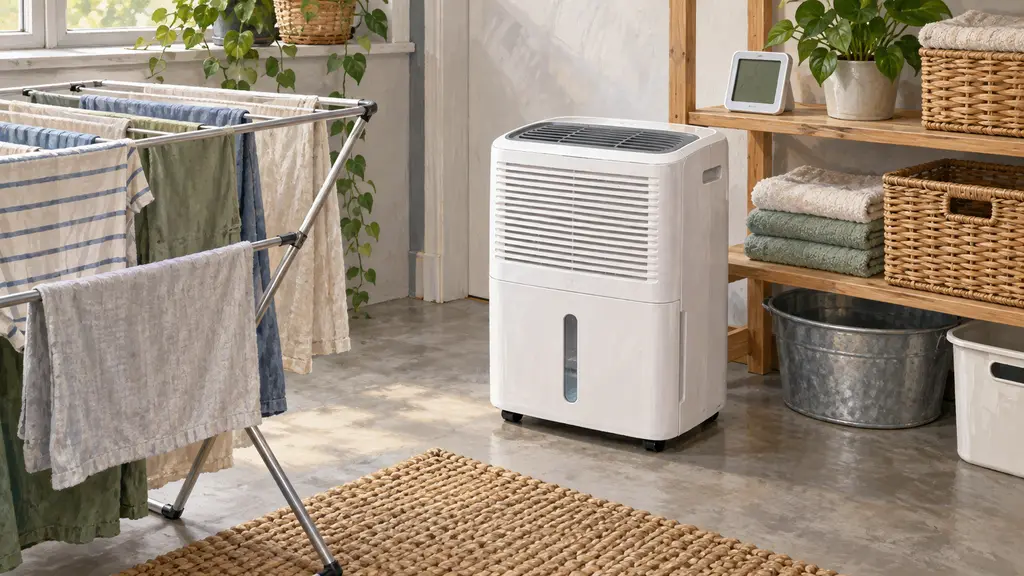
The right dehumidifier size depends on both the room’s floor area and its actual humidity level, not price alone or the highest liters-per-day figure you can find. A small closet needs very little capacity, while an open living room with persistent coastal humidity needs far more to actually keep up.
The quick answer
Match a dehumidifier’s capacity (liters per day) to your space’s size and its real humidity level. A small closet or bathroom is fine with a passive absorber or mini unit, a normal bedroom suits a 20L/day unit, and an open living room or a whole villa floor with persistent humidity needs 30 liters a day or more. A unit bigger than you need means overspending for no real benefit.
Key points
- Capacity is rated in liters of moisture removed per day, a direct measure of how much water vapor the unit actually pulls out, not its physical size (dehumidifier definition from ENERGY STAR).
- Room size is a major factor, since an open living room needs far more capacity than a closet or small bedroom at the same humidity level.
- The room’s actual humidity level changes the math too, so a room near the coast or next to a bathroom or kitchen needs more capacity than a similarly sized room with only mild humidity.
- A unit bigger than you actually need isn’t a bonus feature, it’s overspending, more noise, and a bigger footprint for no real gain.
- Small, enclosed spaces with no power (a closet, car, storage box) suit a passive moisture absorber, not a full compressor unit.
Why the right size matters more than the price
A dehumidifier that’s smaller than the room needs will run constantly without ever reaching a genuinely comfortable humidity level, leaving the room damp despite nonstop operation. On the flip side, a unit far bigger than you actually need means paying more for capacity you won’t use, plus more noise and a bigger footprint taking up a corner of the room for no real benefit. The goal isn’t the highest liters-per-day number available, it’s the number that matches your actual space and its actual humidity.
Size guide by type of space
| Type of space | Typical humidity level | Suitable capacity | Approx. price range |
|---|---|---|---|
| Small closet or bathroom | Mild, no active condensation source | Passive moisture absorber or mini unit | Under 150 AED |
| Normal bedroom | Moderate to high, especially near the coast | 20L/day compressor unit | Around 849 AED |
| Open living room or villa floor | High, persistent through summer months | 30L/day compressor unit | Around 950 AED |
| Closet or car with no power outlet | Mild, no electric operation needed | Refillable passive absorber | Under 100 AED |
This table is a general guide for matching space type to capacity. To see every currently available option with exact prices at publication, see our guide to the best dehumidifier in the UAE.
How to size your room step by step
- Identify the type of space first: a small enclosed closet, a normal bedroom, or an open-plan living space that spans more than one room.
- Assess the actual humidity level, not the assumed one: do you notice a musty smell or condensation despite the AC running? That’s a sign of above-average humidity needing more capacity.
- Treat proximity to the coast as a multiplier: rooms near the coast face higher outdoor humidity year-round than areas further inland.
- Don’t rely on the AC alone in your calculation. The AC only removes humidity as a side effect, covered in detail in AC vs dehumidifier.
- Pick the capacity closest to your actual need, not the highest available, since excess capacity is spending with no meaningful return in most cases.
What size fits most UAE homes
For most normal-sized bedrooms and living rooms in the UAE, a 20L/day unit covers the actual need through humid coastal summer months without constant tank emptying. A practical example in this category: the Pro Breeze 20L/Day Dehumidifier (≈ 849 AED), which carries thousands of positive reviews on Amazon.ae, earning it the top spot in our guide to the best dehumidifier in the UAE. If your space is bigger than a single room or humidity is a persistent rather than occasional problem, a 30L/day unit in the same lineup is a sensible step up.
The bottom line
Choosing the right dehumidifier size starts with matching capacity to your room’s actual size and humidity level, not price alone or the highest number available. Small, enclosed spaces are fine with a passive absorber or mini unit, normal rooms suit a 20L/day unit as the best overall pick for most UAE homes, and larger or more humid spaces need 30 liters a day or more. For the full buying criteria, read our guide on how to choose a dehumidifier, and to check whether your AC alone is enough see AC vs dehumidifier, or browse the full dehumidifiers category.
Sources
- ENERGY STAR, “Dehumidifiers”, definition of a dehumidifier and how its capacity is rated in liters removed per day: https://www.energystar.gov/products/dehumidifiers
This analysis is based on published information from ENERGY STAR (Dehumidifiers).
Frequently asked questions
How do I know how many liters per day my room needs?
Match capacity to the type of space and its actual humidity level, not price alone. A small closet or bathroom is fine with a passive absorber or mini unit, a normal bedroom usually needs a 20L/day compressor unit, and an open living room or a whole villa floor with persistent humidity needs 30 liters a day or more.
Is a bigger capacity always the better choice?
Not necessarily. A unit bigger than you actually need means overspending, more noise, and a larger footprint you don't need. The goal is matching capacity to your room's size and humidity level, not picking the highest number available.
Is a 20L/day unit enough for a full living room?
Usually yes for a normal-sized living room or bedroom, which is why it's the best overall pick for most UAE homes. But a large open-plan space or a whole villa floor with persistent coastal humidity may need a 30L/day unit to keep up without falling behind.
Does the room's current humidity level change the size needed?
Yes, directly. The same-sized room may need a higher capacity if its humidity is severe and constant, such as a room near the coast or next to a bathroom or kitchen, compared to an identically sized room with only mild, occasional humidity.