
 Egypt
Egypt  UAE
UAE  USA
USA Dual-Basket vs XL Air Fryer: Value for Saudi Families
We may earn a commission from purchases through our links, at no extra cost to you. How we choose · Disclosure.
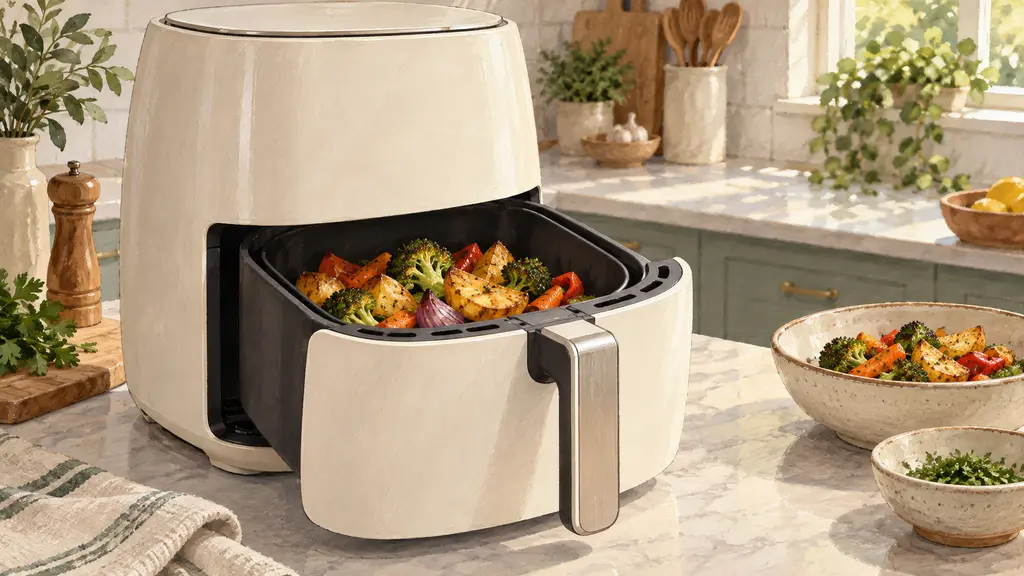
Dual-basket air fryers show up near the top of most best-seller lists on Amazon.sa, and it’s easy to assume bigger and split into two zones automatically means better. It doesn’t, not for every household. The real question is whether you actually cook the way a dual-basket design is built for, or whether a single XL basket quietly does the same job for less money and less counter space. Let’s work through when each one makes sense.
The quick answer
A dual-basket air fryer is worth it if you regularly cook two dishes with different settings and want them ready at the same time, like a protein and vegetables for a family meal or an iftar-style spread. If you mostly cook one dish at a time, or you’re feeding one or two people, a single XL basket does the job for less money and less counter space. It comes down to how you actually cook, not which model looks more capable on the page.
What a dual-basket design actually does
A dual-basket air fryer, like the Ninja Double Stack XL, gives you two separate cooking zones with independent temperature and time controls in one unit. That means you can put chicken in one side at a higher temperature and vegetables in the other at a gentler setting, and a sync function on many models will stagger the start times so both finish together. The Ninja arranges its two zones vertically instead of side by side, which trades counter width for extra height, while a value pick like the BLACK+DECKER Digital Dual Zone Air Fryer keeps a more familiar side-by-side layout at a lower price.
The point isn’t just “more capacity.” A single large basket also gives you more capacity, just in one zone with one setting. What the dual-basket format adds is the ability to run two different settings at once, which is a genuinely different capability, not just a bigger number.
When it’s worth it: bigger families and whole-meal cooking
The dual-basket format earns its keep in a few real situations. If you’re cooking for a family of four or more and regularly plating a protein alongside a side, running both at once instead of in two back-to-back rounds saves real time on a weeknight. It’s also a natural fit for iftar-style cooking, where you’re often getting several dishes ready to serve together rather than one plate at a time. And if your household simply eats different things (someone wants fries, someone wants grilled chicken) at the same meal, two independent zones mean nobody’s food goes cold waiting for the other.
In these cases, the extra cost of a model like the Ninja Double Stack XL (≈ 1,035 SAR) over a standard single-basket unit is a genuine time-and-convenience trade you’re making on purpose, not a premium you’re paying just because the box says “dual.”
See the Ninja Double Stack XL price on Amazon.sa ↗
When a single XL basket is the smarter buy
If you’re cooking for one or two people, or you mostly make one dish per meal, a single XL basket in the 6 to 8L range, like the Cosori 6.4L Wi-Fi Air Fryer or the Philips Airfryer XL 6.2L, gives you plenty of room without paying for a second zone you won’t use often. A single basket is also simpler to clean (one basket instead of two), takes up less counter space, and in many lineups costs meaningfully less than the dual-basket step-up.
The trade-off with a single basket is straightforward: if you do want two different foods at two different settings, you’re cooking in two rounds instead of one. For a lot of households, that’s a minor inconvenience a couple of times a week, not a daily frustration, and it’s not worth paying extra to solve.
A middle ground: value dual-zone models
If you like the two-zone idea but the premium stacked models feel like overkill, a value dual-zone pick like the BLACK+DECKER Digital Dual Zone Air Fryer gives you two independent zones at a noticeably lower price than the Ninja. The combined capacity is smaller, and it won’t carry quite the same review volume, but for a household that wants the dual-basket convenience without the premium price tag, it’s worth a look before you commit to the top of the range.
Counter space is the deciding factor people forget
Before deciding purely on cooking style, measure your counter. A side-by-side dual-basket unit is noticeably wider than a single-basket model of similar total capacity, and in a compact kitchen that width matters as much as the cooking flexibility. A stacked vertical design, like the Ninja Double Stack XL, keeps the footprint closer to a single unit’s width but needs clearance above it, so check your cabinet height too. If your kitchen is genuinely tight on either dimension, that constraint can decide the question for you regardless of how you cook.
Quick comparison: dual-basket vs single XL basket
| Dual-basket | Single XL basket | |
|---|---|---|
| Best for | Families cooking two dishes at once, whole-meal spreads | One or two people, one dish at a time |
| Cooking flexibility | Two independent settings, ready together | One setting per round |
| Counter space | Wider (side-by-side) or taller (stacked) | Smallest footprint for the capacity |
| Typical price | Mid to premium tier | Budget to mid tier |
| Cleaning | Two baskets to wash | One basket to wash |
Bottom line
A dual-basket air fryer is worth it when your household actually cooks two dishes with different settings on a regular basis, whether that’s a nightly protein-and-side routine or bigger, whole-meal cooking for a family or gathering. If you mostly cook one dish at a time, or you’re shopping for one or two people, a single XL basket like the top pick in the best air fryer in Saudi Arabia covers you for less money and less counter space. Either way, match the capacity to your household first, and remember all prices are approximate at publication and change. For the full buying criteria, see our guide to choosing an air fryer, and to compare exact price tiers, check air fryer prices in Saudi Arabia.
For everything in this category in one place, browse our air fryers section.
This analysis is based on published information from Amazon.sa.
Frequently asked questions
What's the actual advantage of a dual-basket air fryer?
A dual-basket air fryer gives you two independently controlled cooking zones in one unit, so you can run a protein at a higher temperature in one basket and vegetables at a gentler setting in the other, and finish them together. That's the core advantage over a single basket: two different foods, two different settings, one appliance, ready at once.
Is a dual-basket air fryer worth it for a small household?
Usually not. If you're cooking for one or two people and mostly making one dish at a time, a single XL basket in the 6 to 8L range gives you enough capacity for less money and less counter space. The dual-basket format earns its price when you're regularly cooking two different foods together, which is more of a bigger-household or whole-meal situation.
How much more does a dual-basket model cost versus a single XL basket?
It varies by brand and capacity, but on Amazon.sa a value dual-zone model like the BLACK+DECKER Digital Dual Zone Air Fryer sits close to the mid tier, while a premium stacked dual-zone unit like the Ninja Double Stack XL runs closer to the top of the range. Compare the exact combined capacity and features rather than assuming dual-basket always means a big jump in price.
Does a dual-basket air fryer take up much more counter space?
A side-by-side dual-basket unit is noticeably wider than a single-basket model, so measure your counter space before buying. A stacked vertical dual-zone design, like the Ninja Double Stack XL, keeps the footprint closer to a single unit but needs more clearance in height, so check your cabinet space above the counter instead.