
 Egypt
Egypt  UAE
UAE  USA
USA White Film on Dishes From the Dishwasher: Cause and Fix
We may earn a commission from purchases through our links, at no extra cost to you. How we choose · Disclosure.
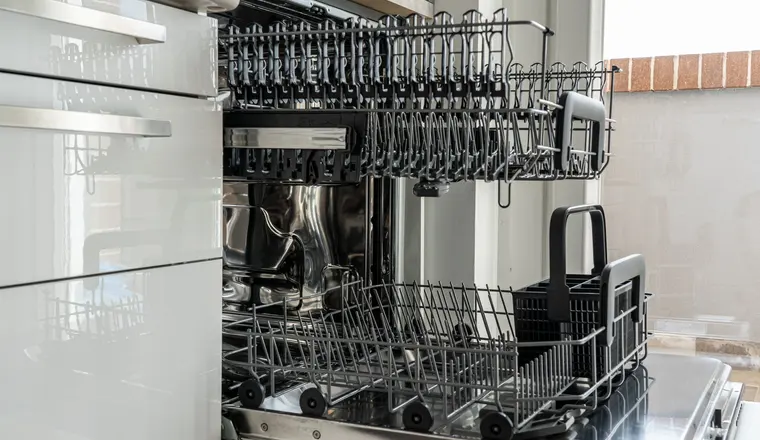
If your dishes and glasses come out of the dishwasher looking clean at a glance but covered in a dull white film or dried spots after every cycle, the cause is almost certainly hard water, not a broken machine or how you’re loading it. Mineral deposits from calcium and magnesium dry onto glass and porcelain during the drying phase and leave that film behind. The direct fix: set your dishwasher’s water hardness setting to match your area, and add rinse aid to every cycle.
Quick answer
White film or a dull layer on dishes after the dishwasher is caused by hard water, meaning calcium and magnesium deposits that dry onto the surface as the water evaporates, not a fault in the machine. The fix starts with setting your dishwasher’s water hardness dial to the correct level for your area, then adding rinse aid to every cycle, since it’s built specifically to stop that layer from forming. If film keeps showing up after that, check your detergent dose against the load size and your drying temperature.
Key points
- Hard water is the most common cause of white film on dishes, because water high in calcium and magnesium leaves mineral deposits that dry on the surface as it evaporates (hard water from USGS).
- Rinse aid is built specifically for this problem, lowering the surface tension of water so it sheets off dishes instead of drying into spots (dishwasher detergent from Britannica).
- The dishwasher’s water hardness setting needs manual adjustment on most models to match your area’s water, and it’s a setting that’s often skipped at first install.
- Too little or too much detergent also plays a role: underdosing doesn’t cut through high hardness, and overdosing can leave its own residue.
- White film isn’t a health hazard, it’s a natural mineral deposit, but it’s a sign your machine isn’t giving you the best result it’s capable of right now.
What actually causes the white layer
Most of Saudi Arabia’s tap water runs fairly hard, meaning it carries a high concentration of dissolved calcium and magnesium salts. During the drying phase, water evaporates off the surface of your dishes and glassware and leaves those salts behind as a thin white layer or dried spots, the same way they build up on a tap or shower head over time. The difference between ordinary film and glass etching, a separate and harder problem to fix, is that film wipes off with a cloth or clears with a quick soak in diluted white vinegar, while etching leaves a permanent cloudiness inside the glass itself that cleaning can’t remove.
Quick diagnosis table: which spot are you dealing with?
| Symptom | Likely cause | Fix |
|---|---|---|
| Thin white film that wipes off easily | Hard water, ordinary calcium buildup | Rinse aid + water hardness setting |
| Dried spots specifically on glasses and cups | Hard water evaporating onto glass during drying | Lower drying heat + rinse aid |
| Permanent cloudiness inside the glass that won’t wipe off | Glass etching from too strong a detergent dose with very hard water | Reduce detergent amount, lower heat; no full fix once it’s happened |
| Clumped white residue on plastic dishes | Detergent tablet didn’t fully dissolve, or too short a cycle | Longer cycle or higher heat, tablet placed correctly in its compartment |
The fix, step by step
- Check the water hardness setting on your machine, if it has a dial or settings menu, and set it to match your area’s hardness level; the manual usually explains how to find that out.
- Add rinse aid to its dedicated compartment and make sure it refills automatically each cycle, since it’s the component actually built to stop dried water spots, not detergent alone.
- Check your detergent dose against the load size and your area’s water hardness, since a full load with a single tablet may not be enough.
- Lower the drying heat slightly if your machine allows it, since high-heat drying speeds up evaporation and leaves a more visible mark.
- Soak affected dishes in diluted white vinegar to clear existing spots quickly, keeping in mind this fixes what’s already built up rather than replacing the steps above.
Does the machine itself matter?
If your current dishwasher doesn’t have an adjustable water hardness setting or a dedicated rinse aid compartment at all, the problem may be the machine rather than how you’re using it. Full-size models like the Midea 12-Place-Setting Dishwasher ship with a rinse aid compartment and a water hardness setting built into its seven programs, and it’s one of our picks in the guide to the best dishwasher in Saudi Arabia if you’re considering a replacement rather than patching around an older unit that never had these settings.
Bottom line
White film on dishes from the dishwasher is a sign of hard water, not a fault in the machine or how you wash. Set the water hardness dial correctly, add rinse aid to every cycle, and check your detergent dose against the load size. If film keeps showing up after that, or your older machine never had the right settings to begin with, it may be time for a new dishwasher; check our guide to the best dishwasher in Saudi Arabia and how to choose a dishwasher before you buy. If the issue is really about picking the right detergent, read best dishwasher detergent tablets. To check current price ranges, browse dishwasher prices in Saudi Arabia, or head back to dishwashers for the full hub.
Sources
- USGS, “Hardness of water”, background on hard water and the mineral salts responsible for the deposits: https://www.usgs.gov/water-science-school/science/hardness-water
- Britannica, “Detergent (dishwashing)”, explanation of rinse aid and detergent’s role in the wash cycle: https://www.britannica.com/technology/detergent
This analysis is based on published information from USGS (Hardness of water), Britannica (Detergent (dishwashing)).
Frequently asked questions
Is white film on dishes from a dishwasher harmful?
No. The white film is a natural mineral deposit from calcium and magnesium dissolved in the water, the same kind that builds up on a tap or shower head over time in a hard water area. It's a cosmetic issue, not a food safety one, but it does mean your wash and dry cycle isn't giving you the best result your machine can deliver.
Does rinse aid really get rid of white film?
Yes, that's exactly what it's designed for. Rinse aid lowers the surface tension of water during the final rinse, so it sheets off dishes and glassware instead of sitting in droplets that dry into spots. Detergent alone doesn't do this job as well, even a good one.
Why do I still get white film if I'm using a good detergent tablet?
Detergent is built to cut grease and food residue, not to stop hard water from drying on glass. If your dishwasher's water hardness setting isn't matched to your area, or the rinse aid compartment is empty, film will keep showing up no matter how good the tablet is.
Does white vinegar remove hard water spots from dishes?
Yes, for existing spots on glassware. Soak the affected piece in vinegar diluted with water for a few minutes, then wash it normally. It's a quick fix for buildup that's already there, but it won't stop new spots from forming; the real prevention is the water hardness setting plus rinse aid.