
 Egypt
Egypt  UAE
UAE  Saudi Arabia
 Air Purifier Electricity Cost: What It Adds to Your Bill
We may earn a commission from purchases through our links, at no extra cost to you. How we choose · Disclosure.
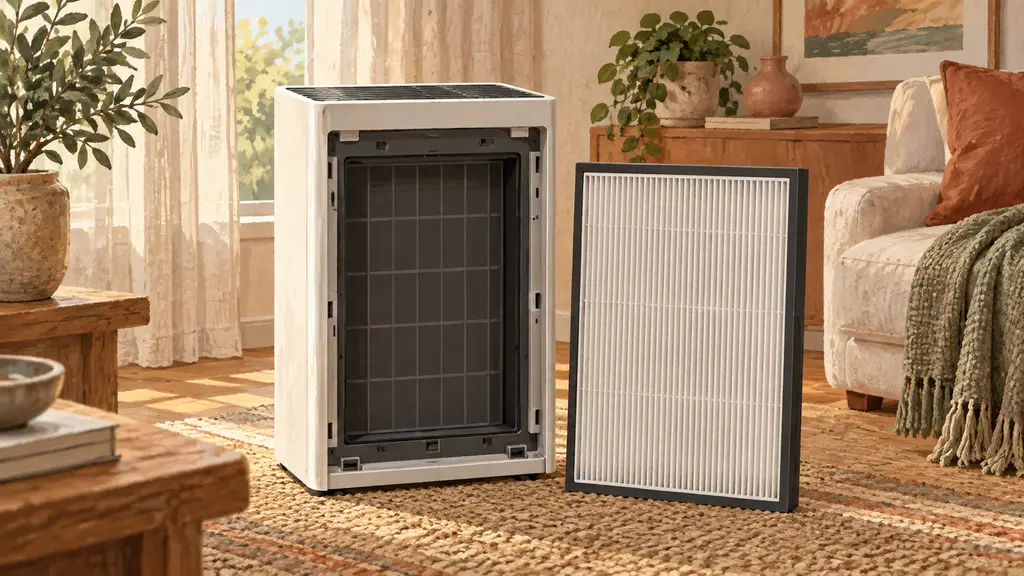
Running a HEPA air purifier around the clock usually adds somewhere between about a dollar and $10 a month to your electricity bill, depending on the unit’s wattage, its fan speed, and your local electricity rate. That’s a wide range, but it’s a small one in absolute terms, most compact and mid-size purifiers draw far less power than a space heater, a hair dryer, or even an older window air conditioner. The exact number for your unit is a quick calculation, not a guess.
The quick answer
A typical HEPA air purifier costs somewhere between about a dollar and $10 a month to run continuously, depending mostly on its wattage and fan speed, with larger units on high settings landing at the top of that range. Electricity used is measured in kilowatt-hours, so the actual cost comes down to watts, hours run, and your rate per kilowatt-hour, all three of which you can check yourself.
Key points
- A kilowatt-hour is the standard unit electricity is billed in, equal to running a 1,000-watt device for one hour, and it’s the number your utility multiplies by its rate to produce your bill (kilowatt-hour from US EIA).
- Fan speed drives the cost far more than the brand does. The same unit can draw several times more power on its highest setting than on low or sleep mode.
- Compact, bedroom-sized units are the cheapest to run, typically 5 to 40 watts depending on speed, which is a fraction of most household appliances.
- Large-room units cost more but still aren’t dramatic, often landing in the 50 to 100+ watt range on higher settings.
- Your utility rate matters as much as the unit itself. The same purifier costs noticeably more to run in a state with a high per-kWh rate than in one with a low rate.
The math, in plain terms
Electricity bills come down to a simple formula: watts, times hours run, divided by 1,000 to get kilowatt-hours, times your utility’s price per kilowatt-hour. So a 40-watt purifier run for 24 hours uses 0.96 kilowatt-hours in a day, which is roughly 29 kilowatt-hours over a 30-day month. At an illustrative rate of about 15 cents per kilowatt-hour, that’s a few dollars for the month. Rates vary a lot by state and utility, so swap in your own rate from a recent bill for an exact figure, the formula itself doesn’t change.
Typical cost by fan speed
Wattage varies by model, but these ranges are typical for compact-to-large HEPA purifiers and give you a starting point before you check your own unit’s label.
| Fan speed | Typical draw | Running 24/7 for a month (at about 15 cents/kWh) |
|---|---|---|
| Low or sleep mode | About 5 to 10 watts | About a dollar |
| Medium | About 30 to 40 watts | A few dollars |
| High | About 50 to 70 watts | Under $10 |
| Large-room unit on high | 100 watts or more | Roughly $10 or more |
If your electricity rate runs higher than 15 cents per kWh, scale these up proportionally, and if it runs lower, scale them down.
Why running it 24/7 usually still makes sense
The temptation is to switch the purifier on only when the air feels bad, but that’s actually the more expensive way to think about it, not because of electricity, but because particulate builds up between sessions and the unit has to work harder to catch up each time you turn it back on. Continuous low-to-medium operation costs a few dollars a month and keeps particulate levels steady rather than spiking and dropping. If cost is genuinely tight, running on a lower fan speed continuously is a better trade than cycling a high setting on and off.
Getting an exact number instead of an estimate
The table above gives you a solid ballpark, but if you want the actual figure for your exact unit and your exact electricity rate, a plug-in energy usage monitor is the simplest way to get it. It sits between the wall outlet and the purifier’s plug and reads out real-time watts and cumulative running cost directly, no formula required. It’s a nice-to-have for anyone who wants certainty rather than an estimate, not something you need to run a purifier safely or effectively.
If you’re shopping for a purifier and want one that’s genuinely cheap to run in the first place, our top pick, the LEVOIT Core 200S-P, is sized for a bedroom or small living room and sits at the low end of the wattage ranges above on its everyday settings. It tops our guide to the best air purifier in the USA.
See the LEVOIT Core 200S-P price on Amazon ↗
Bottom line
An air purifier is one of the cheaper appliances to run continuously, typically about a dollar to $10 a month depending on wattage, fan speed, and your local rate. The exact number is just watts times hours divided by 1,000, times your rate per kilowatt-hour, so check the label on your own unit rather than relying on someone else’s estimate. If cost matters, running a lower fan speed continuously usually beats cycling a high setting on and off. For sizing the right unit to your room in the first place, see what CADR rating you actually need, and for filter upkeep costs, read how often to replace a HEPA filter. If budget is the main concern, see the best budget air purifier, and for the full lineup, browse air purifiers in the USA.
Sources
- US EIA, “Measuring electricity in kilowatt-hours”, definition of the unit electricity is billed in and how the watts-times-hours calculation works: https://www.eia.gov/energyexplained/electricity/measuring-electricity.php
This analysis is based on published information from US EIA (Measuring electricity in kilowatt-hours).
Frequently asked questions
Does an air purifier use a lot of electricity?
No, not compared to most other appliances running that many hours. A compact HEPA purifier typically draws somewhere between 5 and 70 watts depending on fan speed, which usually works out to a few dollars a month even running continuously. Large-room units on their highest setting cost more, but still nowhere near a space heater or an old-style air conditioner.
Is it OK to leave an air purifier running 24/7?
Yes, and it's actually how most units are designed to be used. Continuous low-to-medium operation keeps particulate levels down steadily instead of playing catch-up, and the electricity cost of doing so is modest for most compact and mid-size units.
How do I figure out what my specific purifier costs to run?
Check the wattage printed on the unit's label or spec sheet, multiply by the hours you run it, divide by 1000 to get kilowatt-hours, then multiply by your utility's price per kilowatt-hour. That gives you an exact number instead of a generic estimate.
Does running the air purifier on high instead of low really change the cost much?
It can matter more than people expect. High speed on some units draws several times the wattage of the low or sleep setting, so a unit that costs about a dollar a month on low can cost several times that run continuously on high. If your air quality is generally fine, a lower steady setting is usually enough.