
 Egypt
Egypt  UAE
UAE  Saudi Arabia
 What CADR Rating Do You Need for Your Room Size?
We may earn a commission from purchases through our links, at no extra cost to you. How we choose · Disclosure.
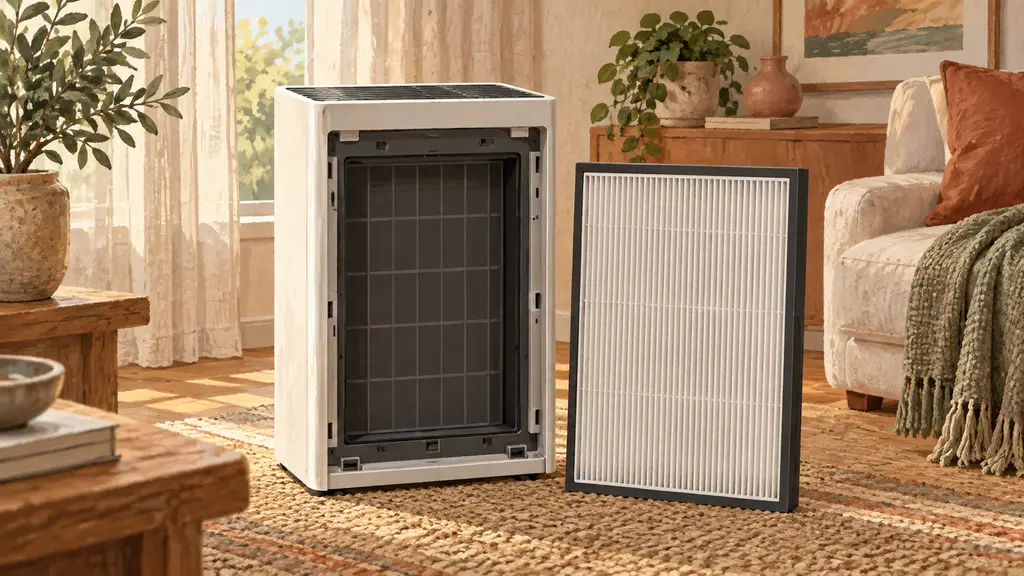
Look for a CADR of roughly 100 or higher for a small bedroom, 150 to 200+ for a standard bedroom or small living room, and 300 or more once you’re covering an open living space. CADR (Clean Air Delivery Rate) is the number that actually tells you how fast a purifier cleans the air in a given room, and matching it to your square footage matters far more than chasing the highest number on the box or the biggest brand name.
The quick answer
Match CADR to your room’s square footage, not to the biggest number you can find. A rough industry rule of thumb is a CADR of at least two-thirds of your room’s area in square feet, so a 200 square foot room wants a CADR around 130 or higher, and a 400 square foot room wants roughly 270 or higher. Undersizing leaves the air feeling stale on bad days; oversizing just means you paid for capacity you didn’t need.
Key points
- CADR is an independently tested airflow measurement, not a marketing number, and manufacturers publish separate ratings for smoke, dust, and pollen because particle size changes how efficiently a filter catches it (air purifier CADR ratings from US EPA).
- The smoke CADR is usually the lowest of the three ratings and the one worth checking first if wildfire smoke, cooking smells, or fine particulates are your main concern.
- A two-thirds rule of thumb is the simplest sizing shortcut: CADR should be at least about two-thirds of your room’s square footage for solid coverage at a reasonable fan speed.
- Running an undersized unit on high all the time is a sign it’s the wrong size, not that something’s broken, an appropriately sized unit shouldn’t need to run flat-out to keep up.
- Bigger CADR usually means a bigger, louder, pricier unit, so the right target is your actual room, not the largest number available.
What CADR actually measures
CADR measures how much particle-free air a purifier delivers per minute, tested under a standardized method so numbers are comparable across brands, unlike vague marketing phrases like “covers large rooms.” A purifier gets three separate CADR scores, for tobacco smoke, dust, and pollen, because those particles differ enough in size that a filter’s efficiency isn’t identical across all three. Smoke particles are the finest of the three and typically produce the lowest number, which is why the smoke rating is the one to check first if wildfire smoke or cooking odor is the problem you’re actually trying to solve.
The sizing rule of thumb
A commonly used shortcut is to aim for a CADR that’s at least two-thirds of your room’s square footage. So a 150 square foot bedroom wants a CADR around 100, a 300 square foot living room wants roughly 200, and a 500 square foot open space wants 330 or more. This rule assumes a typical ceiling height and a reasonable number of air changes per hour, it’s a solid starting point for most homes, not a precise engineering calculation.
CADR by room size
| Room size | Recommended CADR (smoke/dust) | Typical fit |
|---|---|---|
| Up to 150 sq ft (small bedroom) | 100 or higher | Compact unit like the LEVOIT Core 200S-P |
| 150 to 300 sq ft (bedroom or small living room) | 150 to 200+ | LEVOIT Core 200S-P range |
| 300 to 500 sq ft (living room or open studio) | 250 to 350+ | Step up to a large-room rated unit |
| 500 to 1,000+ sq ft (open floor plan) | 400 or higher | Whole-floor or large-room unit |
If your room falls between two rows, size up rather than down, running a slightly larger unit on a lower, quieter setting beats running an undersized one on high all day.
Common sizing mistakes
The two mistakes people make most often are opposite ends of the same problem. Buying based on a brand’s “covers up to X square feet” marketing claim without checking the actual CADR number underneath it can leave you undersized, since coverage claims aren’t standardized the way CADR is. The other mistake is buying the highest-CADR unit available “just in case,” which means paying more upfront, taking up more floor space, and often running louder than a correctly sized unit would need to. Match the number to the room you actually have, not the room you might have someday.
The answer for a bedroom or small living room
For the room size most people are actually shopping for, a bedroom or small living room in the 150 to 300 square foot range, our top pick, the LEVOIT Core 200S-P, lands right in the CADR range that table calls for. It’s a true HEPA unit with a simple control panel, so there’s little to fuss over once you’ve confirmed it’s the right size for your space. It’s the pick that tops our guide to the best air purifier in the USA, which also covers the larger-room step-ups if your space is bigger than a bedroom.
See the LEVOIT Core 200S-P price on Amazon ↗
Bottom line
CADR, not wattage or a vague coverage claim, is the number that tells you whether a purifier can actually keep up with your room. Use the two-thirds rule of thumb (CADR at least two-thirds of your room’s square footage) and check the smoke rating specifically if smoke or fine particulates are the problem you’re solving. For a bedroom or small living room, a compact true-HEPA unit like the LEVOIT Core 200S-P is sized right; bigger spaces need a bigger CADR, not just a bigger price tag. If running cost factors into your decision, see does an air purifier use a lot of electricity, and once you own one, read how often to replace a HEPA filter. If budget is the deciding factor, check the best budget air purifier, or browse our full guide to choosing an air purifier and the air purifiers section.
Sources
- US EPA, “Guide to air cleaners in the home”, explanation of Clean Air Delivery Rate (CADR) testing and how it’s used to rate purifier performance: https://www.epa.gov/indoor-air-quality-iaq/guide-air-cleaners-home
This analysis is based on published information from US EPA (Guide to air cleaners in the home).
Frequently asked questions
What does CADR mean on an air purifier?
CADR stands for Clean Air Delivery Rate, an independently tested measure of how much clean, particle-free air a purifier actually produces per minute, separately rated for smoke, dust, and pollen. It's a better sizing number than wattage or coverage claims alone, since it reflects real airflow through the filter, not just the motor's power.
Is a higher CADR always better?
Higher CADR means faster air cleaning for a given room size, but it also usually means a bigger, louder, and pricier unit. The goal isn't the highest number available, it's matching CADR to your actual room so you're not paying for capacity you don't need or leaving your room under-covered.
What CADR do I need for a 200 square foot bedroom?
As a rule of thumb, look for a CADR of roughly 130 to 150 or higher for a 200 square foot room, which comfortably covers a standard bedroom or small living room at a reasonable fan speed rather than maxing the unit out on high.
Does CADR differ for smoke, dust, and pollen?
Yes, a purifier gets three separate CADR numbers, one each for tobacco smoke, dust, and pollen, because particle size affects how efficiently a filter catches it. Smoke particles are the finest and typically produce the lowest CADR number of the three, so it's the one worth checking first if wildfire smoke or cooking odors are your main concern.