
 Egypt
Egypt  UAE
UAE  Saudi Arabia
 How Often to Replace a HEPA Filter in Your Air Purifier
We may earn a commission from purchases through our links, at no extra cost to you. How we choose · Disclosure.
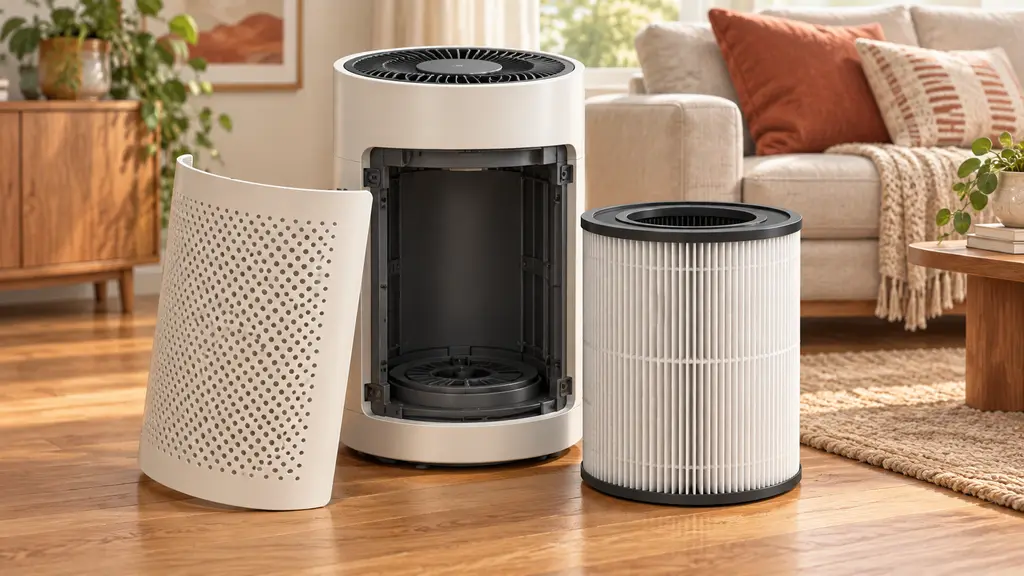
Most HEPA filters need replacing every 6 to 12 months, and that window shrinks fast if you have pets, smokers in the house, or run the unit non-stop during wildfire season or high pollen weeks. There’s no single magic number because it depends entirely on how much your filter is actually catching. The good news: your purifier usually tells you when it’s time, you just need to know what to look for.
The quick answer
Plan on replacing a HEPA filter every 6 to 12 months for average household use, and every 3 to 6 months if you have pets, smokers, or run the unit continuously during high-pollution stretches. Don’t rely on a calendar alone: a filter-reset light, visible discoloration, or weaker airflow at the same setting are all signs it’s overdue, whichever comes first.
Key points
- A HEPA filter is rated to trap a very high percentage of fine airborne particles by forcing air through a dense mesh, and that mesh gradually clogs as it does its job (HEPA definition from US EPA).
- Usage, not time on the calendar, is what actually wears out a filter. A unit running 24/7 in a home with pets works through a filter far faster than one running a few hours a day in a pet-free apartment.
- Airflow is the clearest physical sign of a clogged filter. If the unit sounds the same but you feel noticeably less air coming out on the same setting, the filter is restricting flow.
- A filter-reset light is a timer, not a sensor, on most budget and mid-range units, so it’s a reasonable reminder but not a replacement for actually checking the filter.
- Washing a true HEPA filter usually ruins it. Only the pre-filter (the coarser mesh layer in front of it) is typically washable; the dense HEPA media itself is a replace-only part.
Why filters wear out in the first place
A HEPA filter works by forcing air through a dense web of fine fibers, and every particle it traps stays lodged in that web instead of passing through. That’s the entire point of the filter, but it also means the mesh gradually fills up with dust, pet dander, pollen, and smoke particles over time. As it loads up, less air can pass through at the same fan speed, so the unit either moves less air or the motor works harder to push the same amount through a more clogged filter. Either way, a saturated filter is worse at cleaning the air than a fresh one, which is the whole reason a replacement schedule exists at all.
What shortens the interval
A few common situations push the 6-to-12-month baseline down significantly:
- Pets in the home. Dander and fur are a steady, heavy load on the filter, and multi-pet households often see the biggest drop in filter life.
- Smokers. Cigarette or vape particulates are fine enough to load a filter fast, and the smell itself is a sign the filter is losing capacity.
- Wildfire smoke or heavy pollen season. Running a unit around the clock during a bad air week does in a month what normal use does in several.
- A larger room than the unit is rated for. An undersized purifier working overtime to keep up pulls more total air (and more particulate) through the same filter.
- A busy household with lots of foot traffic, cooking, or dust. More particulate in the air day to day means more particulate loading the filter.
Signs it’s time, by situation
| Household situation | Suggested filter-change interval |
|---|---|
| Standard home, no pets, average daily use | Every 8 to 12 months |
| Home with one or two pets | Every 6 to 8 months |
| Smokers in the home | Every 3 to 6 months |
| Heavy pollen or wildfire-smoke season, running continuously | Every 3 to 4 months |
| Unit runs occasionally on the lowest setting only | Up to 12 months, check the light and airflow first |
Treat this table as a starting point, not a strict rule. If you fall between two rows, for example one pet plus a smoker, lean toward the shorter interval.
How to actually check, instead of guessing
Don’t wait for the filter to fail before you look at it. Pull the filter out every couple of months and check for visible gray or brown buildup across the surface, that’s a fast, free way to confirm what the calendar is only estimating. Pair that with your unit’s filter-reset light if it has one (most mid-range models do), and pay attention if the airflow feels weaker on the same fan setting you always use. Any one of these three checks catching a problem is reason enough to replace the filter, you don’t need all three to agree.
The real fix once you know it’s due
Once the filter is due, the fix is straightforward: buy a compatible replacement HEPA filter sized for your exact model number, not a generic universal filter that only sort of fits. A loose or ill-fitting replacement lets unfiltered air sneak around the edges instead of through the media, which quietly undoes the point of replacing it at all. Check the model number printed on your unit or in the manual before you order, since even purifiers from the same brand often use different filter sizes across models.
If you’re shopping for a purifier in the first place and want one where this whole process is simple, our top pick, the LEVOIT Core 200S-P, uses a true HEPA filter sized for a bedroom or small living room and keeps the controls to one button, no app, no guesswork on settings. It’s the pick that tops our guide to the best air purifier in the USA.
See the LEVOIT Core 200S-P price on Amazon ↗
Bottom line
Plan on a HEPA filter replacement every 6 to 12 months, and shift toward the shorter end of that range with pets, smokers, or a heavy wildfire or pollen season. Skip the guesswork by checking the filter directly every couple of months: visible discoloration, a reset light, or weaker airflow are all valid signs it’s time, and you only need one of them to act. When it’s time to buy, match the replacement filter to your exact model number rather than a generic universal filter. If you’re still deciding what to run in the first place, see our guide to choosing an air purifier, and if operating cost matters as much as filter cost, read does an air purifier use a lot of electricity. For sizing help, see what CADR rating you actually need, and if budget is the deciding factor, check the best budget air purifier. For everything in this category, browse air purifiers in the USA.
Sources
- US EPA, “What is a HEPA filter”, definition of high-efficiency particulate air filtration and how the filter media traps particles: https://www.epa.gov/indoor-air-quality-iaq/what-hepa-filter
This analysis is based on published information from US EPA (What is a HEPA filter).
Frequently asked questions
How often should I replace my air purifier's HEPA filter?
Most manufacturers recommend every 6 to 12 months under average household use. That window narrows to every 3 to 6 months if you have pets, smokers in the home, or run the unit continuously through pollen or wildfire-smoke season.
What happens if I don't replace the HEPA filter on time?
A clogged filter restricts airflow, so the fan works harder for less clean air coming out the other side. Past a certain point it stops catching new particles effectively and just recirculates air through a saturated filter, which defeats the purpose of running the unit at all.
How do I know it's actually time to change the filter, not just guessing?
Check three things: a filter-reset indicator light if your model has one, visible gray or brown discoloration when you pull the filter out, and noticeably weaker airflow at the same fan setting. Any one of those is a clear signal, you don't need to wait for all three.
Can I clean a HEPA filter instead of buying a new one?
No, not the HEPA media itself. Vacuuming or rinsing a true HEPA filter damages the dense fibers that make it effective, and most manufacturers explicitly say not to wash it. The washable part on most units is the pre-filter, a separate mesh layer that catches larger debris before it reaches the HEPA filter.