
 Egypt
Egypt  Saudi Arabia
  USA
USA Bottle Sterilizer Not Working? Check These First
We may earn a commission from purchases through our links, at no extra cost to you. How we choose · Disclosure.
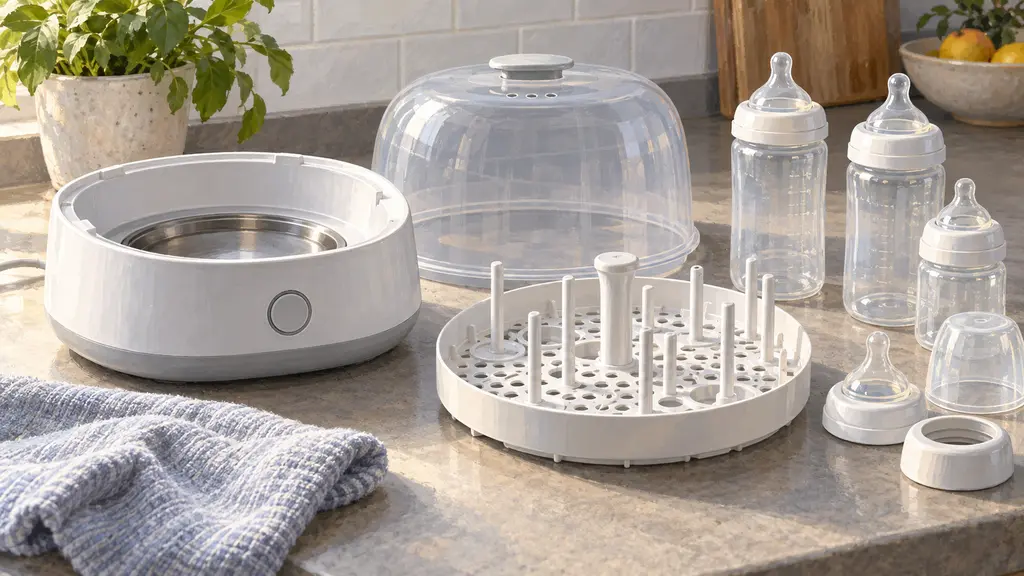
A bottle sterilizer that refuses to turn on, or stops before the cycle finishes, doesn’t have to mean a real fault. Before assuming that, run through a simple checklist in order: power and the outlet, the correct water amount, limescale built up on the heating plate, and whether the lid is properly closed. Most “not working” cases trace back to one of these, not an actual fault in the motor or circuit.
The quick answer
Before assuming a real fault, check in order: the outlet and cord, the correct water amount, limescale on the heating plate, and whether the lid is closed properly. Most issues trace back to one of these rather than an actual motor fault. If you’ve checked all of that and the problem persists, the next step is the warranty, not opening the unit yourself.
Key points
- A steam sterilizer runs on a simple heating element, and most apparent faults trace back to water or limescale, not the element itself.
- Limescale built up on the heating plate is a very common cause of an incomplete cycle, especially with water filled straight from the tap (limescale background from USGS).
- Too little water stops the cycle early, since it evaporates before the required time completes.
- Water in some UAE buildings is harder than you’d assume, because of storage tanks and pipework, which speeds up limescale buildup (hard water background from USGS).
- There’s no need to open the unit’s body yourself, since it houses an electrical circuit and a heating element.
The checklist to run before assuming a real fault
Work through these steps in order, from simplest to most involved:
- Check power first. Try a different outlet you’ve confirmed works, and inspect the cord for cuts or a loose connection at either end.
- Confirm the water amount is correct. Compare it against the fill line marked in the base or your model’s manual, since too little water stops the cycle early.
- Check for limescale on the heating plate. A built-up white layer reduces heat transfer efficiency and can stop the unit from reaching the temperature it needs.
- Make sure the lid is closed properly. Some models have a safety switch that blocks or stops the cycle if the lid isn’t fully closed.
- Look at the indicator light or error message, if there is one. It may tell you the specific cause rather than signaling a general fault.
- If the problem persists after all of that, check your model’s manual for error codes if it has a digital display, and contact customer service if the unit is still under warranty.
Limescale: the most common cause of an incomplete cycle
In most cases where a sterilizer looks like it isn’t working, the real cause is a limescale layer built up on the heating plate itself, especially if you fill the tank straight from the tap without regular descaling. This layer reduces how efficiently heat transfers to the water, so it either stretches the cycle time so long it looks stalled, or stops the unit from reaching the temperature it needs at all, triggering an automatic safety shutoff.
The fix here isn’t a technical repair, it’s cleaning: descale with diluted white vinegar or citric acid dissolved in water, run an empty cycle with the solution if your sterilizer is electric, then rinse thoroughly with clean water twice. If the limescale has built up over a long time, you may need to repeat the step more than once. For the full cleaning routine and how often to run it, see our guide to how to clean a bottle sterilizer and how often.
Never mix vinegar with bleach or any chlorine-based cleaner - the combination releases toxic gases. Use one cleaner at a time and rinse thoroughly between products.
Common symptoms and their likely causes
| Symptom | Likely cause | What to check |
|---|---|---|
| Unit won’t light up or respond at all | Outlet or power cord | Try a different outlet and power source |
| Cycle starts but stops early | Too little water | Compare the amount against the fill line in the base |
| Cycle takes noticeably longer than usual | Limescale on the heating plate | Descale with vinegar or citric acid |
| Indicator light stays on and won’t clear | Low water or a need for descaling | Check your model’s manual for what the light means |
| Unit won’t start the cycle at all despite power and water | Lid not closed properly | Make sure the lid is fully closed per your model’s manual |
If you want to avoid this problem going forward
Descaling on schedule is the cheapest way to avoid an incomplete cycle in the first place, and it’s worth the few minutes it takes. Diluted white vinegar or citric acid is enough for most homes, but there are also ready-made descaling solutions on the market made specifically for baby appliances, which skip the step of mixing your own solution and help if your building’s water is especially hard. There’s no need to buy anything extra to start, vinegar is enough as a first step.
A reliable sterilizer is less likely to run into these problems
A unit backed by a large volume of reviews gives you more confidence in day-to-day reliability. A practical example from our shortlist: the Philips Avent Premium bottle steriliser and dryer is backed by thousands of buyers on Amazon.ae, a review volume that’s a genuine signal of consistent performance. We didn’t pick it for being the cheapest, we picked it because the balance of performance and reliability makes sense, which is why it tops our guide to the best bottle sterilizer in the UAE.
When to stop and call a technician
- The unit shows no light or response after you try a working outlet and inspect the cord.
- The cycle still stops early with the correct water amount and the lid fully closed.
- The cycle remains unusually slow or incomplete after a full descale and thorough rinse.
Stop using the sterilizer and have it checked by a qualified technician or the manufacturer’s warranty service before using it again.
Bottom line
A bottle sterilizer that isn’t working or won’t finish its cycle doesn’t have to mean a fault: check power and the cord, the water amount, limescale on the heating plate, and the lid, in that order, before assuming the worst. If limescale is the cause, our guide to how to clean a bottle sterilizer and how often covers the full routine to keep it from building up again, and if you want to make sure you’re using it correctly from the start, read how to use a bottle sterilizer correctly. If you’ve checked everything and the problem persists, look at the warranty before considering a replacement. For the full buying criteria across baby appliances, read how to choose baby appliances, or browse our baby appliances section.
Sources
- USGS, “Hardness of water”, background on mineral deposits and their effect on home heating appliances: https://www.usgs.gov/water-science-school/science/hardness-water
This analysis is based on published information from USGS (Hardness of water).
Frequently asked questions
My bottle sterilizer won't light up or respond at all, what's the first thing to try?
Try the unit in a different outlet you've confirmed works, and check the cord itself for cuts or a loose connection at either end. Many not-working cases come down to a weak outlet or a cord that isn't fully seated, not a fault in the unit itself.
The sterilizer runs but stops before the cycle finishes, why?
The most common cause is too little water, which evaporates before the full cycle time completes. Check the water amount against the fill line marked in the base or your model's manual. If the amount is correct and the problem continues, limescale built up on the heating plate is the next most likely cause.
Can limescale actually stop a sterilizer from working?
Yes, this is a very common cause, especially if you fill the tank straight from the tap. A limescale layer built up on the heating plate reduces heat transfer efficiency, which can stop the unit from reaching the temperature it needs or stretch the cycle time so long it looks like it's stopped.
An indicator light stays on and won't turn off, what does it mean?
Check your model's manual for what the light means specifically, since most manufacturers use it to flag low water or a need for descaling, not a real fault in the unit. Some indicators need a manual reset after you've resolved the cause.
When should I consider it a real fault and contact the manufacturer?
If you've tried a different outlet, confirmed the correct water amount, and fully descaled the unit, and it still won't work or stops early, the issue is likely the heating element or the internal electrical circuit, which isn't something to fix yourself. Check the warranty period on your purchase receipt and contact the manufacturer's customer service or the retailer.