
 Egypt
Egypt  Saudi Arabia
  USA
USA How Much Electricity Does a Dehumidifier Use?
We may earn a commission from purchases through our links, at no extra cost to you. How we choose · Disclosure.
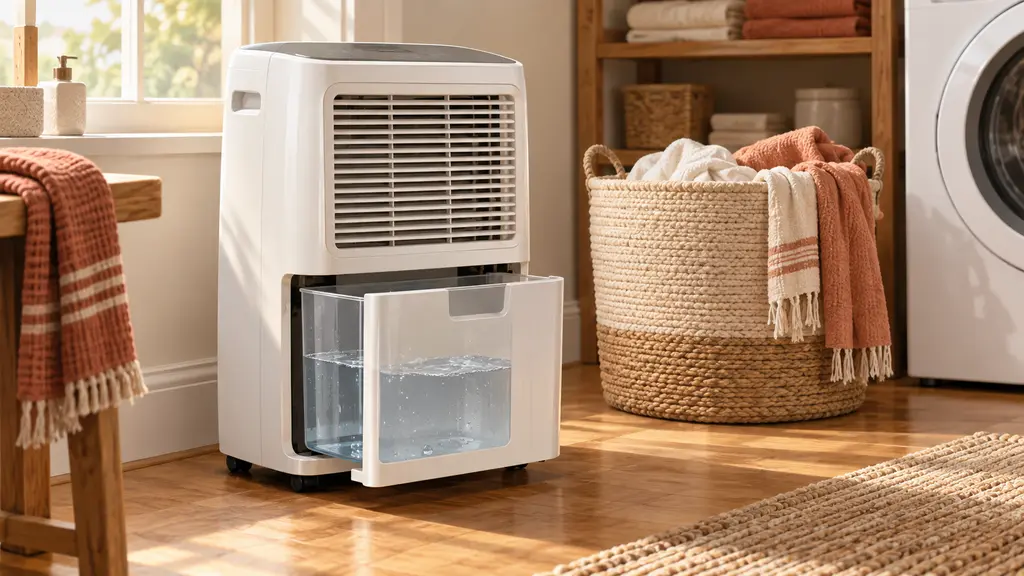
A small electric dehumidifier draws only around 20 to 40 watts, while a proper compressor unit at 20L/day for a bedroom or living room usually draws around 200 to 280 watts while running. Even assuming continuous running for a full month as a worst case, that typically adds only about 50 AED to a DEWA bill, and the unit’s humidistat shuts it off automatically once it hits the target humidity, so the real number is usually lower.
The quick answer
A compressor dehumidifier at 20L/day, the size that fits most UAE bedrooms and living rooms, typically draws around 200 to 280 watts while running, and even assuming continuous running for a full month that adds around 50 AED to a DEWA bill. The unit doesn’t actually run 24 hours a day: an internal humidistat shuts the compressor off once it hits the target humidity, which usually makes real-world consumption lower than that estimate. A passive absorber needs no power at all, and a small electric unit draws only 20 to 40 watts but isn’t built for a full room.
Key points
- Consumption is measured in watts at any given moment and in kWh over a billing period (kilowatt-hour definition from US EIA).
- A compressor dehumidifier doesn’t run continuously. An internal humidistat monitors relative humidity and automatically shuts the compressor off once it hits the target level, so real runtime is usually under 24 hours a day (background on how a dehumidifier works from ENERGY STAR).
- Unit size is the biggest driver of consumption. A 20L/day compressor unit draws far less than a 30L/day unit built for a larger space.
- A refillable passive absorber needs no power at all, but it also removes far less water from the air than an active unit.
- DEWA’s Dubai residential tariff is tiered in slabs, starting around 23 fils per kWh in the lowest slab and rising as a household’s total usage climbs (slab tariff on DEWA’s site).
How many watts each type actually uses
A compressor dehumidifier works on a principle similar to a fridge or an AC unit: a compressor cools a metal coil so water vapor condenses out of the air onto it, and that compressor is what draws most of the power. Roughly:
- A passive moisture absorber (refillable, no power) draws zero watts at all, suited to a closet, car, or spot with no outlet.
- A small electric unit (wardrobe or small-room size, sub-liter tank) typically draws around 20 to 40 watts.
- A mid-size compressor unit (20L/day, sized for a bedroom or living room) typically draws around 200 to 280 watts while actually running.
- A larger compressor unit (30L/day, for a bigger space or heavier humidity) can reach 300 to 400 watts.
These are rough figures that vary model to model, and the most accurate way to know your own unit’s real draw is a simple plug-in energy monitor between the plug and the wall outlet.
Working out the monthly cost on a DEWA bill
To turn watts into an actual cost, assume continuous running around the clock for a full month (30 days) as a worst case, even though a real unit shuts off automatically part of the time once it reaches the target humidity. DEWA’s Dubai tariff starts around 23 fils per kWh in the lowest slab, and once the monthly fuel surcharge is added, the effective rate for many homes lands closer to 30 fils per kWh. On that basis:
| Category | Approx. wattage | kWh per day, continuous | Approx. monthly cost (AED) |
|---|---|---|---|
| Passive absorber (no power) | 0 | 0 | ≈0 |
| Small electric (wardrobe/small room) | 20 - 40 | ≈0.7 | ≈6 |
| Mid-size compressor (bedroom/living room, 20L) | 200 - 280 | ≈5.8 | ≈52 |
| Larger compressor (30L, bigger space) | 300 - 400 | ≈8.4 | ≈76 |
These are illustrative worst-case, continuous-running figures, and your own tariff depends on which slab your household’s total usage falls into, especially during summer months when overall consumption climbs into pricier slabs because of the AC.
Why real-world consumption is usually lower than that table
Unlike a fridge, which runs continuously around the clock, a dehumidifier has a humidistat that monitors the room’s relative humidity and automatically shuts the compressor off once it hits the target level (usually 45 to 55 percent). On a humid UAE summer day, that means the unit is realistically running around 8 to 14 hours, not a full 24, so the true monthly cost is usually closer to half or two-thirds of the figure in the table above. Setting the target humidity slightly higher (55 instead of 45 percent, for example) also means fewer compressor cycles and lower consumption, without giving up much in terms of a noticeably drier room.
What actually raises consumption
- An undersized unit for its space: a 20L unit in a space that genuinely needs 30L runs longer, more frequent cycles trying to keep up, using more power than a correctly sized unit would from the start.
- A dirty filter or coil: a layer of dust on the coil or air filter forces the unit to run longer to reach the same humidity target, and cleaning the filter on schedule keeps consumption at its normal level.
- A door or window left open while running: a constant flow of fresh, humid air keeps the unit from ever reaching its target, so it keeps running without a break.
- A humidistat set too low: every extra percentage point below the normal target range (45-55 percent) means longer compressor cycles.
Knowing your own unit’s real consumption
The practical way to actually lower your bill is matching the unit’s size to your real room, setting the humidistat to around 50 percent instead of an unnecessarily low number, and cleaning the filter on schedule so the unit isn’t running longer than it needs to. If you want an exact figure for your specific unit instead of relying on general category estimates, a simple plug-in energy usage monitor (a smart plug placed between the unit and the outlet) reads the real watts and the accumulated kWh day by day, a cheap addition that’s especially useful if you run more than one unit in the home.
A unit that won’t surprise you on the bill
If you’re shopping for a dehumidifier that won’t spike your bill unexpectedly, the practical criteria are a size matched to your actual space and a humidistat that shuts itself off automatically instead of a unit that just keeps running unchecked. A practical example from our shortlist: the Pro Breeze 20L/Day Dehumidifier (≈ 849 AED), sized for a bedroom or living room with a humidistat that regulates humidity automatically, which is why it tops our guide to the best dehumidifier in the UAE. If your space is bigger, that same guide also covers the 30L option built for it. For the right size for your room in more detail, see our guide on how to choose a dehumidifier.
See the Pro Breeze 20L/Day Dehumidifier price on Amazon.ae ↗
Bottom line
A mid-size compressor dehumidifier typically draws around 200 to 280 watts, and even assuming continuous running for a full month, that adds around 50 AED to a DEWA bill, far smaller than an AC unit. Real-world consumption is usually lower thanks to the humidistat that shuts the unit off automatically, and what actually raises it is an undersized unit for its space, a dirty filter, or a window left open while it runs. Match the unit’s size to your room first, and let the humidistat handle the rest. If you’re still weighing running the AC alone against buying a dedicated unit, see AC vs dehumidifier, and for the right capacity for your space read what size dehumidifier do you need. To browse the full category, head back to dehumidifiers in the UAE.
Sources
- US EIA, “Measuring electricity in kilowatt-hours”, definition of the unit of electricity consumption that shows up on power bills: https://www.eia.gov/energyexplained/electricity/measuring-electricity.php
- ENERGY STAR, “Dehumidifiers”, background on how a compressor dehumidifier works with its coil and humidistat: https://www.energystar.gov/products/dehumidifiers
- Dubai Electricity and Water Authority (DEWA), slab-based consumption tariff used for the monthly cost estimate: https://dewa.gov.ae/en/consumer/billing/slab-tariff
This analysis is based on published information from US EIA (Measuring electricity in kilowatt-hours), ENERGY STAR (Dehumidifiers), Dubai Electricity and Water Authority, slab tariff.
Frequently asked questions
How many watts does a dehumidifier use?
It mainly depends on the type and capacity. A passive, refillable moisture absorber needs no power at all. A small electric unit sized for a wardrobe or small room typically draws about 20 to 40 watts. A proper compressor unit at 20L/day for a bedroom or living room usually draws around 200 to 280 watts while running, and a bigger 30L/day compressor for a larger space can reach 300 to 400 watts. These are rough figures that vary by model, and a simple plug-in energy monitor between the plug and the wall outlet gives you your own unit's exact number.
Does running a dehumidifier all day raise a DEWA bill a lot?
Less than most people expect, because a real dehumidifier doesn't actually run nonstop for 24 hours. It has a humidistat that automatically shuts the compressor off once the room hits the target humidity level, so real runtime on a humid day is usually 8 to 14 hours, not 24. Even assuming continuous running as a worst case, a mid-size 20L/day compressor unit typically adds around 50 AED a month to the bill, and with the humidistat's real cycling the actual number is usually lower.
Is a dehumidifier cheaper to run than an AC unit?
Yes, by a clear margin. An AC unit typically uses several kWh a day because it continuously cools a large volume of air, while a 20L/day compressor dehumidifier uses a fraction of that, closer to 5 or 6 kWh a day running continuously. A dehumidifier works alongside the AC rather than replacing it, so its addition to the bill stays smaller than any extra AC runtime.
Does a small electric dehumidifier use less power than a compressor unit?
Yes, by a wide margin, but the performance gap is bigger than the power gap. A mini unit draws only around 20 to 40 watts versus 200 watts or more for a compressor unit, but it also removes far less water from the air and isn't built for a full living room or a humid villa bedroom. Match the unit type to the actual job, not just the lowest consumption.
How do I know my own unit's exact consumption instead of a general estimate?
The most accurate way is a plug-in energy usage monitor (a smart plug with a power sensor) placed between the unit's plug and the wall outlet, which reads the real watts at any moment and the accumulated kWh over time for your specific unit, instead of relying on general category estimates. This is especially useful if you run more than one dehumidifier in the home and want to know which one is actually driving the bill up.