
 Egypt
Egypt  Saudi Arabia
  USA
USA How Long Does a Water Dispenser Last?
We may earn a commission from purchases through our links, at no extra cost to you. How we choose · Disclosure.
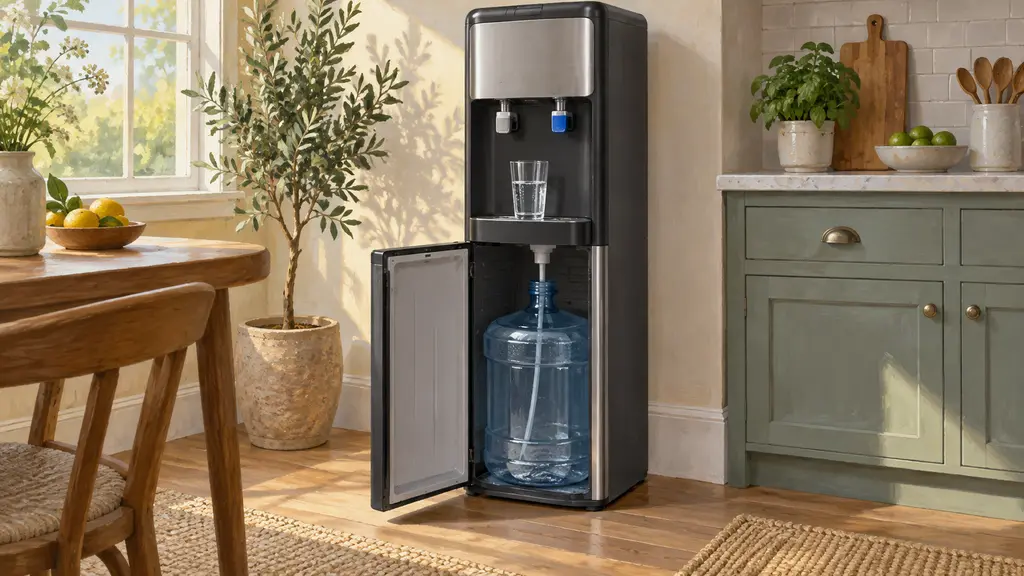
A full-size water dispenser with a compressor and heating element generally lasts roughly 5 to 8 years with normal use and maintenance, a shorter range than many other kitchen appliances because the hot tank stays warm nearly all the time, which speeds up limescale buildup. The UAE’s water hardness and how consistently you descale the unit are the two factors that push that number up or down noticeably.
The quick answer
Manufacturers estimate a lifespan of roughly 5 to 8 years for a full dispenser, but the UAE’s water hardness clearly shortens it if regular descaling is neglected. The practical rule for deciding: a simple fault on a unit under three years old is worth repairing, while a recurring fault on a unit past six years old gets close to the point where replacing is the better value. A bottle pump lasts on a completely different timeline, since it has no hot tank for limescale to build up on in the first place.
Key points
- 5 to 8 years is a common estimated range for a full dispenser, not a precise guarantee for every unit or every home (general background on the water cooler, from ENERGY STAR).
- The UAE’s hard water speeds up limescale buildup inside the hot tank and on the heating element itself (background on how limescale forms, from USGS).
- Regular descaling (white vinegar or citric acid) noticeably extends the real-world lifespan, and it’s the one genuine fix worth adopting before anything else.
- The practical rule: a repair costing less than half the price of a new unit is usually worth it, especially in the first three years.
- A bottle pump lasts on a completely different timeline, since it has no hot tank or heating element for limescale to build up on at all.
Why does the lifespan vary in the first place?
A full-size water dispenser relies on a cooling compressor and a resistive heating element, both of which wear down gradually with use. Four factors actually determine how fast that wear happens:
- Your home’s water hardness: the UAE’s hard water deposits limescale gradually inside the hot tank and on the heating element, making it work harder to reach the water temperature it needs and speeding up its wear (background on limescale, from USGS).
- How heavily the hot tap is used: every time fresh cold water enters the tank after hot water is drawn, the heating element runs an extra cycle, so a household that uses the hot tap often stresses the element faster than one that barely touches it.
- How consistent the descaling routine is: a vinegar or citric acid cleaning cycle every month or two directly reduces the load on the compressor and heating element.
- The model’s original build quality: models with weaker tank insulation or thinner plastic parts run into faults earlier regardless of maintenance.
When it’s worth repairing, and when it’s worth replacing
| Unit age | What it means | Best decision |
|---|---|---|
| Under 3 years | Usually a first or second fault | Repairing is worth it in most cases |
| 3 to 6 years | Recurring faults start to appear | Compare the repair cost to half a new unit’s price before deciding |
| Over 6 years with a recurring fault | Cumulative repair cost gets close to a new unit’s price | Replacing is usually the better long-term value |
| Weaker hot water than usual or a leak | A sign of internal wear regardless of age | Worth considering replacement or repair right away |
The common rule of thumb: if a repair costs less than half the price of a new unit and the same fault hasn’t happened before, repairing is usually the more economical choice. The same fault recurring more than once flips that math quickly.
Descaling: the real fix that actually extends the lifespan
Before thinking about replacement at all, the single most important step is stopping limescale from building up in the first place, and it doesn’t require buying anything:
- Unplug the dispenser and empty the hot tank once it has fully cooled.
- Mix a solution of equal parts white vinegar and water, or citric acid dissolved in warm water as a less pungent alternative.
- Pour the solution into the tank and let it sit for 20 to 30 minutes to dissolve buildup on the tank walls and the heating element.
- Run the solution all the way through the tap until it comes out clean, then flush the tank with plain water several times to make sure no vinegar or acid residue remains.
- Repeat this cycle every month or two, depending on your area’s water hardness and how much you use the hot tap.
This one step, at zero extra cost, is largely what decides whether your dispenser lands closer to the 5-year mark or pushes past 8 years in the real world. For anyone who’d rather not mix the solution themselves, dedicated descaling solutions and powders made for water dispensers exist on the market, a convenient time-saving alternative but not a necessity if you’re comfortable with plain vinegar or citric acid.
A bottle pump’s lifespan: a completely different factor
If you’re using a bottle pump instead of a full dispenser, the lifespan question looks entirely different. A pump has no hot tank or heating element for limescale to build up on, so there’s no descaling to do at all. A manual pump has no battery or electric motor, so there’s nothing electronic to fail, and it can run for many years. On an electric or USB-C rechargeable pump, the part that typically weakens first is the rechargeable battery itself after hundreds of charge cycles, not the simple motor that moves the water.
If you decide to replace it
Once a recurring repair crosses out of the economically sensible zone, or you’re buying a dispenser for the first time and want a unit worth investing routine maintenance in, the Midea Top-Loading Water Dispenser at roughly ≈ 339 AED is the cheapest of the full-size dispensers we found on Amazon.ae, with 3 taps for hot and cold water and hundreds of buyer reviews. You’ll find more picks and a full comparison in our guide to the best water dispenser in the UAE.
See the Midea Top-Loading Water Dispenser price on Amazon.ae ↗
Bottom line
A full-size water dispenser generally lasts roughly 5 to 8 years, but the UAE’s water hardness clearly shortens that number if limescale is left to build up. A simple fault on a unit under three years old is worth repairing, while a recurring fault on a unit past six years old gets close to the replacement point. A vinegar or citric acid descaling cycle every month or two, at zero extra cost, pushes that point back noticeably. To check what a dispenser adds to your electricity bill before you buy, read how much electricity does a water dispenser use, and for the full buying criteria see how to choose a water dispenser or browse the full water dispensers section.
Sources
- ENERGY STAR, “Water coolers”,” general background on water dispenser parts and how they work: https://www.energystar.gov/products/water_coolers
- USGS, “Hardness of water”,” background on how limescale forms from hard water and its effect on household appliances: https://www.usgs.gov/water-science-school/science/hardness-water
This analysis is based on published information from ENERGY STAR (Water coolers), USGS (Hardness of water).
Frequently asked questions
How many years does a full-size water dispenser typically last?
Manufacturers generally estimate a lifespan of roughly 5 to 8 years for a full unit with a compressor and heating element, with normal use and maintenance. That's a shorter range than many other kitchen appliances, because the hot tank stays warm almost all the time, which speeds up limescale buildup compared to a device that only heats water occasionally.
Does the UAE's water hardness actually shorten a water dispenser's lifespan?
Yes, noticeably. Limescale from hard water gradually builds up inside the hot tank and on the heating element itself, making it work harder to reach the water temperature it needs, which speeds up wear and shortens the real-world lifespan compared to a softer-water environment. Regular descaling clearly reduces this effect.
When should I decide to repair rather than replace?
A common rule of thumb is that a repair is worth it if it costs less than half the price of a new unit and the same fault hasn't happened before. A simple fault on a unit under three years old is usually worth repairing, while a second or third fault on a unit past six years old gets close to the point where replacing becomes the better value long-term.
Does a bottle pump last a different amount of time than a full dispenser?
Yes, its lifespan depends on an entirely different factor. A pump has no hot tank or heating element for limescale to build up on, so its simple motor can run for many years with moderate use. The part that typically wears out first is the rechargeable battery in an electric pump, not the motor itself, and a manual pump has no battery or electric motor to fail at all.
Does regular descaling actually extend a water dispenser's lifespan?
Yes, directly. A white vinegar or citric acid descaling cycle every month or two dissolves limescale before it builds up on the heating element and inside the internal tubing, which reduces the load on the compressor and heating element, the two parts whose wear eventually leads to a fault serious enough to consider replacement over repair.