
 Egypt
Egypt  Saudi Arabia
  USA
USA How Much Electricity Does a Water Dispenser Use?
We may earn a commission from purchases through our links, at no extra cost to you. How we choose · Disclosure.
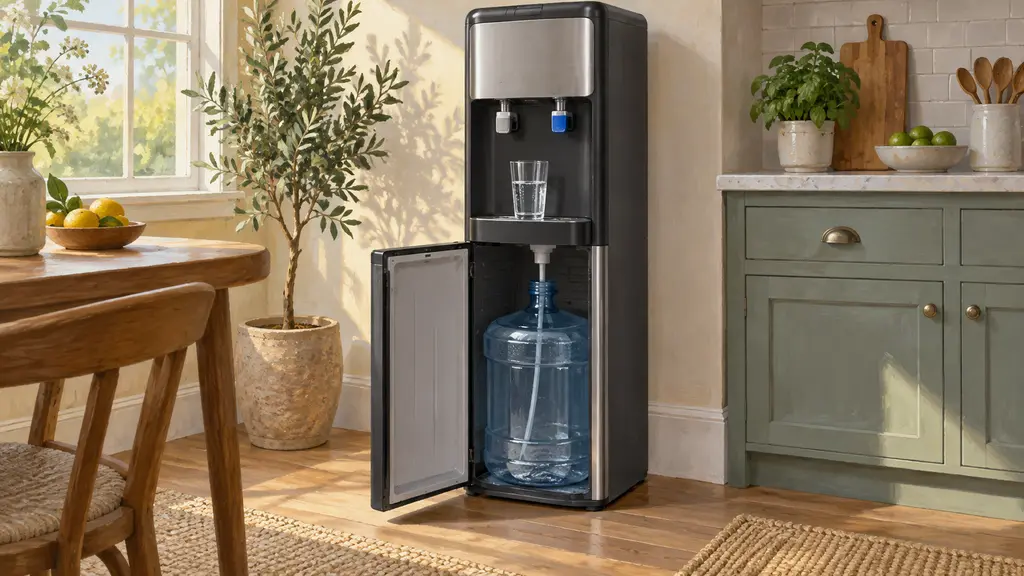
A full-size water dispenser combines two separate systems: a compressor-cooled side that typically draws around 70 to 100 watts while running, and a heating side with a resistive element that typically draws around 420 to 500 watts while running. That sounds like a lot at first, but an internal thermostat on each side shuts the heating or cooling off once it hits its target temperature, so the real addition to a DEWA bill usually lands under 50 AED a month, not more.
The quick answer
A full-size water dispenser typically adds under 50 AED a month to a DEWA bill, even with normal daily use. The cooling side draws around 70 to 100 watts while running, and the heating side draws around 420 to 500 watts while running, but both cycle on and off under a thermostat rather than running continuously all day. A bottle pump, manual or electric, uses far less than that, since it never heats or cools the water at all.
Key points
- A water dispenser combines a compressor cooling system and a resistive heating element, and those two sides are what determine total consumption (general background on the water cooler, from ENERGY STAR).
- The heating element is the clear power drain, since heating water and keeping it hot takes far more energy than cooling it.
- A thermostat on each side automatically shuts the heating or cooling off once it reaches its target temperature, so the unit isn’t drawing full power the whole time.
- A bottle pump doesn’t heat or cool water at all, so its power draw is close to zero next to a full dispenser.
- Consumption is measured in watts at any given moment and in kWh over a billing period (kilowatt-hour definition from US EIA).
How many watts each side actually uses
A full-size water dispenser isn’t one appliance for power purposes, it’s two in one box:
- The cooling side runs on a small compressor similar to a mini fridge, typically drawing around 70 to 100 watts while actively running, shutting off automatically once the cold tank hits its target temperature.
- The heating side relies on a resistive heating element that typically draws around 420 to 500 watts while running, well above the cooling side because heating water and holding it hot costs far more energy than cooling it.
- An electric or USB-C rechargeable bottle pump only needs power for a few seconds while dispensing, or briefly while its battery tops up, a tiny draw next to any full dispenser.
- A manual bottle pump needs no electricity at all, it works by hand pressure alone.
These are rough figures that vary a little model to model, and the most accurate way to know your own unit’s real draw is a simple plug-in energy monitor between the plug and the wall outlet.
Working out the monthly cost on a DEWA bill
To turn watts into an actual cost, assume continuous running around the clock for a full month on each side separately as a theoretical worst case, even though a real unit never actually runs this way. DEWA’s Dubai tariff starts around 23 fils per kWh in the lowest slab, and once the monthly fuel surcharge is added, the effective rate for many homes lands closer to 30 fils per kWh. On that basis:
| Category | Approx. wattage | kWh per day, continuous | Approx. monthly cost (AED) |
|---|---|---|---|
| Manual pump (no power) | 0 | 0 | ≈0 |
| Electric or USB-C pump (occasional charging only) | 5 - 10 | ≈0.2 | ≈2 |
| Full dispenser, cooling side alone (if it never stopped) | 70 - 100 | ≈2.0 | ≈18 |
| Full dispenser, heating side alone (if it never stopped) | 420 - 500 | ≈11.0 | ≈99 |
| Full dispenser, combined real-world daily use | - | ≈2.5 - 3.5 | ≈25 - 35 |
The third and fourth rows are illustrative worst-case figures for each side running nonstop for a full month, which doesn’t happen in practice. The last row is the realistic estimate for a full dispenser, since the thermostat on each side shuts it off for most of the day.
Why real-world consumption runs well below the theoretical sum
Unlike a unit that runs continuously, a water dispenser has a thermostat on each side that monitors the actual tank temperature and shuts the compressor or heating element off automatically once it hits its target. On a normal day of use, that means each side is only actually running for a small fraction of the 24 hours, not the whole time. That’s why the real monthly cost for a full dispenser stays under 50 AED, not the combined theoretical figures above that add up to well over 100 AED. The better insulated the hot tank is, the fewer heating cycles it runs, and the lower the consumption.
What actually raises consumption
- Heavy use of the hot tap: every time you draw hot water, fresh cold water enters the tank, so the heating element needs an extra cycle to bring it back up to temperature.
- Placing the dispenser near a heat source or direct sunlight: this forces the cooling side to work harder and longer to reach the same target temperature.
- An older unit with worn insulation or internal buildup: as the tank’s insulation weakens or scale builds up on the heating element, the unit needs more time to reach the same temperature, using more power for the same result.
- Leaving the unit plugged in unnecessarily during a long trip: both sides stay ready to run the whole time with zero actual use.
A dispenser that won’t surprise you on the bill
If the hot tap is something you genuinely use every day, a full dispenser remains the sensible choice despite its higher draw than a bottle pump, and the real monthly difference (under 50 AED) is small next to other appliances in the home like the AC. A practical example from our shortlist: the Midea Top-Loading Water Dispenser (≈ 339 AED), the cheapest of the full-size dispensers we found on Amazon.ae, with 3 taps for hot and cold and hundreds of buyer reviews, and it’s our top pick in the best water dispenser in the UAE. If your daily use is mostly cold water, a bottle pump saves you even that small amount, and we break down that trade-off fully in our guide on how to choose a water dispenser.
See the Midea Top-Loading Water Dispenser price on Amazon.ae ↗
Bottom line
A full-size water dispenser typically adds under 50 AED a month, because the thermostat on both the cooling and heating sides shuts each one off automatically for most of the day rather than running nonstop. The heating element is the clear power drain inside the unit, and a bottle pump sidesteps nearly all of that consumption since it never heats or cools the water at all. If you’re still deciding between a full dispenser and a pump, or between bottom-load and top-load, see bottom-load vs top-load water dispensers, and for the realistic lifespan to expect before you buy, read how long does a water dispenser last. To see the full price ranges, check water dispenser prices in the UAE, or browse the full water dispensers hub.
Sources
- ENERGY STAR, “Water coolers”,” general background on how water dispenser cooling and heating mechanisms work: https://www.energystar.gov/products/water_coolers
- US EIA, “Measuring electricity in kilowatt-hours”,” definition of the unit of electricity consumption that shows up on power bills: https://www.eia.gov/energyexplained/electricity/measuring-electricity.php
- Dubai Electricity and Water Authority (DEWA), slab-based consumption tariff used for the monthly cost estimate: https://dewa.gov.ae/en/consumer/billing/slab-tariff
This analysis is based on published information from ENERGY STAR (Water coolers), US EIA (Measuring electricity in kilowatt-hours), Dubai Electricity and Water Authority, slab tariff.
Frequently asked questions
How many watts does a hot and cold water dispenser use?
It depends on two separate sides of the unit. The cooling side runs on a small compressor similar to a fridge, typically drawing around 70 to 100 watts while it's actively cooling. The heating side uses a resistive heating element that typically draws around 420 to 500 watts while it's actively heating, to keep the hot tank at temperature. Neither side runs at full power all the time: an internal thermostat shuts each one off once it hits its target temperature, so real daily consumption is well below the sum of those two numbers.
Does running a water dispenser all day raise a DEWA bill a lot?
Less than most people expect. Even assuming continuous running on both the cooling and heating sides for a full month as a worst case, the actual addition to the bill usually stays under 50 AED a month for a full-size dispenser, because the thermostat on each side shuts it off once it reaches the target temperature, so neither side truly runs nonstop.
Is a bottle pump cheaper to run than a full dispenser?
Yes, by a very wide margin. A manual pump needs no electricity at all. An electric or USB-C rechargeable pump only draws current for a few seconds while dispensing, or briefly while its battery charges, which is closer to charging a phone than to a unit that keeps a tank of water hot all day.
Is the hot tap what uses most of the power?
Yes, the heating element is the clear power drain inside a water dispenser, because heating water and holding it hot takes far more energy than cooling it. If your daily use is mostly cold or room-temperature water and you don't actually need a hot tap, a bottle pump does the same core job for a fraction of the power and cost.
How do I find my own dispenser's exact consumption instead of a general estimate?
The most accurate way is a plug-in energy usage monitor (a smart plug with a power sensor) placed between the dispenser's plug and the wall outlet, which reads the real watts at any moment and the accumulated kWh over time for your specific unit, instead of relying on general category estimates.