
 Egypt
Egypt  Saudi Arabia
  USA
USA What BTU Portable AC Do You Need? Room Sizes for the UAE
We may earn a commission from purchases through our links, at no extra cost to you. How we choose · Disclosure.
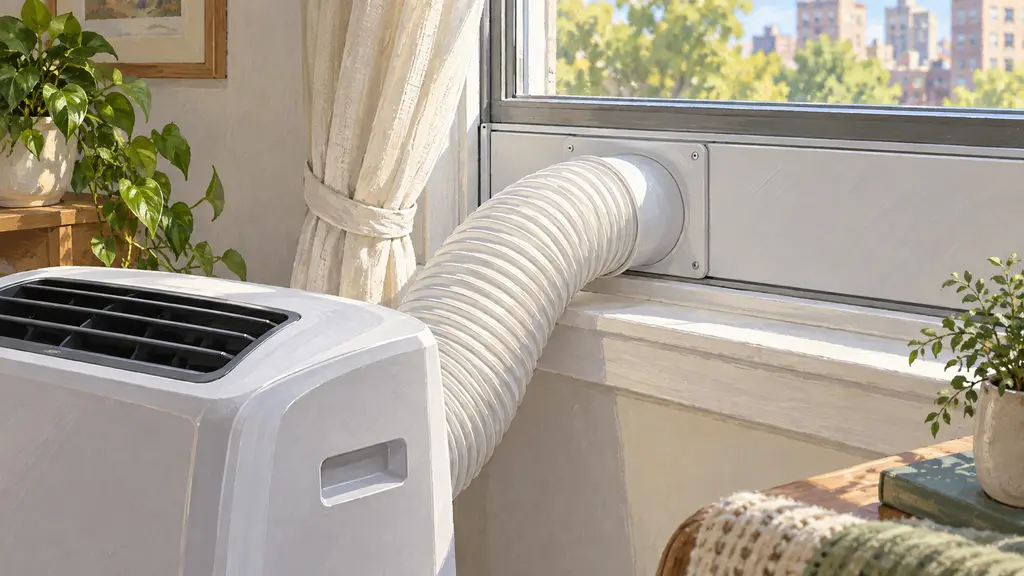
Trying to match a portable AC to your room and drowning in BTU numbers? The short version: size by your room area in square meters, then remember the BTU printed on the box is a marketing figure, not the cooling you will actually feel. A small UAE bedroom of 10 to 18 square meters wants a unit sold as roughly 9,000 to 12,000 BTU, and you size up for glass, sun, and Gulf humidity. Here is the full method before you shop the best portable AC in the UAE.
The quick answer
Match the BTU to your floor area, not your gut. A rough UAE starting point: 10 to 18 square meters wants a unit marketed around 9,000 to 12,000 BTU, 18 to 28 square meters around 13,000 to 16,000 BTU, and 28 to 40 square meters around 16,000 to 20,000 BTU. Past 40 square meters, a big open living room or villa majlis is usually split-AC territory, not a single portable. Then adjust up for direct sun, floor-to-ceiling glass, a top-floor flat, or a humid room. In a 45-degree summer, sizing up is cheap insurance; sizing down means a unit that runs non-stop and never quite catches up.
Key takeaways
- Area comes first, then adjustments. Your floor size in square meters sets the baseline BTU class; UAE conditions push it up from there.
- The box number is a marketing number. Portable ACs are sold on the ASHRAE rating, but the real cooling is often little more than half of it, so read the big figure with a pinch of salt.
- Gulf heat and humidity push you up a band. A 45-degree afternoon and coastal humidity both make a unit work harder, so the safe move is to size up, not trim to the minimum.
- Evaporative coolers are not sized in BTU. For an air cooler rather than a true AC, the BTU math here does not apply.
- When unsure, round up. Undersizing in this climate is the mistake you feel every afternoon, and the harder one to fix after buying.
The number on the box is not the cooling you get
Here is the honesty point almost nobody local spells out. The headline BTU figure on a listing is usually the ASHRAE rating, an older lab number. The figure that matches real-room performance is the SACC rating (Seasonally Adjusted Cooling Capacity), a newer standard that accounts for heat leaking back through the exhaust hose and the losses a portable design carries. SACC is typically little more than half the ASHRAE number. So a portable marketed as 14,000 BTU may deliver closer to 7,000 to 8,000 BTU of real cooling, and that gap widens in a room that is already baking.
This matters most here because our summers are so brutal. Size a unit right at the edge of your room’s calculated need and you have quietly bought a machine that is undersized the moment the box number becomes real cooling. That is why the table below is built around the advertised number, with the honest expectation that its true output is lower. For the buying criteria beyond capacity, our guide on how to choose a portable AC covers hose length, drainage, and noise too.
Match the BTU to your room size
Measure your floor area (length times width, in meters) and find your band. The marketed-BTU column is the number on the listing, set deliberately high so the lower real-world output still covers a hot room.
| Room size | Typical UAE room | Real cooling you need | Marketed BTU on the box |
|---|---|---|---|
| 10 to 18 m² | Small bedroom, study, home office | ~5,000 to 6,000 BTU | ~9,000 to 12,000 BTU |
| 18 to 28 m² | Standard bedroom, small closed majlis | ~7,000 to 8,000 BTU | ~13,000 to 16,000 BTU |
| 28 to 40 m² | Living room, family majlis | ~9,000 to 11,000 BTU | ~16,000 to 20,000 BTU |
| 40 m² and up | Large open living, villa majlis | 12,000 BTU and up | 22,000 BTU and up, usually a split |
The simple rule: find your floor area, read across to the marketed BTU, and lean toward the higher end of the band in the UAE, never the lower. Past roughly 40 square meters, a single portable unit stops being the sensible answer, and a fixed split AC is what will actually keep that much air cold.
What the UAE climate does to the math
The bands above assume an average room in average conditions, which almost no room here is. Push up a class when any of these apply:
- Floor-to-ceiling glass or a sun-facing room. Large windows facing the afternoon sun pour heat in all day, and glass is the single biggest reason a correctly-sized unit still struggles. West and south-facing rooms are the usual culprits.
- Top-floor flats and rooms under a roof. Heat soaks down from a sun-blasted roof, so a top-floor bedroom needs more capacity than the same room two floors down.
- Humidity on the coast. In humid months a true AC spends real effort pulling moisture from the air, not just lowering temperature, which eats into its cooling headroom. It is also why an air cooler struggles here, a point we cover in portable AC vs evaporative cooler.
- People and heat sources. More than two people in the room, a busy kitchen next door, or several devices running all add load that a bare floor-area number ignores.
Stack two or three of these and you should be a full band higher than the table suggests, not fiddling with the minimum.
Which unit actually fits your room
One honest caveat before you shop: BTU sizing applies to a true refrigerant portable AC. If your room is dry and you are open to an air cooler instead, that is a different decision with different math. For a true portable AC, the larger unit we carry is the Gree 1.5 Ton, marketed at 18,000 BTU, in the best portable AC in the UAE. It is a useful yardstick for reading a listing: through the SACC lens, that marketed 18,000 lands nearer 9,000 to 10,000 BTU of real cooling, enough for a standard bedroom or a small closed majlis, marginal in a large living room, and undersized for a villa majlis, where a split is the right call.
So what should you actually buy?
If your room lands in the small or standard bedroom bands and you need real refrigerant cooling, a true portable AC around the 14,000 to 18,000 BTU marketed class is your target, and the Gree 1.5 Ton we carry sits in that class at about 1,950 AED. If your space is genuinely dry and you mostly want air movement, an evaporative cooler is the cheaper, simpler route from around 400 AED, just know it is not a true AC. And past 40 square meters, do not force a portable to do a split’s job. All prices are approximate and change.
Size your room in a minute
- Measure floor area: length times width, in meters.
- Find your band in the table and read across to the marketed BTU.
- Add a band if the room has big glass, faces the sun, sits on the top floor, or holds more than two people.
- Remember the box number is generous: real cooling runs closer to half, so never size to the minimum.
- Past 40 square meters, plan for a split AC, not a portable.
- Check portable AC prices in the UAE to see what each class costs before you commit, and remember all prices are approximate.
For everything in this category in one place, browse our portable ACs section.
This analysis is based on published information from Amazon.ae.
Frequently asked questions
How many BTU do I need for a room in the UAE?
Start from your floor area, then add a margin for the heat here. As a rough guide, a small bedroom of 10 to 18 square meters is comfortable with a unit marketed at roughly 9,000 to 12,000 BTU, a standard bedroom or small majlis of 18 to 28 square meters wants around 13,000 to 16,000 BTU, and a living room of 28 to 40 square meters wants around 16,000 to 20,000 BTU. Anything larger than about 40 square meters, like a big open-plan living room or a villa majlis, is usually beyond a single portable unit, and a split AC is the more honest answer there. Push a band higher if the room has floor-to-ceiling glass, faces the afternoon sun, sits on the top floor, or regularly holds more than two people.
Why is my portable AC weaker than its BTU rating suggests?
Because the big number on the box and the cooling you actually feel are two different figures. Most portable ACs are marketed on the older ASHRAE rating, while the real delivered cooling, measured by the newer SACC standard, is often little more than half of it. A unit sold as 14,000 BTU can deliver closer to 7,000 to 8,000 BTU of real cooling once the hose losses and a hot room are accounted for. This is exactly why sizing right at the edge of your room's needs backfires in a Gulf summer, and why we tell you to read the box number as a marketing figure, not a promise.
Is a bigger BTU portable AC always better?
No. An oversized unit cools the air fast, then switches off before it has pulled much moisture out, so the room can end up cold but clammy, and the unit short-cycles, which is noisier and harder on the compressor. The goal is to match the room, then add a sensible margin for UAE heat, not to buy the biggest number you can find. Undersizing is the more common and more painful mistake here, but oversizing has a real cost too.
What size portable AC do I need for a majlis?
It depends heavily on whether the majlis is a closed room or open to a hallway and other spaces. A small, closed majlis of around 20 to 28 square meters can work on a true portable AC marketed at roughly 14,000 to 18,000 BTU. A large villa majlis open to the entrance and dining area, often 35 square meters and up, is realistically split-AC territory, because no single portable unit will keep that volume of air cold through a peak afternoon. If you are set on a portable, size to the top of the range and keep doors closed, but go in knowing the honest limits.