
 Egypt
Egypt  UAE
UAE  USA
USA How to Vent a Portable AC Without a Suitable Window
We may earn a commission from purchases through our links, at no extra cost to you. How we choose · Disclosure.
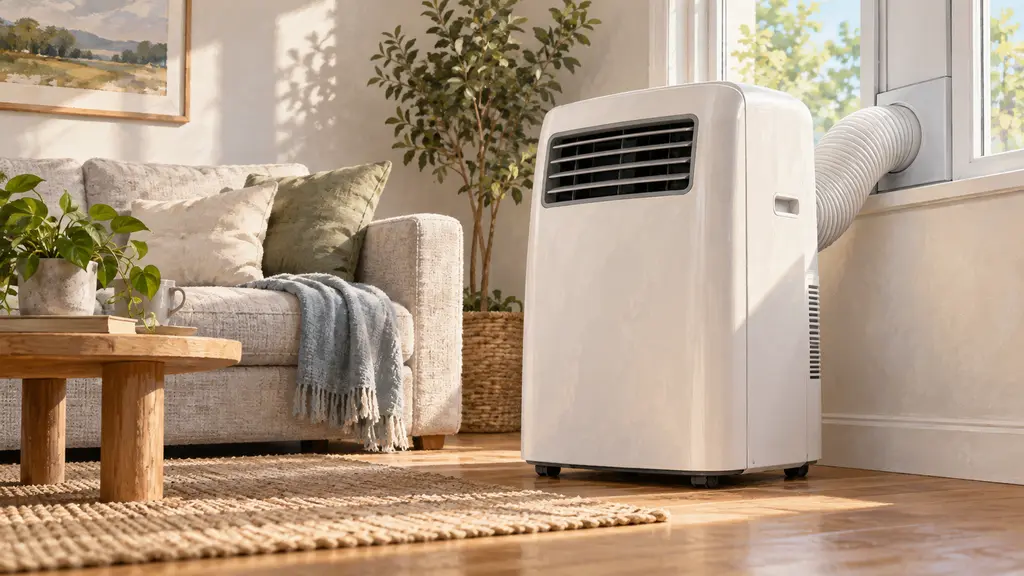
Some Saudi rooms, especially interior rooms in apartments or converted storage spaces, simply don’t have an opening window, or the opening is an odd shape that doesn’t fit the stock hose panel. A portable AC needs to exhaust hot air to true outside air to actually work, so what’s the fix when there’s no suitable window?
The quick answer
The fixed principle first: the end of the hose has to reach real outdoor air, not an adjoining room or an interior hallway, or you’re just moving heat around the home instead of removing it. If your room doesn’t have an opening window, there are three real fixes ranked from least effort to most permanent: an adjustable vent kit for a nearby sliding door or window that reaches outside, routing the hose through a drop ceiling that genuinely connects to outdoor air, or a permanent through-wall vent kit if you own the property or have the landlord’s sign-off.
Key takeaways
- The hose exhausts genuinely hot air, so venting it inside the home instead of outside just relocates the heat rather than removing it (how air conditioning works, from Britannica).
- A non-standard opening isn’t a permanent dead end, adjustable vent kits are built specifically for sliding doors, sliding windows, or openings that don’t match the stock panel’s size.
- Sealing the gap around the hose matters as much as having an outdoor route at all, since a wide gap pulls in hot air and cancels out part of the benefit of venting.
- A permanent through-wall solution is the most effective option but takes real effort and usually requires the landlord’s approval in a rented apartment.
- Routing the hose through a drop ceiling only works if it genuinely reaches outdoor air, not just the closed void above your ceiling tiles.
Why the air actually needs to reach outside
A single-hose portable AC, the most common design in this category, pulls air from inside the room itself to cool its compressor, then exhausts that hot air out through the hose. If the hose ends inside an adjoining room or a closed hallway instead of true outside air, you’re moving heat from one room to another within the same home, not removing it, and the adjoining room’s temperature often rises noticeably. The core principle is simple: the end of the hose has to reach real outdoor air, whether through a window, a door that opens outside, a wall, or a ceiling that genuinely connects to open air, never any other interior space no matter how “far” it feels from your room.
Options based on the opening you actually have
- A nearby sliding door or window that reaches outside: an adjustable vent kit built specifically for sliding doors and windows lets the opening close almost completely around the hose panel, with only a very narrow gap left, far better than leaving a door cracked with no seal at all.
- A drop ceiling: if the building uses a suspended ceiling that genuinely reaches an outdoor void or a real vent opening, you can route an extension pipe through one of the ceiling tiles, provided the other end actually reaches real outdoor air rather than just the closed void above the ceiling, otherwise you’re just heating the space above your ceiling instead of the outdoors.
- A permanent through-wall opening: a dedicated vent kit, similar to a dryer vent opening, gives the best seal and the fewest leakage gaps, but it needs drilling into the wall and usually the landlord’s permission in a rented apartment, making it best suited to owners or long-term tenants cooling the same room for years.
- An adjoining room that genuinely reaches outside: if the room next door has its own window or door to real outdoor air, you can extend the hose to that opening instead of your own room, as long as the pipe’s final end actually exits the home.
Comparing venting methods
| Venting method | Effort required | Permanence | Effectiveness |
|---|---|---|---|
| Standard hose through an opening window | Low | Temporary, easy to remove | Good if sealed well around the opening |
| Permanent through-wall vent kit | High, needs drilling and usually landlord approval | Permanent | Highest, a sealed fixed opening with no gaps |
| Routing through a drop ceiling | Medium, depends on the building | Semi-permanent | Good only if the pipe truly reaches outside air |
| Adjustable vent kit for a sliding door or window | Low to medium | Temporary and portable | Good, better than a standard hose in non-standard openings |
An adjustable window vent kit: a practical add-on, not a substitute for the basics
If your available opening is non-standard, a wide sliding door or an unusually shaped window, an adjustable vent kit solves a problem the stock plastic panel that ships with most units can’t, since that panel is built for one specific standard window width. This kind of kit typically extends or adapts to different widths, with a dedicated opening for the hose and better sealing around the remaining gaps. Remember it’s an add-on that completes your venting solution, not a substitute for the core principle: the end of the pipe always has to reach real outdoor air.
The AC that’s worth solving the venting problem for
If you’re going to spend time solving the venting problem properly, make sure the unit itself is worth it. Our top pick, the Super General 1.5-Ton 18,000 BTU Window AC (≈ 1,199 SAR at publication), is actually a window-mounted AC rather than a hosed portable unit, so it solves the venting problem in a completely different way: it installs directly into the window opening instead of relying on a flexible hose. If your search for a venting solution ends with the conclusion that your room simply doesn’t have a suitable opening for a true portable unit’s hose, a real window AC like this one may be the simpler fix, provided your window opening can take it. Find it in full in our guide to the best portable AC in Saudi Arabia.
Bottom line
Venting a portable AC without an opening window is genuinely possible, as long as you stick to one unchanging principle: the end of the hose has to reach real outdoor air, whether through a sliding door with an adjustable vent kit, a drop ceiling that genuinely reaches outside, or a permanent through-wall opening if you own the property. Never vent it into a closed adjoining room thinking that solves the problem. To confirm the unit’s size actually suits your room before you solve the venting question, see our guide to what size portable AC you need, and if you’re already weighing a window AC against a hosed portable unit, read portable AC vs window AC. For the full buying criteria see how to choose a portable AC, or head back to portable ACs for the full hub.
Sources
- Britannica, “Air conditioning”, how refrigeration systems exhaust heat: https://www.britannica.com/technology/air-conditioning
This analysis is based on published information from Amazon.sa, Britannica (Air conditioning).
Frequently asked questions
How do I vent a portable AC if my room has no opening window?
There are three real options: a permanent through-wall vent kit to true outside air, routing the hose through a drop ceiling that genuinely reaches outdoor air rather than just the ceiling void, or moving the exhaust to a nearby door or window in an adjoining room using an adjustable vent kit. Never vent it into another closed interior room or hallway, because that just moves heat around your home instead of removing it.
Can I vent a portable AC's hose through a sliding door instead of a window?
Yes, and this is actually a common setup. An adjustable vent kit made for sliding doors and windows lets the door close almost fully around the hose panel, leaving only a very narrow gap, which is far better than leaving the door cracked open with no seal panel at all.
Is a permanent through-wall vent opening worth the cost and permission required?
If you own the property and plan to cool the same room for years, usually yes, since it's the option with almost no leakage gaps and saves you reinstalling a hose every time. If you're a renter or move the unit between rooms regularly, a temporary solution with an adjustable vent kit makes more sense.
Does venting a portable AC into an adjoining room instead of outside work?
No, and this is a common mistake worth clarifying. The hose exhausts genuinely hot air, so if it ends inside an adjoining room instead of true outside air, you're just moving heat from your room into another one, not removing it from the home at all. The end of the hose always needs to reach real outdoor air, whether through a window, a wall, or a door that opens to the outside.