
 Egypt
Egypt  UAE
UAE  USA
USA What Size Portable AC Do You Need in Saudi Arabia?
We may earn a commission from purchases through our links, at no extra cost to you. How we choose · Disclosure.
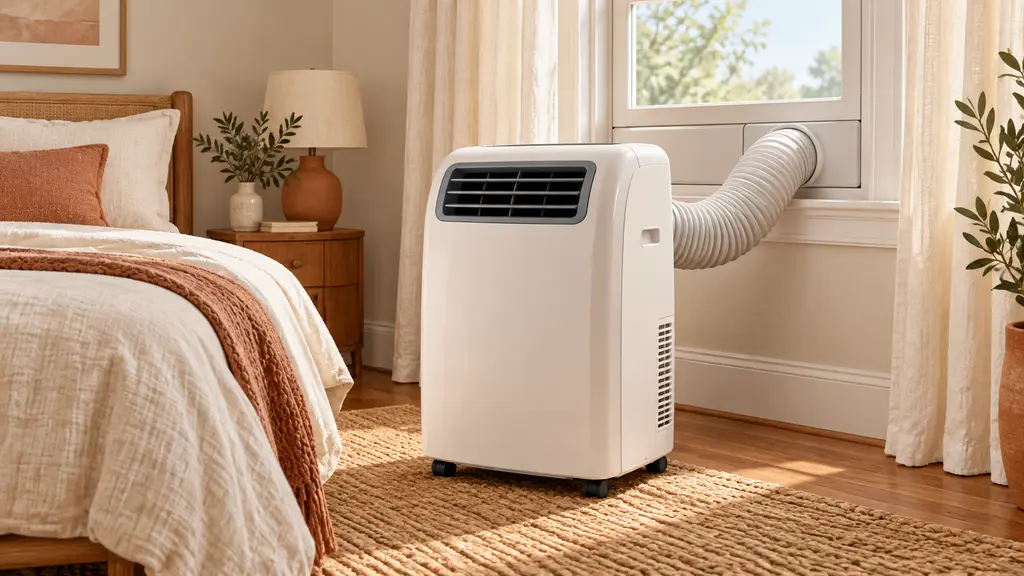
The quick rule: measure your room’s floor area in square meters first, that is the real starting point, then treat the BTU number printed on a portable AC box with some skepticism, because it is a marketing figure, not the cooling you will actually feel. A small bedroom (10 to 16 m²) wants a unit marketed at roughly 9,000 to 12,000 BTU, and a standard bedroom or small living room (16 to 25 m²) wants around 12,000 to 16,000. Add a full band on top for Saudi heat, especially on upper floors or sun-facing rooms.
The quick answer
Match the AC to your floor area first, not your gut feeling or the cheapest listing you see. As a rough Saudi starting point: 10-16 m² wants a unit marketed around 9,000-12,000 BTU, 16-25 m² wants around 12,000-16,000, and 25-35 m² wants around 16,000-18,000. Past roughly 35 m², a large open living room or a wide majlis, the honest answer is a split AC quote rather than pushing one portable unit past its limits. Then adjust up for a top-floor room, a big sun-facing window, or a room next to the kitchen. Once you know your size, see our picks in the best portable AC in Saudi Arabia.
Why the number on the box is bigger than the cooling you feel
Here is the honesty point most listings skip. The large figure printed on most portable AC ads is the ASHRAE rating, an older, optimistic lab number. The figure closer to what you actually feel in your room is the SACC rating (Seasonally Adjusted Cooling Capacity), a newer standard that accounts for heat leaking back in through the exhaust hose and the real-world losses built into a portable design. SACC typically comes in at half the ASHRAE number or a little more. A unit marketed at 14,000 BTU may deliver closer to 7,000 to 8,000 BTU of real cooling, and that gap widens further in a room that is already hot before you switch it on. This is why sizing right at the edge of your room’s calculated need backfires fast in a Saudi summer: the printed number has already lost real cooling by the time it reaches your skin. For the buying criteria beyond size, like noise and drainage, our guide to choosing a portable AC covers it in full.
Match the BTU to your room size
Measure your floor area (length times width, in meters) and find your band. The “box number” column is the marketed figure, printed deliberately high so the lower real-world output still covers a hot room.
| Room size | Common Saudi example | Real cooling needed (SACC, approx.) | Marketed BTU on the box |
|---|---|---|---|
| 10-16 m² | Small bedroom, home office | ~4,000-5,000 BTU | ~9,000-12,000 BTU |
| 16-25 m² | Standard bedroom | ~5,500-7,000 BTU | ~12,000-16,000 BTU |
| 25-35 m² | Large bedroom, small living room | ~7,000-9,000 BTU | ~16,000-18,000 BTU |
| Above 35 m² | Large living room, open majlis | 9,000 BTU and up | 20,000 BTU and up, usually a split by that point |
The simple rule: find your area, read across to the box number, and lean toward the top of the band in Saudi heat, never the bottom. Past roughly 35 square meters, a single portable unit stops being the sensible answer.
Saudi heat adjustments you should actually make
The table above assumes an average room in average conditions, which describes very few real rooms. Push up a full band when any of these apply:
- Top floor, or a room directly under the roof. Heat soaks down from a sun-baked roof all day, so a top-floor room needs more capacity than the same room lower down.
- A large sun-facing window. Big glass facing west or south takes on a direct heat load all afternoon, often the single biggest reason a correctly-sized unit still struggles.
- A room next to the kitchen. Cooking heat and a fridge compressor add real thermal load next door, load a floor-area number alone misses.
- A ceiling higher than standard. Sizing tables assume a ceiling around 2.4 to 2.7 meters; a noticeably taller ceiling means more air volume for the same floor area, so size up.
Stack two or three of these and you need a full band higher than the table suggests, not a unit trimmed to the minimum.
Venting and the exhaust hose: why the wrong size runs nonstop
A true wheeled portable AC needs to exhaust hot air outside through a hose, usually run through a window kit. Single-hose units pull air from the room itself to cool their compressor, then push it outside, which creates negative pressure that draws hot air back in from outside or from other rooms to replace it, cutting into the cooling you actually receive. A hose kept as short as possible, a proper window seal kit, and sometimes a draft strip under the door, noticeably cut this loss. Ignoring these details is one quiet reason a correctly-sized unit still runs nonstop without ever reaching the target temperature.
We will say this plainly too: most of what gets marketed as “portable AC” in Saudi search results is actually a window-mounted unit or an evaporative cooler, not a genuine wheeled box with a hose. That shows up in Amazon.sa’s own lineup, where the one credible true refrigerant pick we recommend is window-mounted rather than hose-vented, so it sidesteps the hose dilemma entirely but trades it for a different one: whether your window opening can actually take it. If you are weighing the two formats, portable AC vs window AC breaks down the difference in detail.
Which option actually fits your space in Saudi Arabia
If your room falls in the standard bedroom to small living room range (roughly 16 to 25 m²) and you need real refrigerant cooling, the one credible true-AC pick we found on Amazon.sa lands at around 1,200 SAR, and you can see it in full in the best portable AC in Saudi Arabia. If your space is smaller or reasonably dry and does not strictly need refrigerant cooling, an evaporative cooler under about 900 SAR does a solid job for a fraction of the cost, though it is not sized in BTU at all, it is sized by tank capacity and coverage area, a completely different physics we break down in portable AC vs evaporative cooler. Check portable AC prices in Saudi Arabia to compare every class before you decide.
Bottom line
Sizing correctly starts with your floor area in square meters, not the biggest number in a listing. Read the printed BTU figure with a healthy dose of skepticism, since it is an optimistic ASHRAE rating rather than real SACC cooling, then add a full band for a top floor, a sun-facing window, a kitchen-adjacent room, or a high ceiling. Past roughly 35 square meters, stop thinking about a single portable unit and start pricing a split AC instead. All prices are approximate at publication and change, so double-check on Amazon.sa before you buy.
For everything in this category in one place, browse our portable ACs section.
Sources
- US EIA, British thermal unit: https://www.eia.gov/energyexplained/units-and-calculators/british-thermal-units.php
- Britannica, Air conditioning: https://www.britannica.com/technology/air-conditioning
- US Department of Energy, Air Conditioning (Energy Saver): https://www.energy.gov/energysaver/air-conditioning
This analysis is based on published information from Amazon.sa.
Frequently asked questions
What size portable AC do I need for my room?
Start by measuring your room's floor area in square meters (length times width). A small bedroom of 10 to 16 square meters suits a unit marketed at roughly 9,000 to 12,000 BTU, and a standard bedroom or small living room of 16 to 25 square meters wants around 12,000 to 16,000. For anything larger than about 35 square meters, a single portable unit usually is not enough, and a split AC quote is the more honest answer.
Why does my portable AC feel weaker than the BTU number on the box?
Because most listings quote the older ASHRAE rating, an optimistic lab figure, while the cooling you actually feel is closer to the SACC rating, which is often half the printed number or a bit more once heat loss through the exhaust hose is accounted for. A unit marketed at 14,000 BTU may deliver closer to 7,000 to 8,000 BTU of real cooling, and that gap widens further in a room that is already hot to begin with.
Is a bigger portable AC always the better choice?
No. An oversized unit cools the air fast, then shuts off before it has pulled enough moisture out, so the room ends up cold but still feels clammy, and it short-cycles on and off, which is noisier and harder on the compressor. The goal is to match the room size, then add a sensible margin for Saudi heat, not to buy the biggest number you can find. Undersizing is still the more common and more frustrating mistake, but oversizing carries a real cost too.
Does the exhaust hose and venting actually change the size I need?
Yes, significantly. A single-hose portable AC pulls air from the room itself to cool its compressor, then exhausts it outside, which creates negative pressure that draws hot air back in from outside or from other rooms to replace it, cutting into your real cooling. A short, well-sealed hose with a proper window kit, and sometimes a door draft strip, noticeably reduces that loss. Ignoring these details is one quiet reason a theoretically correct-sized unit runs nonstop in practice.