
 Egypt
Egypt  UAE
UAE  USA
USA How Much Electricity Does a Portable AC Use in Saudi Arabia?
We may earn a commission from purchases through our links, at no extra cost to you. How we choose · Disclosure.
Saudi summer runs long, and an AC unit ends up working most hours of most days, which raises a fair question before you buy: how much will this actually add to the electricity bill? The answer comes down mainly to the type of unit, how well its size matches your room, and how many hours it genuinely runs, not the sticker price alone.
The quick answer
A true refrigerant AC (window or portable) draws noticeably more electricity than an evaporative cooler or a misting fan, because the compressor is the single most power-hungry part of any cooling device. Work out the cost by multiplying the unit’s wattage by the hours it runs each day, dividing by 1,000, and comparing that to the per-unit rate on your bill. The biggest practical saving rarely comes from switching units, it comes from sizing the one you have correctly for your room, setting a sensible target temperature instead of the coldest setting, and sealing the exhaust hose opening at the window so it isn’t pulling hot air back in.
Key takeaways
- The compressor is what drives most of the electricity use in any true AC, while an evaporative cooler has no compressor at all, so its draw is closer to a regular fan (air conditioning from Britannica).
- A correctly sized unit runs shorter, less frequent cycles than one that’s too small or too large for the room.
- The single-hose design pulls air from inside the room to cool the compressor, then exhausts it outside, creating mild negative pressure that draws hot outside air back in, which stretches out actual runtime (room air conditioner guide from the US Department of Energy).
- Setting a sensible target temperature instead of the coldest setting meaningfully reduces the load on the compressor over long running hours.
- Sealing the gap around the exhaust hose at the window stops extra hot air leaking in and forcing the unit to work longer to compensate.
How to work out the actual cost
The formula is simple: kWh = the unit’s wattage divided by 1,000, multiplied by hours run, and cost = kWh multiplied by your per-unit rate. That rate varies by consumption tier on your Saudi Electricity Company bill, so check your latest bill for the exact figure rather than relying on a generic number that may not match your tier. The bigger swing in a monthly bill rarely comes from the rated wattage difference between two models, it comes from actual runtime: a unit whose compressor keeps recycling because of an air leak or a poor size match can add a full extra hour or more of real running time every day compared to one that’s correctly sized and sealed, and that difference is what actually shows up on the bill.
Why a true AC draws more power than a cooler
The difference here is physical, not marketing. A true air conditioner, whether window-mounted or a genuinely wheeled portable unit, runs a full refrigerant compressor that actively moves heat out of the room, and that draws noticeably more power than a simple fan-and-water mechanism. The evaporative coolers we recommend, like the Koolen 450W 100L model or the Koolen 250W 60L model, have no compressor at all, so their draw sits closer to a large fan with a small water pump. The trade-off is honest: that lower draw comes at the cost of partial cooling that only works in dry heat and weakens as humidity climbs.
Power draw by device type
| Device type | Cooling mechanism | Typical power draw | Best for |
|---|---|---|---|
| True refrigerant AC (window or portable) | Real refrigerant compressor, cools and dehumidifies | Highest of the options here; check your unit’s data plate for the exact wattage | A hot or humid room that needs real cooling |
| Evaporative cooler (Koolen 100L) | Fan and evaporating water, no compressor | ≈ 450W | Dry heat, a larger room |
| Evaporative cooler (Koolen 60L) | Fan and evaporating water, no compressor | ≈ 250W | Dry heat, a single room |
| Misting fan | Regular fan with an added water mist | Lower draw than any cooler in this table | A light cooling boost, not real cooling |
Practical steps that cut the bill without sacrificing cooling
- Match the unit’s size to your room first. An oversized unit short-cycles expensively, and an undersized one runs almost nonstop. Our what size portable AC do you need guide walks through the math.
- Set a sensible target temperature, around 24 to 25°C rather than the coldest setting, since every extra degree toward cold adds load to the compressor without a comfort gain that matches the bill impact.
- Run the unit only when the room actually needs it, with a timer or thermostat rather than leaving it on all day, especially in rooms that sit empty during the day.
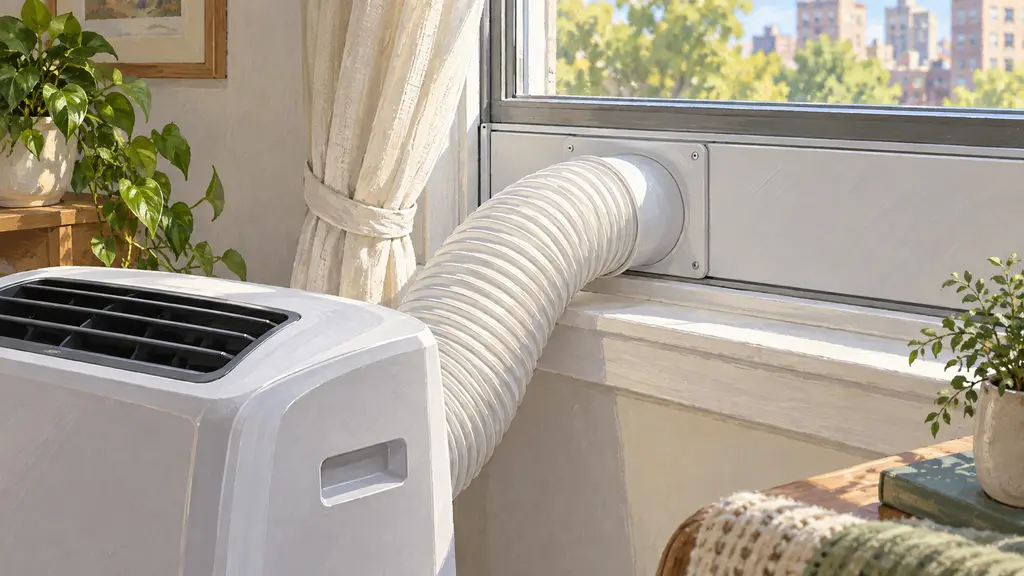
- Seal the exhaust hose opening at the window. The thin plastic panel that ships with most portable ACs leaves small gaps around it, and those gaps let hot air leak back in and force the compressor to restart working. An added window seal kit closes those gaps and shortens actual runtime, a low-cost add-on that complements the stock hose rather than replacing it, though it never makes up for a unit that’s the wrong size for your room in the first place.
The AC that earns its electricity bill
If you’ve decided real refrigerant cooling is what you actually need rather than partial evaporative cooling, our top pick, the Super General 1.5-Ton 18,000 BTU Window AC (≈ 1,199 SAR at publication), remains the most sensible choice on electricity versus real cooling, since it’s the only unit in our lineup with a genuine refrigerant compressor instead of relying on evaporating water. That means you’re paying for cooling that actually reaches and holds your target temperature, not a partial effect that needs longer runtime to get a similar result on a hot day. You’ll find it in full, with its current price and the Amazon.sa link, in our guide to the best portable AC in Saudi Arabia.
Bottom line
A portable AC’s electricity use comes down to three real factors: the type of unit (true compressor versus evaporative), how well its size matches your room, and the actual hours it runs once you account for any air leaking around the hose. Work out the cost with the watts-hours-rate formula, and put your effort into correct sizing and sealing the hose before you consider swapping the unit itself. If you’re still weighing window AC against portable on efficiency, read portable AC vs window AC, and to get the size right first see our guide to what size portable AC you need. For the full buying criteria see how to choose a portable AC, check portable AC prices in Saudi Arabia to compare, or head back to portable ACs for the full hub.
Sources
- Britannica, “Air conditioning”, how a refrigerant compressor moves heat: https://www.britannica.com/technology/air-conditioning
- US Department of Energy, Air Conditioning guide: https://www.energy.gov/energysaver/air-conditioning
This analysis is based on published information from Amazon.sa, Britannica (Air conditioning), US Department of Energy (Air conditioning).
Frequently asked questions
How many kWh does a portable AC use per day?
There's no single correct figure for every unit. Calculate your own by multiplying your unit's wattage, printed on its rear data plate rather than the marketing BTU number, by the hours it runs each day, then divide by 1,000 to get kWh. Multiply that by the per-unit rate on your Saudi Electricity Company bill to get an approximate daily cost.
Is a window AC cheaper to run than a true portable AC?
Usually, yes. A window AC is one sealed unit with the compressor and condenser coil built into a single body, while most true portable ACs use a single-hose design that pulls in hot outside air to replace the air it exhausts. That raises the actual runtime needed to reach the same temperature, so the bill climbs even when the rated wattage looks similar.
Is an evaporative cooler cheaper on electricity than a real AC?
Yes, by a clear margin. An evaporative cooler has no refrigerant compressor at all, it's essentially a fan with a small water pump, so its draw is closer to a regular fan than an air conditioner. The trade-off isn't free though: it doesn't actually cool in humid conditions and only works well in dry heat.
Does leaving the AC running all day raise the bill a lot?
Yes, especially if there's air leaking around the exhaust hose or the unit's size doesn't match your room, because the compressor then keeps recycling on and off instead of reaching a stable temperature and holding it. Correct sizing and a well-sealed hose cut actual runtime more than any other single change.
Does a window seal kit actually reduce electricity use?
Indirectly, yes. The thin plastic panel that ships with most portable ACs leaves small gaps around the hose, and those gaps let hot air leak back in, forcing the compressor to run longer to compensate. An added seal kit closes those gaps and shortens actual runtime, but it doesn't make up for a unit that's the wrong size for your room in the first place.