
 Egypt
 UAE
 Saudi Arabia
How to Choose a Blender in the USA (2026)
How to choose a blender for a US kitchen: countertop vs personal formats, manual rules for hot liquids and ice, working fill, and budget checks.

We may earn a commission from purchases through our links, at no extra cost to you. Full disclosure.
Check price on Amazon.com See all picksVerdict: Start with the format that fits your batch size and check the exact model's owner's manual for ice, hot-liquid, and cleaning rules before comparing wattage. Personal cups suit single-serve smoothies, countertop pitchers handle multi-serving batches, and high-power blenders take on heavier daily prep. For a mid-range countertop option on our US shortlist, the Ninja Professional Plus Blender with Auto-iQ (≈ $110 when checked on 2026-09-26) combines a full-size pitcher with Auto-iQ preset programs.
Our picks
Ninja Professional Plus Blender with Auto-iQ
Ninja
Approx. price when checked: $110 (as of September 2026)
Advantages
- Listed Auto-iQ preset programs
- Full-size countertop pitcher format
Before you buy
- Check the exact manual for permitted recipes, hot-liquid rules, and cleaning
- Pitcher format rather than a personal-cup pack
Price checked: September 26, 2026
The right blender depends on what you put in the container, how much you pour at once, and what the exact model’s owner’s manual permits. Most buyer regret comes from shopping by the biggest wattage number on the box while overlooking the container format, the maximum liquid fill line, or model-specific rules for ice and hot liquids.
- Personal blender: built around single-serving cups for quick smoothies and protein shakes with a compact footprint.
- Countertop pitcher blender: the everyday household default for multi-serving smoothies, sauces, and crushed ice.
- High-power countertop blender: a heavier-duty pitcher format (such as the Vitamix 5200 on our full shortlist) designed for frequent frozen mixtures, purees, and nut butters within the manual’s rules.
For a practical mid-range countertop option on our best blenders in the USA shortlist, the Ninja Professional Plus Blender with Auto-iQ (≈ $110 when checked on September 26, 2026) pairs a full-size pitcher with Auto-iQ preset programs. We work on a research-and-synthesis model without hands-on testing, comparing published manuals, specifications, and dated Amazon.com offers; see our how we choose page.
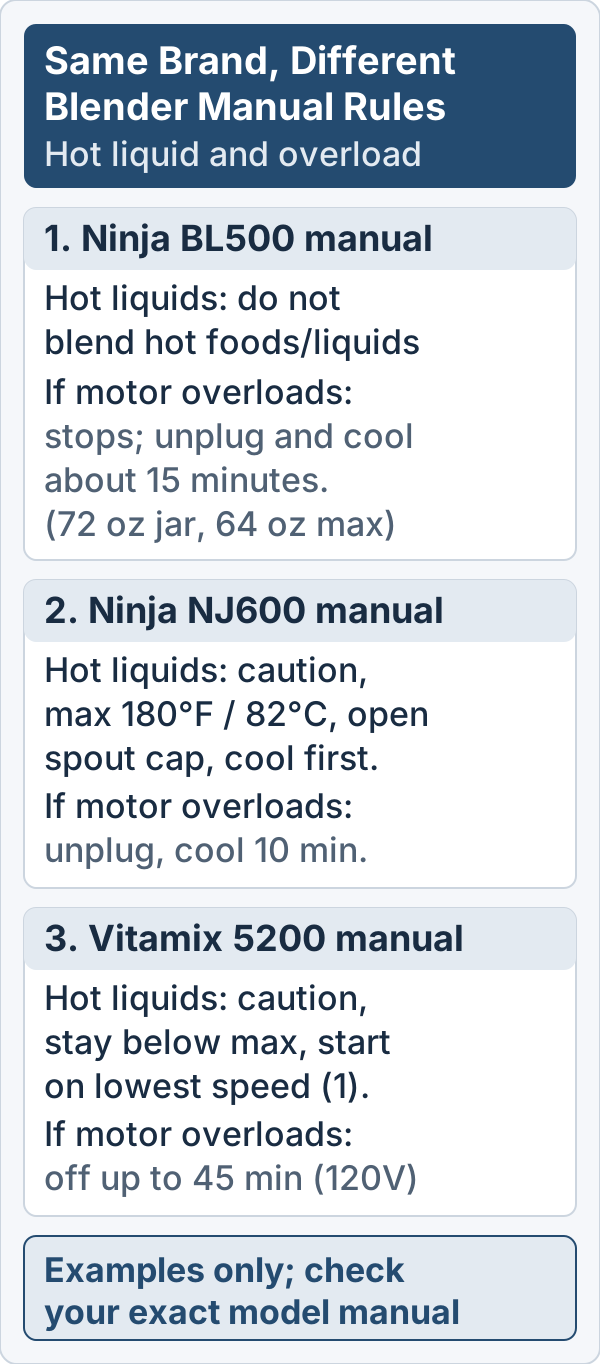
Check the manual of the exact model you will buy; these models are examples, not our picks except the Vitamix 5200 on our full shortlist.
Pick the format: countertop, personal, or high-power
Choose the format that matches how you prepare food before comparing motor figures.
| Format | Best fit | Typical strengths | What to verify before buying |
|---|---|---|---|
| Countertop pitcher blender | Multi-serving household batches | Full-size pitcher for smoothies, crushed ice, and sauces; often includes pulse or timed presets | Printed max-liquid line, under-cabinet height with the lid on, and exact manual rules for hot liquids |
| Personal / single-serve blender | One or two people making individual drinks | Blends directly in a to-go cup; fewer large parts to store | Whether the manual requires liquid with ice, and any prohibition on warm, hot, or carbonated liquids in a closed cup |
| High-power countertop blender | Frequent heavy-duty blending | Variable speed control and wide recipe support; the Vitamix 5200 Owner’s Manual lists juice, frozen mixtures, sauces, soups, purees, batters, and wet chopping | Higher upfront price, manual time limits on thick oil-based recipes, and counter clearance |
Related appliance choices
- If your priority is pureeing hot soup directly in the cooking pot, compare immersion blenders vs countertop blenders.
- If you want pulp-free extracted juice rather than whole-fruit smoothies, read blender vs juicer.
Wattage, ice, and frozen ingredients
A common mistake is assuming a higher wattage number automatically guarantees stronger blending or effortless ice crushing. Watts measure electrical input draw, not how effectively the pitcher geometry and blades move food through the jar.
Instead of relying on wattage alone, check what the exact model’s manual states for frozen loads and motor protection:
- Ice condition and loading rules: Even within the same brand, the manual gives specific instructions for ice. The Ninja Professional Blender BL500 Owner’s Guide instructs users: “Do not use ice that has been sitting out or has started to melt. Use ice straight from the freezer.” On personal-cup blenders (such as NutriBullet-style models), check the exact model’s manual before blending bare ice, as many personal cups require liquid to be added with ice.
- Thick mixtures and recipe time limits: High power does not remove operating rules. The Vitamix 5200 Owner’s Manual warns: “When making nut butters or oil-based foods, do not process for more than one minute after the mixture starts to circulate in the container. Processing for longer periods can cause dangerous overheating.”
- Overload and thermal reset procedures: Manuals specify different cool-down steps when a heavy load stalls or overheats the motor. In the Ninja BL500 Owner’s Guide, the motor stops if overloaded; for an overload or thermal reset, unplug the blender and let it cool for approximately 15 minutes. In the Ninja Professional Blender NJ600 Owner’s Guide, an internal thermal switch shuts off an overheated motor and resets after you unplug the unit and let it cool for approximately 10 minutes. In the Vitamix 5200 Owner’s Manual (also explained in the Vitamix Engineering FAQ), 120-volt machines require turning off the power switch for up to 45 minutes to reset the thermal protector.
Hot soups and hot liquids: check before you buy
Never assume two countertop pitchers from the same brand share the same hot-liquid rules, and never blend hot liquids without checking the exact model number’s manual first:
- Ninja BL500: The Ninja BL500 Owner’s Guide states: “CAUTION: DO NOT BLEND HOT FOODS OR HOT LIQUIDS.”
- Ninja NJ600: The Ninja NJ600 Owner’s Guide warns to exercise extreme caution when blending hot liquids, states “CAUTION: Do not process food or liquid that is hotter than 180°F / 82°C. Allow very hot ingredients to cool before processing,” and instructs users to open the pouring spout cap when processing hot liquids.
- Vitamix 5200: The Vitamix 5200 Owner’s Manual cautions that spray or escaping steam can cause scalding and burns, instructs users not to fill the container to maximum capacity, and states: “Always begin processing on the lowest speed setting, variable speed 1.” According to the Vitamix Engineering FAQ, the manufacturer also states that blade friction can bring cold soup ingredients to steaming hot in about six minutes.
- Unverified or sealed-cup models: Because we did not verify a primary PDF manual for the Ninja BN701 or for personal-cup models such as the NutriBullet Pro in this review, do not transfer BL500 or NJ600 rules to them. Always read the manual for your exact model number before blending warm or hot ingredients.
Capacity: printed size versus working fill
A frequent sizing mistake is reading the total container volume in a product title as the amount of liquid you can blend in one batch. Because liquids expand and aerate when blended, the usable maximum liquid fill line is lower than the total rim capacity:
- In the Ninja BL500 Owner’s Guide, the specifications list Pitcher Capacity: 72 oz. (9 cups, 2.1 L) alongside MAX Liquid Capacity: 64 oz. (8 cups, 1.9 L), with the rule: “When blending any kind of liquids, such as mixtures of any drinks or smoothies, do not exceed the ‘Max liquid’ mark (64 oz.) on the pitcher.”
- Buying the biggest pitcher is not always better for small batches. Wide pitchers need enough ingredients to cover the blades and circulate properly, so a household blending only one portion at a time is often better served by a personal cup or a dual system that includes both a pitcher and single-serve cups.
Presets, cleaning, and storage
Daily convenience comes down to three checks you can make before ordering:
- Program presets: Automated preset buttons (such as Auto-iQ programs on select Ninja models) combine timed pulses and pauses. They are worth paying for only if they match drinks you make regularly; if you blend one simple smoothie recipe, manual speed and pulse controls are enough.
- Blade and lid cleaning: Check how the blade assembly comes apart and whether the manual clears parts for the dishwasher. For example, the Ninja BL500 Owner’s Guide states that the pitcher, lid, and removable blade assembly are dishwasher-safe and recommends placing the lid and blades on the top rack, while warning to handle the loose blade shaft by its upper plastic post because the blades are sharp.
- Counter and cabinet storage: Measure the space between your countertop and upper cabinets against the assembled height listed on the product page. A tall pitcher sitting on its motor base may need to store with the pitcher beside the base or inside a deeper cupboard.
Is a cheap blender good enough?
At our September 2026 check on Amazon.com, the blenders on our US list ran from about $30 for basic entry-level models up to about $110 for a mid-range countertop pitcher and about $480 for a high-power blender (see our blender prices guide). On the budget end of our checks, the BLACK+DECKER 10-Speed Countertop Blender and the Bear Countertop Blender with Grinder were each around $30 at their June and September 2026 checks.
When a basic model around $30 can be enough
A low-cost blender can cover light routines when:
- You mainly blend soft fruit, yogurt, protein shakes, or light sauces in small batches.
- You follow the manual’s loading order and stay below the maximum liquid mark.
- If the blender struggles with frozen fruit or a thick mixture, you switch to a smaller permitted batch or add more liquid rather than repeatedly restarting a stalled motor.
When spending more makes sense
Stepping up to a mid-range or high-power model pays off when you need a larger working liquid fill, specific ice-crushing or hot-liquid permissions verified in the manual, timed preset programs, or longer warranty coverage. Before paying at any price tier, compare the complete purchase:
| Part of the purchase | Questions to ask before paying |
|---|---|
| Containers | How many jars or personal cups are included, what is the marked max-liquid line, and do travel lids come in the box? |
| Ice and frozen ingredients | Does the exact manual permit crushing ice cubes or frozen fruit, and does it require liquid in the jar first? |
| Cleaning | Are the pitcher, lid, and blade assembly top-rack dishwasher-safe in the manual, and are gaskets or stacked blades removable? |
| Counter space | Will the assembled base and jar fit under your cabinets, or do you have cupboard space for the pitcher and extra cups? |
| Warranty and returns | Who issues the warranty on the current Amazon.com listing, how long does coverage last, and what are the return terms? |
Pre-purchase checklist: mistakes and fixes
Run through these five checks on any listing before you buy:
| Common mistake | What to do instead |
|---|---|
| 1. Shopping by wattage alone | Read the manual’s permitted ingredients, batch limits, and thermal-reset rules instead of treating watts as a performance test. |
| 2. Assuming every blender takes hot soup | Check the exact model’s manual for hot-liquid prohibitions (such as the BL500 ban) or temperature caps and venting rules (such as the NJ600 180°F / 82°C limit). |
| 3. Reading total rim volume as liquid capacity | Size your batch to the printed max-liquid line (for example, 64 oz max liquid on a 72 oz Ninja BL500 pitcher). |
| 4. Expecting every jar to crush bare ice | Confirm whether the manual requires liquid with ice or calls for fresh freezer ice and a dedicated ice setting. |
| 5. Skipping dimensions, cleaning, and warranty | Check assembled height, dishwasher rules in the manual, and seller warranty terms on the Amazon.com listing before paying. |
Our practical pick: Ninja Professional Plus
If you want a mid-range countertop pitcher for a US kitchen, the Ninja Professional Plus Blender with Auto-iQ (≈ $110 when checked on September 26, 2026) is the main pick on our best blender in the USA guide. It pairs a full-size countertop pitcher format with listed Auto-iQ preset programs at a mid-tier price well below a high-power commercial-style machine. Before using it for hot ingredients or dishwasher cleaning, verify the exact instructions in the BN701 owner’s guide included with your unit, and skip it if you only want a compact single-serve cup blender.
See the Ninja Professional Plus price on Amazon ↗
Bottom line
Choose your blender in order: match the format (countertop pitcher, personal cup, or high-power machine) to your typical batch, verify the exact model’s manual rules for ice, hot liquids, and usable liquid fill, and pay extra only for capacity, presets, or warranty coverage you will actually use. To compare specific models and price tiers, visit our best blender in the USA shortlist, check blender prices in the USA, or browse the blenders hub. All prices are approximate at the date checked and change on Amazon.com.
About this guide
- Editing
- Mizaan Home editorial team
- Text revised
Research based on published specifications, without hands-on testing. How we choose
Prices are checked per product; the oldest check on this page:
This analysis is based on published information from Amazon.com, SharkNinja: Ninja Professional Blender BL500 Owner's Guide, SharkNinja: Ninja Professional Blender NJ600 Owner's Guide, Vitamix: 5200 Series Owner's Manual, Vitamix: Engineering FAQ, as of October 21, 2026.
Frequently asked questions
What is the most common mistake people make when buying a blender?
Chasing a high headline wattage number before checking whether the format, usable liquid fill mark, and exact manual rules match the drinks and recipes you actually make.
Does higher wattage always mean a better blender?
No. Wattage describes electrical power draw rather than guaranteed blending results on every ingredient. Real performance depends on pitcher geometry, blade design, and whether the model's manual permits your ingredients and batch size.
How do I know what size blender I need?
Size the blender to the batch you pour at one time, and compare the maximum liquid fill line rather than the total rim volume. On a Ninja BL500 pitcher, for example, total capacity is 72 oz (9 cups), while max liquid capacity is 64 oz (8 cups).
Is a cheap blender good enough?
Yes, for light tasks such as soft-fruit smoothies, protein shakes, and simple sauces when the manual permits your ingredients and you work within the container's fill limit. Spend more when you need a larger pitcher, verified ice-crushing or hot-liquid rules, preset programs, or a longer warranty.
Will a more expensive blender last longer?
Price alone does not guarantee how many years a blender will last. Lifespan depends on staying within the manual's permitted ingredients and batch rules, letting the motor cool if overloaded, and checking the written warranty terms.
What is worth paying extra for?
Pay extra only for verified capabilities you will use regularly: a full-size pitcher with a higher max-liquid mark, manual permission for your ice or hot-liquid recipes, timed preset programs, or longer warranty coverage.