
 Egypt
Egypt  UAE
UAE  USA
USA HEPA vs Ionizer Air Purifier: What's the Actual Difference
We may earn a commission from purchases through our links, at no extra cost to you. How we choose · Disclosure.
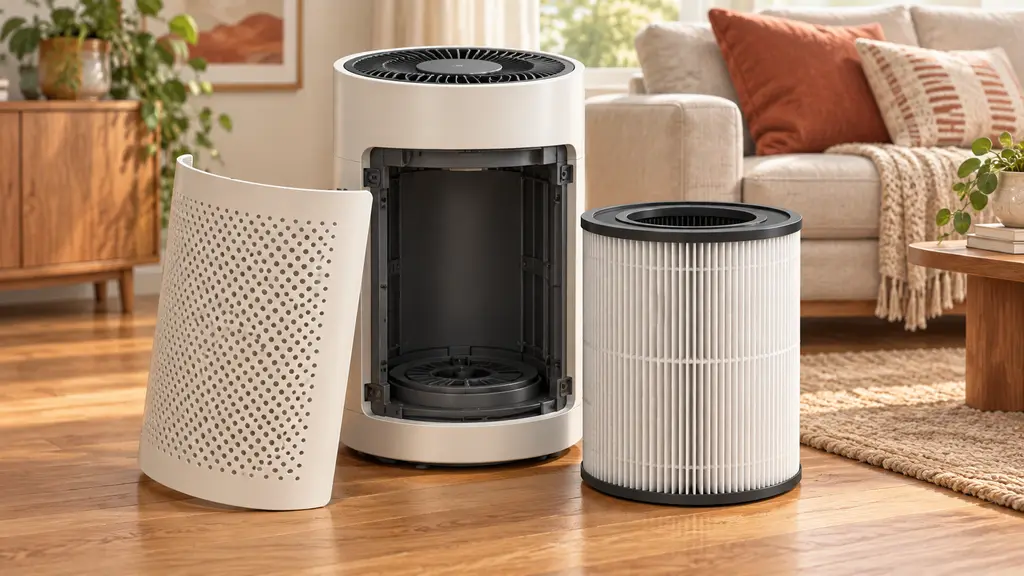
When you’re shopping for an air purifier you’ll see listings that mention a “HEPA filter” and others that mention “ionizing technology” or an “ionizer,” and a lot of buyers assume these do the same thing in two different ways. That’s not accurate: a filter physically traps particles inside the unit, while an ionizer electrically charges particles so they clump and fall out of the air, usually onto surfaces in the room rather than inside the unit. The difference matters directly if your complaint is Saudi dust and pollen.
The quick answer
A genuine HEPA filter pulls air through a dense mesh that physically traps fine particles inside the unit, so less comes out than went in. An ionizer traps nothing, it electrically charges particles so they clump and fall, usually onto your furniture and floor rather than into a filter basket. For Saudi dust and pollen, a genuine HEPA filter is the more reliable choice because it actually removes particles from the room instead of moving them from the air to another surface.
Key points
- A HEPA filter works by physical capture: a dense mesh traps fine particles as air passes through it (HEPA definition from US EPA).
- An ionizer works by electrical charging: it releases ions that attach to airborne particles, making them heavier so they fall, usually onto surrounding surfaces rather than inside the unit (air ioniser definition from US EPA).
- Particles an ionizer drops stay in the room, they’ve only moved from the air to a shelf or the floor, the opposite of what a filter does by actually trapping them out of circulation.
- Some cheaper ionizing units produce a small amount of ozone as a byproduct of the charging process, a health consideration worth checking when comparing models.
- The two can be combined in one unit, some air purifiers use a HEPA filter as the base and add an optional ionizing function, where the filter is doing the real removal work.
How a HEPA filter actually works
A genuine HEPA filter is rated specifically to capture a very high percentage of fine airborne particles as they pass through a dense mesh of fibers. Once a particle enters the unit and gets trapped in the filter, the air coming out the other side carries a measurably lower particle concentration. That means dust, pollen, and other allergens are actually removed from the air circulating in the room, not just moved from one place to another.
How an ionizer actually works
An ionizer releases negative or positive ions into the air, and these ions attach to airborne dust and smoke particles, giving them an electrical charge. The charged particles attract each other and clump into heavier clusters, which then fall out of the air faster than they would on their own. The catch is that this fallout usually lands on the nearest surface, a shelf, a table, or the floor, not inside the unit itself. The result is that the air might feel lighter temporarily, but the particles themselves are still in the room, they’ve just settled instead of floating.
Quick comparison table
| Factor | Genuine HEPA filter | Ionizer |
|---|---|---|
| How it removes particles | Physical capture inside the filter | Electrical charging that makes them fall onto surfaces |
| Where the particles end up | Trapped in the filter and replaced with it | Settled on room furniture and floors |
| Effectiveness on Saudi dust and pollen | High, backed by a rated capture spec | Partial, it relocates the problem rather than solving it |
| Possible side effect | None, a purely mechanical filter | Some cheaper models produce ozone |
| Maintenance cost | Periodic filter replacement | No filter, but real-world effectiveness is limited |
Which to choose for Saudi dust specifically
If your actual complaint is airborne dust, allergy symptoms, or frequent sneezing indoors, you need a unit that actually traps particles rather than moving them to another surface, and that’s what a genuine HEPA filter does. A unit like the LEVOIT Smart Wi-Fi Air Purifier (≈ 448 SAR) uses true HEPA-class filtration sized for a medium bedroom or living room, and carries thousands of positive reviews on Amazon.sa. Don’t assume every unit labeled “air purifier” on the box actually uses HEPA, check the listing before buying, especially if “ionizer” is listed as the main function instead of a filter.
See the LEVOIT Smart Wi-Fi Air Purifier price on Amazon.sa ↗
Bottom line
A HEPA filter actually traps particles out of air circulation, while an ionizer moves them from the air onto surrounding surfaces without truly removing them. For Saudi dust and pollen, a genuine HEPA filter is the more reliable choice and the easiest to explain in terms of measurable effectiveness. If you’re also weighing water-based filtration, see do water-based air purifiers actually work, and for a quick pick on the best unit overall, read the best air purifier in Saudi Arabia. For running a unit during an actual dust storm, see air purifier during a dust storm, and for the split between airborne and settled dust, read do air purifiers help with dust. For the full buying criteria, see our guide on how to choose an air purifier. For the full lineup, browse air purifiers in Saudi Arabia.
Sources
- US EPA, “What is a HEPA filter”, definition of high-efficiency particulate air filtration: https://www.epa.gov/indoor-air-quality-iaq/what-hepa-filter
- US EPA, “How ionizers work as air cleaners”, definition of ionizing technology and how it acts on airborne particles: https://www.epa.gov/indoor-air-quality-iaq/what-are-ionizers-and-other-ozone-generating-air-cleaners
This analysis is based on published information from US EPA (What is a HEPA filter), US EPA (How ionizers work as air cleaners).
Frequently asked questions
Does an ionizer clean the air as effectively as a HEPA filter?
Not in the same way. A HEPA filter physically traps particles inside the filter, so less comes out than went in. An ionizer traps nothing, it charges particles so they clump and fall, usually onto surfaces in the room rather than inside the unit. The particles move from the air to a shelf or floor, they aren't actually removed from the room.
Do ionizing air purifiers produce ozone?
Some cheaper models that rely on ionizing technology produce a small amount of ozone as a byproduct of the charging process. That's a health consideration worth checking before buying, especially if the unit will run for long hours in a bedroom.
Which is better for Saudi dust, HEPA or an ionizer?
A genuine HEPA filter is better for Saudi dust and pollen because it actually removes particles from air circulation, instead of moving them from the air onto furniture and floors the way an ionizer does. If your real complaint is airborne dust or allergy symptoms, this difference matters directly.
Is there a purifier that combines HEPA and an ionizer?
Yes, some air purifiers use a HEPA filter as the actual removal mechanism and add an optional ionizing function you can switch on or off. In that case, the filter is doing the real removal work, and ionizing is an optional extra, not the basis of the cleaning.