
 Egypt
Egypt  UAE
UAE  USA
USA Do Water-Based Air Purifiers Actually Work? Versus a HEPA Filter
We may earn a commission from purchases through our links, at no extra cost to you. How we choose · Disclosure.
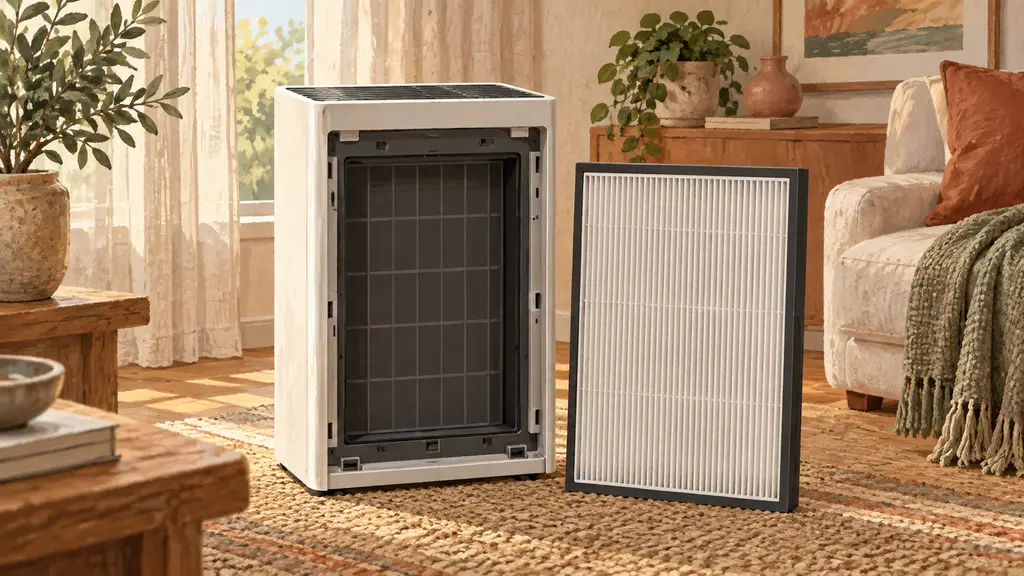
Water-based air purifiers are sold locally as a “natural” alternative with no filters to replace, but the real difference is simple: these units usually carry no HEPA rating and no comparable CADR figure, while a genuine HEPA filter is officially rated for the percentage of fine particles it captures. If your problem is specifically Saudi dust, that difference matters directly before you buy.
The quick answer
A water-based air purifier passes air through a water basin or a fine mist, and usually carries no official HEPA rating and no CADR figure comparable to standard units. It adds humidity to the room and may release a scent if you add essential oils to the water, but its actual performance at capturing fine dust and pollen isn’t proven with the same clarity as a genuine HEPA filter. For Saudi dust specifically, an officially rated HEPA filter is the more reliable choice.
Key points
- Water-based units work on a completely different principle from a filter: air passes through water or a fine mist instead of a dense filter mesh.
- Most water-based units don’t publish a CADR figure or an official HEPA rating, which makes comparing their real performance to a standard filter unit difficult or impossible from the listing alone.
- These units add humidity to the air, which can genuinely help in a room made very dry by constant AC use, but that’s a humidity side effect, not proof of removing particles.
- The water reservoir needs frequent, regular cleaning, since standing water is a suitable environment for bacteria or mold if left for days without changing.
- A genuine HEPA filter is officially rated for the percentage of fine airborne particles it captures, a figure that’s comparable across models (HEPA definition from US EPA).
How a water-based air purifier actually works
This type works by passing air through a small water basin or a spinning disc that wets the air moving through it, sometimes with an added mist. The marketing idea is that particles “stick” to the water instead of passing through, but this is a much weaker physical principle than a dense filter mesh specifically designed to block fine particles. Most of these units are functionally closer to a humidifier with a marketed cleaning extra, not a genuine air purifier that substitutes for a real filter.
Why their real effectiveness is hard to verify
The biggest difference is the lack of a measurable figure. A genuine HEPA filter comes with an official rating for the percentage of particles of a given size it captures, a number you can confidently compare across models. Water-based units rarely publish anything similar, so the buyer relies on the marketing claim alone with no real way to verify performance against actual fine dust. That doesn’t mean the unit is completely useless, but it does mean you’re buying with far less certainty than you would with an officially HEPA-rated filter unit.
Quick comparison table
| Factor | Water-based purifier | Genuine HEPA filter unit |
|---|---|---|
| Cleaning mechanism | Passes air through water or a mist | Physical capture through a dense filter mesh |
| Official, comparable rating | Rarely published | Yes, a defined capture rate and often a CADR figure |
| Side effect | Raises room humidity | Doesn’t change humidity |
| Maintenance | Frequent water reservoir cleaning to prevent bacteria growth | Periodic filter replacement based on runtime |
| Reliability for Saudi dust | Not proven with official figures | Proven with an official rating and wide buyer review consensus |
Which should you actually choose
If your real problem is fine dust, pollen, or allergy symptoms, a genuine HEPA-class filter unit is the choice backed by an official figure that proves its performance, not just a marketing claim. A unit like the LEVOIT Smart Wi-Fi Air Purifier (≈ 448 SAR) carries true HEPA-class filtration sized for a medium bedroom or living room, and thousands of positive reviews on Amazon.sa confirm its real-world performance. If your main goal is actually raising the humidity in a room made very dry by AC, that’s a completely different reason worth thinking about separately from a dust problem.
See the LEVOIT Smart Wi-Fi Air Purifier price on Amazon.sa ↗
Bottom line
A water-based air purifier passes air through water or a mist with no official figure proving its effectiveness against fine particles, and it needs frequent reservoir cleaning to avoid bacteria growth. A genuine HEPA filter comes with an official, comparable rating, making it the more reliable choice for Saudi dust and pollen specifically. If you’re also weighing ionizing technology, see HEPA vs ionizer air purifier, and for a quick pick on the best genuine filter unit, read the best air purifier in Saudi Arabia. For running a unit during an actual dust storm, see air purifier during a dust storm, and for the split between airborne and settled dust, read do air purifiers help with dust. For the full buying criteria, see our guide on how to choose an air purifier. For the full lineup, browse air purifiers in Saudi Arabia.
Sources
- US EPA, “What is a HEPA filter”, definition of high-efficiency particulate air filtration and its official rating: https://www.epa.gov/indoor-air-quality-iaq/what-hepa-filter
This analysis is based on published information from US EPA (What is a HEPA filter).
Frequently asked questions
Do water-based air purifiers actually clean dust?
Usually not as effectively as a genuine HEPA filter. A water-based unit passes air through a water basin or a fine mist, and rarely publishes an official capture rating for fine particles, while a HEPA filter comes with an official, comparable rating. If your problem is genuinely fine dust, a HEPA filter is the more reliable choice.
Do water-based air purifiers raise the humidity in a room?
Yes, that's an expected side effect of passing air through water or a mist. This can genuinely help in a room that's very dry from constant AC use, but it isn't proof of removing dust or pollen, raising humidity and filtering particles are two entirely different processes.
Do water-based air purifiers need frequent cleaning?
Yes, more than a standard filter unit. The water reservoir is a suitable environment for bacteria or mold growth if left for days without changing or cleaning, so regular maintenance here isn't optional, it's necessary for safe use.
Which is better for Saudi dust, a water-based unit or a HEPA filter?
A genuine HEPA filter is better for Saudi dust and pollen specifically, because it comes with an official, comparable rating that proves its fine-particle capture rate. A water-based unit is closer to a humidifier with a marketed cleaning function, not a proven substitute for a genuine filter.