
 Egypt
Egypt  UAE
UAE  Saudi Arabia
 How Long Does an Air Purifier Last?
We may earn a commission from purchases through our links, at no extra cost to you. How we choose · Disclosure.
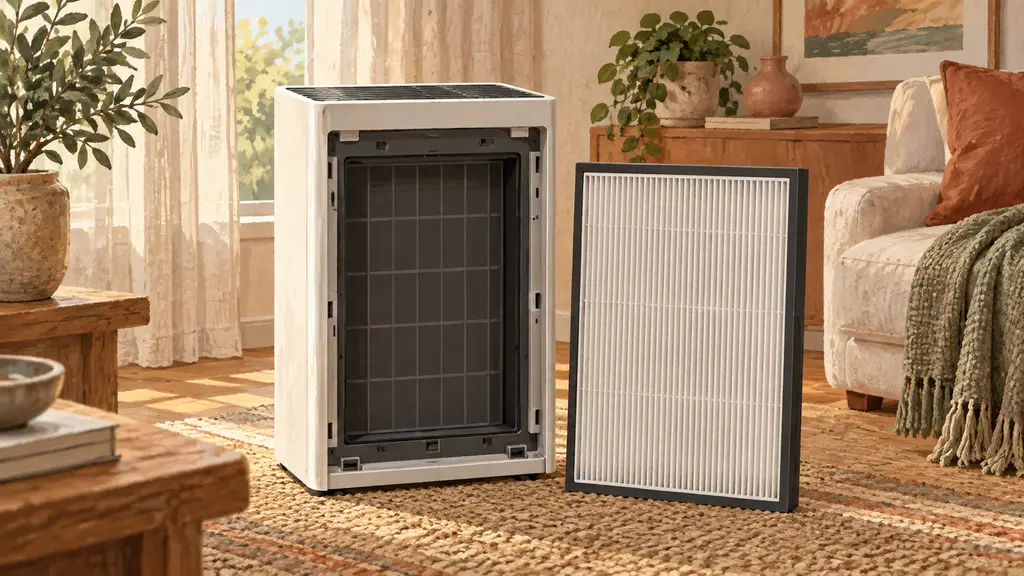
Most air purifiers are built to run for several years of regular use, but the purifier and the filter wear out on very different timelines. The filter is a consumable you replace every few months regardless of the unit’s age, while the motor and housing are what actually decide how many years the whole unit lasts.
The quick answer
Most air purifiers are built to run for several years of regular use, but “the purifier” and “the filter” wear out on very different timelines: the filter is a consumable you replace every few months regardless of the unit’s age, while the motor and housing are what actually determine how many years the whole unit lasts. Running it continuously in a dusty or smoky environment shortens both timelines, and buying a reputable, well-reviewed model is the best hedge against an early failure.
Key takeaways
- The filter and the unit are on two separate clocks. The filter needs replacing every few months per the manufacturer’s schedule, the motor and housing are what determine the unit’s actual multi-year lifespan.
- Ignoring the filter schedule doesn’t extend the unit’s life. It just means dirtier air, weaker filtration, and more strain on the motor as it works to pull air through a clogged filter.
- Heavy, continuous use in a dusty, smoky, or pet-heavy home shortens both timelines compared to lighter, occasional use in cleaner air.
- Review consensus is a better longevity signal than the spec sheet. A spec sheet can’t show you how a motor holds up after a couple of years of daily use, but thousands of consistent reviews over time can.
- A true HEPA filter is the part actually doing the filtering work (HEPA definition from US EPA), so a unit that makes filter swaps easy and affordable is easier to keep running well for its full lifespan.
What actually wears out first
The part that ultimately ends an air purifier’s life is almost always the motor and fan assembly, the components that run continuously, sometimes around the clock, for years. Housing plastic and controls rarely fail on their own. It’s the moving parts, the fan bearing and motor, that accumulate wear from constant operation, and that wear is what eventually shows up as unusual noise, weaker airflow that a filter change doesn’t fix, or the unit simply not turning on.
The filter is a separate clock, not a lifespan indicator
It’s easy to assume that replacing the filter regularly is what “maintains” the unit’s lifespan, but the filter and the unit are really on two different schedules. The filter needs swapping every few months regardless of how new the purifier is, that’s just how a consumable filter media works as it accumulates trapped particulates. Skipping the swap doesn’t damage the motor directly, but it does mean the motor has to work harder pulling air through a clogged filter, and it means you’re breathing dirtier air in the meantime. Treat the filter schedule as routine upkeep, not as a sign the whole unit is wearing out.
How usage pattern changes the timeline
A unit running nonstop in a home with pets, wildfire smoke seasons, or heavy dust is doing meaningfully more work than one running occasionally in a home with generally clean air. That heavier duty cycle accelerates wear on both the filter (which clogs faster) and the motor (which runs more total hours). This isn’t a reason to run it less if you actually need the filtration, it’s a reason to budget for filter swaps on a shorter cycle and to expect the unit itself to show its age sooner than a lightly used one would.
Typical lifespan by component
| Component | Typical replacement interval | What shortens it |
|---|---|---|
| Pre-filter (mesh or foam) | Rinse or vacuum every few weeks | Heavy pet hair, dust, wildfire smoke seasons |
| True HEPA filter | Every few months, per the manufacturer’s manual | Continuous heavy use, ignoring the swap schedule |
| Motor and housing | Multiple years of regular use | Nonstop round-the-clock running, airflow blocked by a neglected filter |
Buying for longevity: what actually matters
Since the spec sheet won’t tell you how a motor holds up after two or three years, the best signal available before you buy is the consensus of buyer reviews over time. A model like the LEVOIT Core 200S-P (≈ $75) carries thousands of positive reviews on Amazon.com, which is a reasonable proxy for real-world reliability that a features list alone can’t show you. It’s a compact, simple design too, fewer moving parts and a straightforward control panel tend to hold up well over years of daily use.
See the LEVOIT Core 200S-P price on Amazon ↗
Bottom line
An air purifier’s lifespan really comes down to two separate questions: how long the filter lasts before it needs swapping (a few months, regardless of the unit’s age) and how long the motor and housing last before they wear out (several years of regular use, shortened by continuous heavy-duty running). Keep up with the filter schedule, don’t run it harder than your room actually needs, and lean on review consensus rather than the spec sheet when judging whether a model is a good long-term buy. To keep it running its full lifespan, see how to clean an air purifier, and if you’re still deciding whether the cost is worth it in the first place, read is an air purifier worth it. For the full buying criteria, see our guide to choosing an air purifier, and if you’re still shopping, check out the best air purifier in the USA or browse air purifiers in the USA.
Sources
- US EPA, “What is a HEPA filter”, definition of high-efficiency particulate air filtration and the filter media the motor pulls air through: https://www.epa.gov/indoor-air-quality-iaq/what-hepa-filter
This analysis is based on published information from US EPA (What is a HEPA filter).
Frequently asked questions
How many years does an air purifier usually last?
The motor and housing on a well-built unit are generally designed for several years of regular use, well beyond any single filter's life. The honest caveat is that this depends heavily on how continuously you run it and how dusty or smoky the environment is, so treat any number as a rough guide, not a guarantee.
Does the filter need to be replaced sooner than the whole unit?
Yes, and by a wide margin. The filter is a consumable that needs swapping every few months per the manufacturer's schedule regardless of how new or old the unit is, while the motor and housing are what actually determine the unit's overall lifespan. Don't confuse a filter swap with the unit reaching the end of its life.
Does running an air purifier 24/7 wear it out faster?
Continuous use in a dusty, smoky, or pet-heavy environment puts more strain on both the filter and the motor than occasional, seasonal use in cleaner air. It doesn't mean you shouldn't run it continuously, that's often exactly when it's doing the most good, just budget for filter swaps on a shorter cycle if your air quality is consistently poor.
What are the signs an air purifier is reaching the end of its life?
Reduced airflow that a fresh filter doesn't fix, unusual grinding or rattling noise from the motor, and a noticeably weaker effect on smells or dust even right after a filter swap are the main signs. If a fresh filter doesn't restore performance, the issue has likely moved from the filter to the unit itself.