
 UAE
UAE  Saudi Arabia
  USA
USA Air Fryer vs Oven: Which One Is Right for Your Kitchen?
We may earn a commission from purchases through our links, at no extra cost to you. How we choose · Disclosure.
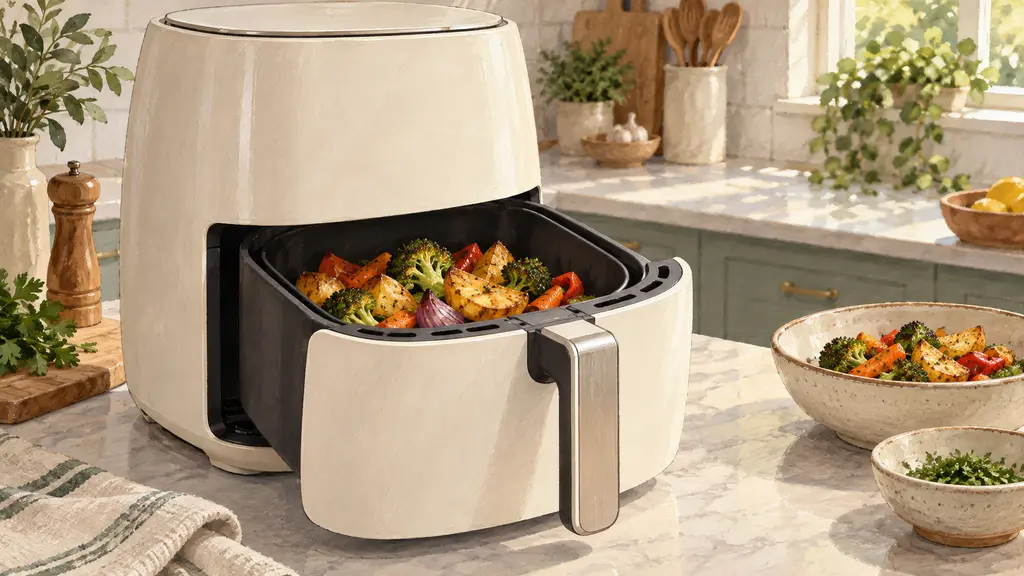
If you’re thinking of buying an air fryer, you’ve probably asked the obvious question: I already have an oven, so what does this do that the oven doesn’t? And the reverse is just as common, plenty of people ask whether an air fryer can replace the oven entirely. The truth is that the two work on almost the same principle, but practical differences in speed, capacity, and electricity make each one better suited to certain situations. Let’s break it down with the numbers and the logic, no spin.
The quick answer
An air fryer is essentially a miniature, fast convection oven, not a different technology. It wins on speed, electricity savings, and crispiness for smaller meals, while the oven wins on capacity, baking, and large batches. So it isn’t “better than” the other, each has its job, and most homes benefit from having both.
Key takeaways
- An air fryer and an oven work on the same principle: convection. Both push hot air over the food with a fan, and the difference is size and speed, not technology (air fryer definition from University of Nebraska-Lincoln Extension).
- An air fryer heats and cooks faster because its chamber is much smaller, so the hot air circles the food more densely over a shorter distance (convection oven background from Britannica).
- An air fryer needs far less oil to reach crispiness close to frying, which is its main health advantage over deep frying (air fryer from University of Nebraska-Lincoln Extension).
- The oven wins on capacity: multiple trays, multiple racks, and large quantities at once, something a small air fryer can’t do.
- For small meals the air fryer is cheaper to run, but if you’re filling a full oven, the oven becomes more efficient because you cook everything in one go.
How does an air fryer actually work?
An air fryer isn’t magic and it doesn’t fry with air, the name is a little misleading. At its core it’s a small convection oven: there’s a heating element and a fan that pushes hot air quickly around the food in a tight basket or drawer. Because the space is small, the hot air circles the food densely and from every direction, so the surface dries, browns, and crisps quickly with very little oil, or none at all.
This is exactly the same principle as a convection oven with a fan, just on a much smaller scale and at higher air speed. That’s why the result is closer to frying in terms of crispiness, without the volume of oil that deep frying needs.
A regular oven vs a convection oven: there’s a difference
Before we compare, it helps to separate two types of oven:
- A regular (conventional) oven: heats with top and bottom elements and no fan, so heat spreads slowly and can be uneven, and preheating takes time.
- A convection oven: has a fan that distributes the hot air, so it cooks faster and more evenly, and this is the closest type to an air fryer in how it works.
So if your oven has a “fan” or “convection” mode, you effectively already own a larger, slightly slower version of an air fryer. The main remaining difference is size and speed.
The head-to-head: air fryer vs oven
So you can see the full picture in one place:
| Factor | Air fryer | Oven (conventional / convection) |
|---|---|---|
| Speed and heating | Faster, near-instant heating | Slower, needs preheating |
| Capacity | Limited (roughly 4 to 7L) | Large, multiple trays and racks |
| Crisp with little oil | Excellent, its main strength | Good with a fan, less concentrated |
| Baking and cakes | Limited, less space and stability | Best, even space and heat |
| Electricity for a small meal | Usually cheaper | Higher to run a large chamber |
| Electricity for a large batch | Needs multiple rounds | More efficient, all at once |
| Cleaning | Small basket, easy to wash | Larger, takes longer |
The takeaway from the table: the air fryer wins on speed, small meals, crispiness, and cleaning, while the oven wins on capacity, baking, and large batches. There’s no absolute “winner”, just whichever fits the situation.
What is the air fryer best for? And the oven?
Choose the air fryer if:
- You cook for one person or a small family and want speed on everyday meals.
- You love crispiness (fries, chicken, frozen foods) with the least oil possible for health reasons.
- Your kitchen is small, or you want to save electricity on quick meals without firing up a full oven.
Stick with the oven if:
- You bake bread, cakes, or pastries that need space, even heat, and stability.
- You host gatherings and cook large quantities and trays at once.
- You need to cook more than one item on different racks at the same time.
In reality, most Egyptian homes don’t choose “one instead of the other”, they use both: the air fryer for fast everyday cooking, and the oven for volume and baking. If you’re still unsure whether to get an air fryer at all, read is an air fryer worth it?.
So how do I choose an air fryer if I decide to get one?
The first thing to settle is the right capacity for your family size, because it affects everything else. A smaller capacity is enough for one or two people, while 6 to 7L suits an average family. If you want to understand the capacity ranges in detail, see our air fryer sizes guide, and if electricity is your main concern, see air fryer electricity cost.
A practical example of an air fryer that covers most homes: the Philips Essential XL HD9270 at 6.2L and 2000W. That capacity feeds a family of 4 to 6, it heats faster than a conventional oven and crisps nicely with less oil, and it comes with Philips’ reach, warranty, and agent in Egypt. We didn’t recommend it as a “replacement for the oven”, we recommended it because it covers fast everyday cooking with a good balance of capacity, power, and reliability, which is what puts it at the top of our guide to the best air fryer in Egypt. You’ll find its current price and the Noon link in the card below.
Bottom line
The air fryer and the oven aren’t rivals, they’re teammates in the kitchen that complement each other. The air fryer is a small, fast convection oven that wins on everyday meals, crispiness, and electricity savings for small quantities, while the oven wins on capacity, baking, and gatherings. If you’re getting an air fryer, focus on the right capacity for your family first, and remember it complements rather than replaces. For the step-by-step details, see our guide on how to choose an air fryer, and browse the available options in our air fryers section.
Sources
- University of Nebraska-Lincoln Extension, “How air fryers work”, definition of the air fryer as a miniature convection oven that cooks with hot air and little oil: https://food.unl.edu/free-resources/newsletters/food-safety-tips-electric-air-fryers/
- Britannica, “Convection”, explanation of the convection oven and the fan that distributes hot air for faster, more even cooking: https://www.britannica.com/science/convection
This analysis is based on published information from University of Nebraska-Lincoln Extension (How air fryers work), Britannica (Convection).
Frequently asked questions
What's the main difference between an air fryer and an oven?
An air fryer is essentially a small, fast convection oven: a fan circulates hot air around the food in a tight space, so it cooks faster and crisps with less oil. A regular oven is much larger, so it takes longer to heat up but fits trays and bigger batches.
Does an air fryer actually save electricity?
For small and medium meals, usually yes. Because the chamber is smaller and heats up faster, it finishes sooner and draws less power than running a big oven for a few pieces. But if you're cooking a large batch that would fill the oven, the oven is more efficient because you cook everything at once.
Does an air fryer taste the same as an oven?
Some foods come out better, and the oven wins on others. The crispiness of fries, chicken, and frozen foods is excellent and faster in an air fryer. But for bread, cakes, and recipes that need space and even, stable heat, the oven comes out ahead.
Can an air fryer fully replace an oven?
For most homes, no, it complements rather than replaces. It covers fast everyday cooking for one person or a small family, but big gatherings, large trays, and baking still need the oven. Many homes use both: the air fryer for speed and the oven for volume.