
 UAE
 Saudi Arabia
 USA
How to Choose a Stand Mixer in Egypt
Choose a stand mixer by recipe quantities, dough limits, tools and kitchen space. Check the exact model manual and warranty instead of filtering by watts.
We may earn a commission from purchases through our links, at no extra cost to you. Full disclosure.
Check price on Amazon.eg See all picksVerdict: Compare the Kenwood Homebake KHH01 by its permitted recipes, tools and space requirements. Its current card was checked at about 7,597 EGP on October 11, 2026; 1400W does not by itself establish dough performance.
Our picks
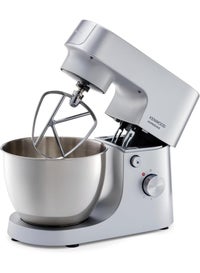
Kenwood Homebake KHH01.000SI (5L, 1400W)
Kenwood
Approx. price when checked: 7,597 EGP (as of October 2026)
Advantages
- Listed stainless-steel bowl
- Whisk, beater and dough hook listed
Before you buy
- Confirm recipe and operating limits for this exact Homebake model
- Do not transfer limits from MultiOne or other Kenwood ranges
Price checked: 11 October 2026
Choose a stand mixer around a recipe and quantity you actually make. Before buying, find the matching model’s table of permitted quantities, speeds and operating times. Bowl size and input power are useful labels, but they do not replace those limits.
Which stand mixer buying mistakes should I avoid?
Avoid choosing by wattage or price alone. Write down the kind of baking you do and the flour and total dough weights, then compare them with the exact model’s capacity table. Check the smallest batch suitable for the whisk as well as the maximum dough load, required tool, speed and run/rest limits. A dough hook or planetary action does not guarantee that every recipe is suitable. Measure the space with the head raised and allow room to remove the bowl and store the tools. Ask for written warranty terms and compatible replacement parts before paying. On a tight budget, shortlist machines that permit your actual recipes rather than assuming the cheapest is enough or that a higher price guarantees savings on repairs.
Write down three recipes and their quantities
For bread, record flour weight, total dough weight and the recipe’s water proportion. For cake or cream, note your smallest and largest batches. Compare the required tool and permitted quantity for each recipe. Higher input power is not automatic evidence of greater torque or smoother dough.
Liters describe bowl volume, not dough weight. For example, Kenwood’s MultiOne KHH300WH specification separates its 4.3L bowl from a 500g flour and 800g total dough limit. This illustrates how to read a specification; these are not the limits of the other mixers in our shortlist.
The existing Kenwood Homebake KHH01.000SI card was checked at about 7,597 EGP on October 11, 2026. Its 5L bowl and 1400W label do not establish its flour or total dough limit. Obtain the matching manual before selecting it for your recipes.
Check the tools and mixing design
A whisk, flat beater and dough hook serve different tasks. Confirm that the tool you need is in the exact bundle, how it attaches and how it must be cleaned. A hook does not permit an unlimited dough load, and planetary action does not mean a recipe can never require stopping and scraping the sides.
Distinguish a full stand mixer from a hand mixer mounted on a stand using the design, tools and operating instructions. A listing title or model-code prefix alone is insufficient. Some tools have limited dough uses; the actual recipe limits decide suitability.
Measure the space in your kitchen
Measure the machine closed and with its head raised, including room to remove the bowl. If it will live in a cupboard, consider its weight and how you would lift it. On the counter, allow the clearance and ventilation required by its instructions. Do not infer noise from a metal body or weight alone.
Ask about warranty and replacement tools
Ask which service provider covers the model in Egypt, what proof of purchase is required and whether its bowl, hook and whisk are available as matching replacement parts. An international-warranty claim does not identify a local service route. A paid protection plan is also different from a manufacturer’s warranty.
Questions to settle before payment
| Your requirement | Evidence to check |
|---|---|
| Bread batch | Clear flour and total dough limits for the recipe type |
| Consecutive batches | Specified operating and rest periods |
| Small batches | Minimum quantity suitable for the tool |
| Attachments | Exact box contents and compatibility of extras |
| Cleaning | Instructions for each part, especially dishwasher use |
Compare the stand-mixer shortlist and dated prices. Compare the actual model and offer rather than assuming every model from a brand shares the same capabilities.
For narrower decisions, read mixer sizes, choosing for a small kitchen and whether a mixer is worth buying. The Kenwood and KitchenAid comparison helps frame model-specific questions.
About this guide
- Editing
- Mizaan Home editorial team
- Text revised
Research based on published specifications, without hands-on testing. How we choose
Prices are checked per product; the oldest check on this page:
This analysis is based on published information from Kenwood: MultiOne KHH300WH capacity example.
Frequently asked questions
How many watts should a stand mixer have?
There is no universal wattage threshold that guarantees suitable kneading. Compare the recipe, tool, permitted quantity, speed and run/rest instructions.
Can I choose bowl size by liters alone?
No. Check flour and total dough limits, plus the smallest batch suitable for the tool.
Does a metal body prove the mixer is quieter or stronger?
No. Weight and material alone do not verify noise or torque. Use model-specific specifications or measurements.
How do I distinguish a stand mixer from a hand mixer on a stand?
Check the design, tools, instructions and recipe limits. The product name or model-code prefix alone is insufficient.