
 UAE
UAE  Saudi Arabia
  USA
USA Air Fryer Disadvantages: What to Know Before You Buy
We may earn a commission from purchases through our links, at no extra cost to you. How we choose · Disclosure.
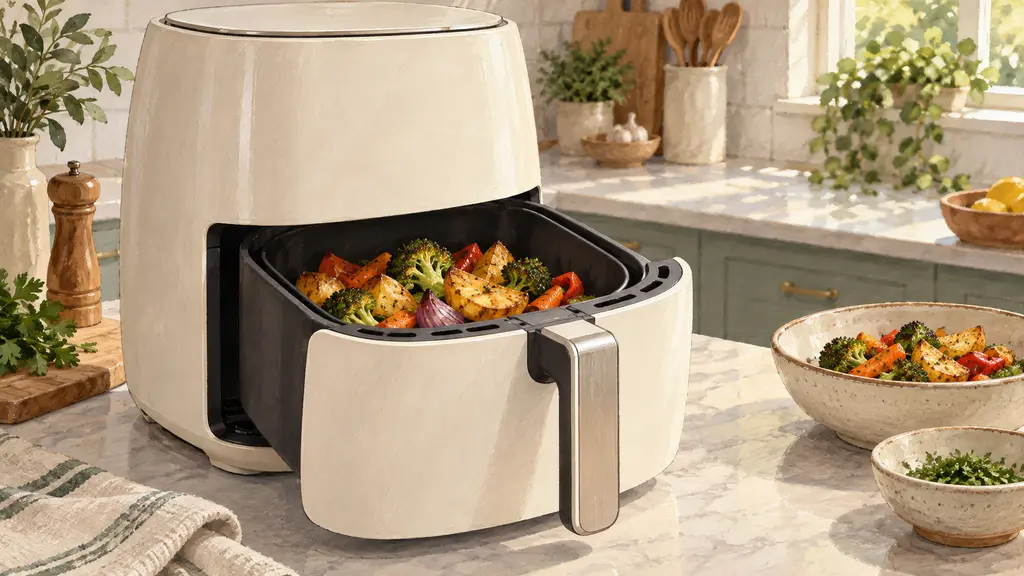
The air fryer does not have major disadvantages that should stop you from buying one, but it has real limits worth knowing first: capacity is limited if your family is large, food will not taste exactly like deep-fried food, there is fan noise while it runs, and it needs cleaning after every use. These downsides are minor next to the benefit, and most of them get solved simply by picking the right capacity and model.
The quick answer
The air fryer has 4 real downsides, no more: limited capacity that needs to match your family size, a texture and taste that differs a bit from deep-fried food, noticeable fan noise while it runs, and cleaning that needs to happen after every use. If you pick the right capacity and power for your home from the start, these downsides matter far less and the time and health payoff is much bigger.
Key takeaways
- An air fryer works by convection, not by submerging food in oil, so the final texture is crisp outside and tender inside, not the same as the heavy, oily crispness you get from deep frying (air fryer definition from University of Nebraska-Lincoln Extension).
- Capacity genuinely matters for the number of people you feed: around 4L is enough for one or two people, while a family of 4 to 6 needs 6 to 7L or more so you are not cooking in multiple batches.
- The fan makes noise the whole time it runs, not as loud as a blender but noticeable in a quiet kitchen or one that opens onto a living room.
- Liquid or batter-based food does not work in an air fryer because it is built for food with a fixed shape that needs hot air to circulate around it, unlike a deep fryer, which works on a completely different principle (deep fryer background from Britannica).
- Cleaning after every use is necessary to avoid smoke and smell, which is a bit more effort than leaving a regular frying pan in the sink.
Taste and texture differ from deep frying
An air fryer rapidly circulates hot air around the food instead of submerging it in a deep pool of oil, so the result is a light crisp outside and a tender inside, but it is not the same heavy, oily crispness you get from a deep fryer. If you are hoping for the exact taste of deep-fried fries, you will notice the difference. The practical fix is a light spray of oil on the food before it goes in, which brings the texture closer to deep-fried without needing anywhere near the amount of oil a deep fryer requires.
Limited capacity: size it to your family, not the unit
The most common complaint is that the air fryer is “too small” and needs more than one batch. The problem is not the air fryer itself, it is buying a capacity smaller than you need. If you live alone or as a couple, around 4L is enough, but a family of 4 to 6 should look for 6 to 7L, like the Philips Essential XL or the Kenwood HFM80, or you will end up cooking half the meal and waiting on a second batch. If you regularly cook two different dishes together, a dual-basket model solves this problem outright.
Fan noise and counter space
An air fryer runs a fan the entire time it cooks, which produces a steady hum, not as loud as a blender but noticeable if your kitchen is quiet or opens onto a living room. Its size also takes up a fixed spot on the counter, especially larger or dual-basket models. If your kitchen space is tight, this is a real factor to weigh when comparing models.
Cleaning is extra effort, but simple once you know how
The oil and crumbs that fly up inside the basket need washing after every use, or you will get smoke and smell the next time. That is genuinely more effort than leaving a regular pan in the sink, but it only takes a couple of minutes with a model that has removable parts and a good non-stick coating. Read our full guide to cleaning an air fryer for the step-by-step.
Not every food suits an air fryer
Runny batter, dough, and soup will not work in an air fryer because it is built for food with a fixed shape that needs hot air circulating around it to cook. If you need to cook liquid dishes or roast a whole large cut of meat, an oven or stovetop is still the better fit.
The air fryer that cuts these downsides
Not all of these downsides carry equal weight, and some models reduce their impact clearly:
| Downside | Real impact | How to reduce it |
|---|---|---|
| Limited capacity | Cooking in batches if the family is large | Pick a 6 to 7L model instead of 3 to 4L |
| Different taste than deep frying | Lighter crisp, but less oil | A light spray of oil before cooking |
| Fan noise | Noticeable in a quiet kitchen | Place it away from seating areas while it runs |
| Cleaning after every use | More effort than a regular pan | A model with removable parts and non-stick coating |
| Not suited to every food | Liquids and batters do not work | Use an oven or stovetop for those |
A practical example from our shortlist: the Philips Essential XL HD9270 at 6.2L solves the limited-capacity problem for a family of 4 to 6, and its removable parts make cleaning faster, backed by Philips’s reach and warranty in Egypt. We did not pick it for being flawless, we picked it because it cuts the impact of the most common downsides, which is why it tops our guide to the best air fryer in Egypt.
Bottom line
Air fryer disadvantages are real but minor: capacity needs to be sized correctly, the taste differs a bit from deep frying, fan noise is noticeable, and cleaning is needed after every use. None of them is reason enough to skip buying one if you genuinely need it. If you are still torn on the purchase itself, read is an air fryer worth it?, and if you are deciding between a cheap model and a pricier one see is a cheap air fryer worth it?, or head back to our guide on how to choose an air fryer or browse our air fryers section.
Sources
- University of Nebraska-Lincoln Extension, “How air fryers work”, definition of the air fryer and how convection cooking works: https://food.unl.edu/free-resources/newsletters/food-safety-tips-electric-air-fryers/
- Britannica, “Traditional deep-fat frying”, background on deep frying and how its principle differs from an air fryer: https://www.britannica.com/topic/deep-frying
This analysis is based on published information from University of Nebraska-Lincoln Extension (How air fryers work), Britannica (Traditional deep-fat frying).
Frequently asked questions
Does an air fryer use oil?
An air fryer needs very little oil, sometimes none at all for foods with natural fat, but a light spray on drier foods like potatoes improves crisping and gets closer to a deep-fried texture.
Does air fryer food taste like deep-fried food?
Close but not identical. Convection cooking gives a lighter, less oily crisp than a deep fryer's heavy crust, since it circulates hot air instead of submerging food in oil.
Is the smaller capacity actually a problem?
Only if you buy the wrong size. Around 4L works for one or two people, while a family of 4 to 6 needs 6 to 7L or more, otherwise you will end up cooking in batches.
Is an air fryer loud?
It has a fan running the whole time it cooks, which produces a steady hum, noticeably quieter than a blender but audible in a quiet kitchen.