
 UAE
UAE  Saudi Arabia
  USA
USA How Many BTU Does a Portable AC Need for Your Room?
We may earn a commission from purchases through our links, at no extra cost to you. How we choose · Disclosure.
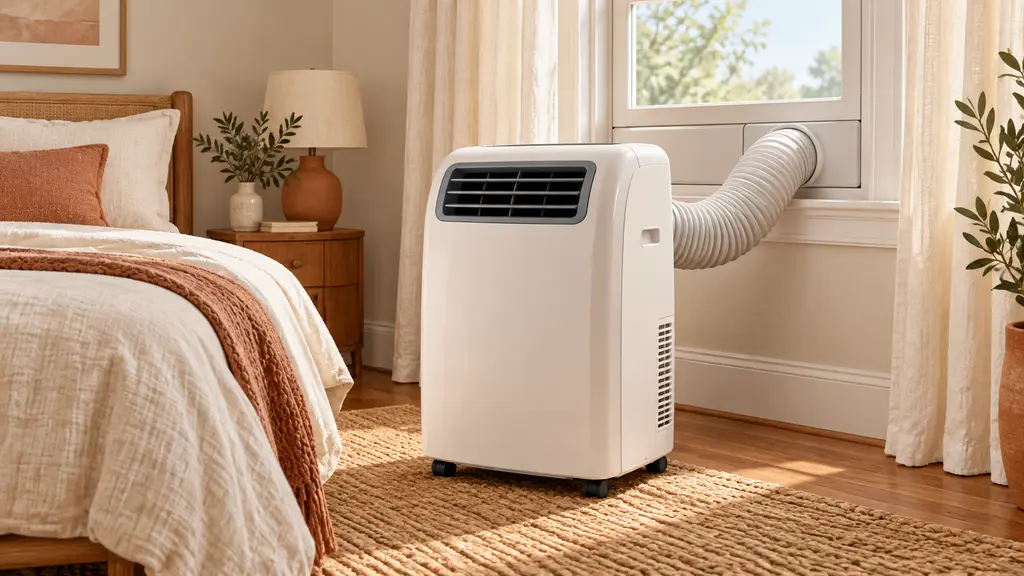
A portable AC for a room up to 12 square meters needs roughly 8,000 to 10,000 BTU, and a standard bedroom from 12 to 18 square meters needs 10,000 to 12,000. That’s a starting figure, not a precise engineering calculation, and it doesn’t account for things like direct sun or a high ceiling, but it’s a far better starting point than guessing. And the rule that matters most: a portable AC needs more power than a split unit for the exact same room, not the same figure.
The quick answer
Measure your room’s area in square meters and check it against the table below to get a starting BTU range to shop for. If your room gets a lot of direct sun, has a high ceiling, or regularly holds more than two people, lean toward the higher end of that range. If you’re torn between two figures, pick the higher one: a unit slightly stronger than you need runs comfortably, while an undersized one keeps struggling without ever getting there.
Key takeaways
- Room area is the starting point, but direct sun, a high ceiling, and occupant count all push the real need above the base figure.
- A portable AC needs more power than a split unit for the same room, because most models run on a single hose that draws the room’s own air to expel it (background on how portable ACs operate, Britannica).
- An oversized unit is safer than an undersized one, a small bump in power use beats an AC that never actually cools the room properly.
- The British thermal unit (BTU) is a measure of energy, not area, and it’s the standard used to rate cooling power (BTU definition, US EIA).
- A sizing table is always approximate, no single number fits every home, especially where insulation and window orientation vary as much as they do across Egypt.
Starting sizing table
| Room area, roughly | Starting cooling power (BTU) | Note |
|---|---|---|
| Up to 12 sqm | 8,000 to 10,000 | A small room or home office, enough margin |
| 12 to 18 sqm | 10,000 to 12,000 | A standard bedroom, the closest fit for most homes |
| 18 to 25 sqm | 12,000 to 14,000 | A large bedroom or a small, partly open living space |
| Over 25 sqm | 14,000+ or a split AC | Portable units start losing efficiency here |
Treat this table as a general rule of thumb, not a precise formula for your room. Use it as a starting comparison point, not a final answer.
Why does a portable AC need more power than a split unit?
The difference isn’t marketing, it’s how the two actually work. Most portable air conditioners run on a single hose that draws air from inside the room to expel it outside along with the heat it collected, and that creates a slight negative pressure inside the room that pulls warm air back in from outside (under the door or through small gaps) to compensate. The result is the unit works somewhat against itself, which is why many international air conditioning sizing guides recommend a step up in BTU class over what a split AC would need for the exact same room.
Factors that push your need above the table
- A lot of direct sun on the room, especially at midday, raises the heat load above the base figure.
- A higher-than-average ceiling means a larger volume of air to cool, even at the same floor area.
- More than two people regularly in the room adds to the heat load, since the human body itself generates heat.
- An open kitchen or several electrical appliances in the same space add extra heat the AC has to work against.
So which number do you actually pick?
If your room falls in between two figures on the table, always lean toward the higher one. The risk isn’t balanced: a unit slightly stronger than you need cools faster and runs comfortably, and the worst outcome is a small bump in power use. An undersized unit keeps running at full power the whole time without ever reaching the cooling you want, which is worse for power use in the long run, not better. From our shortlist, the Ocean 12,000 BTU Portable Air Conditioner falls in the mid-size-to-large room range, and it’s the only true portable AC that met our stock and rating bar on Amazon.eg, which is why it tops our guide to the best portable AC in Egypt. You’ll find its current price and the Amazon link in the card below.
See the Ocean 12,000 BTU Portable AC price on Amazon.eg ↗
Bottom line
Measure your room’s area in square meters, check it against the table to get a starting BTU range, and lean toward the higher figure if you have direct sun, a high ceiling, or more occupants. Remember a portable AC needs more power than a split unit for the same room because of how its single-hose venting works. If your room is mid-size to large, the Ocean 12,000 BTU is our top pick. If your room is small or a studio, see the best small portable AC for a bedroom for a tighter recommendation. To browse all the options and prices, see our guide to the best portable AC in Egypt, compare current portable AC prices, or read our full how to choose a portable AC guide. To browse all the options, see our portable AC section.
Sources
- Britannica, “Air conditioning (self-contained units)”, background on single-hose portable AC operation and its effect on required cooling power: https://www.britannica.com/technology/air-conditioning
- US EIA, “British thermal units (Btu)”, definition of the BTU used to measure cooling power: https://www.eia.gov/energyexplained/units-and-calculators/british-thermal-units.php
This analysis is based on published information from Britannica (Air conditioning (self-contained units)), US EIA (British thermal units (Btu)).
Frequently asked questions
My bedroom is 16 square meters, what portable AC size fits?
A room that size falls roughly in the 10,000 to 12,000 BTU range on the starting table. If the room gets a lot of direct sun or has a higher ceiling, lean toward the higher end of that range, which is exactly the range our pick (the Ocean 12,000 BTU) sits in.
Is it a problem if I buy a portable AC stronger than my room needs?
The risk is much smaller than the opposite. A unit slightly stronger than the room cools faster and runs more comfortably, and the worst that happens is a small bump in power use. An undersized unit is the real problem, since it runs flat out constantly without ever reaching the cooling you actually want.
Why does a portable AC need more power than a split AC for the same room?
Most portable units run on a single hose that draws the room's own air to push it back outside, which creates a slight negative pressure that pulls warm air back in from outside to compensate, unlike a split system, which doesn't have that effect ([background on how portable ACs operate, Britannica](https://www.britannica.com/technology/air-conditioning)). That's why many international sizing guides recommend a step up from the split-AC figure for the same room.
Is this table 100 percent accurate?
No, and that's by design. The table is a starting point based on a general rule of thumb common in air conditioning guides, not a precise engineering calculation for your specific room. A high ceiling, a lot of direct sun, more occupants, or an open kitchen connected to the room all push the real need above the table's number.