
 UAE
UAE  Saudi Arabia
  USA
USA Portable AC vs Desert Cooler: The Real Difference
We may earn a commission from purchases through our links, at no extra cost to you. How we choose · Disclosure.
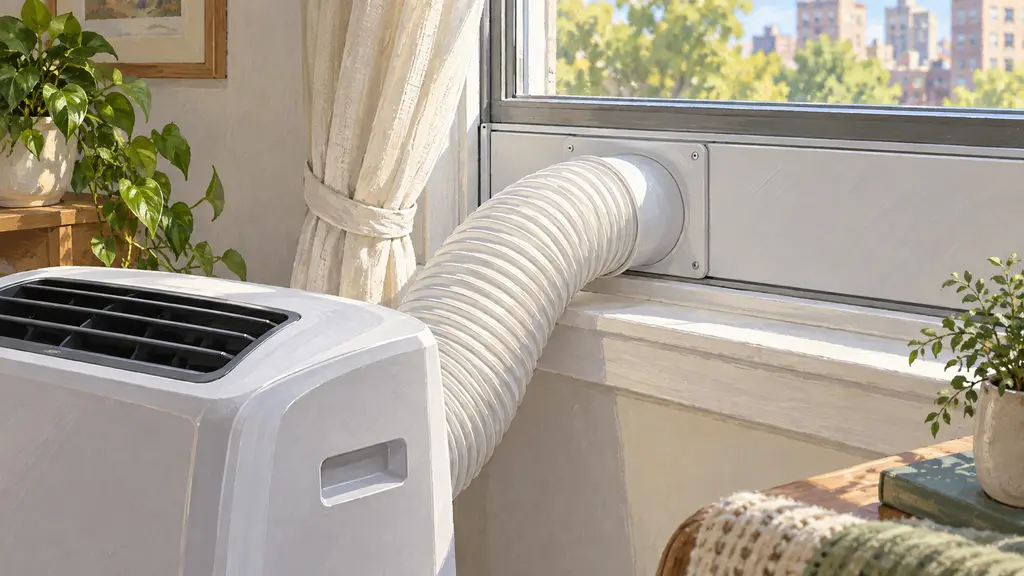
There’s no power difference between a true portable AC and a portable desert cooler, the difference is the underlying technology. A true portable AC uses a refrigerant compressor to actually cool and dehumidify the air. A “desert cooler,” in most cases, is a marketing name for an evaporative cooler, which blows air across a wet pad and adds humidity to the room while it runs. The name alone leads a lot of shoppers to assume they’re buying a true AC and get surprised after the purchase.
The quick answer
The word “desert” in a product name is not a technical spec, it’s usually a marketing label applied to an evaporative cooler rather than a true refrigerant AC. A true AC cools and dehumidifies with a compressor; a desert cooler (an evaporative cooler) cools through evaporation and adds humidity. The price gap between them is large too, so paying AC money for a cooler, or the reverse, means you’ll be arguing with the unit within a week of using it.
Key points
- “Desert cooler” is largely a marketing term, not a recognized technical category, and it’s applied to a lot of evaporative coolers to make them sound closer to a true air conditioner.
- A desert cooler (evaporative cooler) works on evaporation: air blows across a wet pad, and the evaporating water absorbs heat, but adds humidity to the air coming out (evaporative cooler background from Britannica).
- A true portable AC uses a refrigerant compressor, the same core technology as a split AC, which is why it cools and dehumidifies at the same time regardless of the weather outside.
- The price gap exposes the hardware gap: a real evaporative cooler runs around 4,600 EGP, a true portable AC around 20,000 EGP on Amazon.eg.
- The fastest way to tell them apart: look for the word compressor or refrigerant in the spec sheet; if it’s missing and the listing only mentions a water tank, it’s a cooler, not an AC.
Why does “desert cooler” confuse so many buyers?
In the Egyptian market, plenty of products are sold under names like “portable desert cooler” or “desert AC,” and the word AC in the name makes buyers assume they’re getting a portable version of the same technology as a split system. The reality is that the large majority of these products are evaporative coolers: they pull air through a water-soaked pad, and as the water evaporates it absorbs heat from the air, so what comes out the other side is genuinely cooler, but also more humid. That’s a completely different principle from the compression-based cooling a true refrigerant AC uses, which makes a desert cooler a useful product in the right conditions, but not a real substitute for an AC.
The problem isn’t the product itself, it’s the expectation. Bought as what it actually is, an evaporative cooler, it can genuinely help in dry heat. Bought as if it were a true AC, you’ll be surprised the room feels heavier rather than cooler in humid weather.
How to tell them apart from a listing in a minute
Before buying anything called a portable desert cooler, check the listing or spec sheet for these signs:
- The word compressor, refrigerant, or R32/R410A in the specs: present means a true refrigerant AC. Absent usually means an evaporative cooler.
- A water tank or cooling pad listed as a main feature: that’s an evaporative cooler description, not a true AC.
- Price: a true portable AC typically runs above 20,000 EGP in the Egyptian market. If it’s under 5,000 EGP and calls itself an AC, it’s almost certainly an evaporative cooler.
- Power draw in watts: a compressor pulls far more power than an evaporative cooler’s fan, so a very low wattage rating is another sign it’s a cooler, not an AC.
- An exhaust hose: a true refrigerant AC needs a hose to vent heat outside; an evaporative cooler usually doesn’t.
Quick comparison: desert cooler (evaporative) or true refrigerant AC?
| Criterion | Desert cooler (evaporative) | True portable refrigerant AC |
|---|---|---|
| How it cools | Evaporation off a wet pad | Refrigerant compressor |
| Effect on humidity | Adds moisture | Removes moisture |
| Spec sheet tell | Water tank, cooling pad | Compressor, refrigerant |
| Approx. price | ≈ 4,599 | ≈ 19,990 |
| Best climate | Dry heat | Any climate, including humid |
| Exhaust hose | Usually not needed | Required, vented outside |
The simple rule: don’t trust the name on the box, judge the spec sheet. If it’s named “desert” but specs a compressor and refrigerant, it’s a true AC. If it’s named “AC” but specs a water tank and pad, it’s an evaporative cooler no matter what the label says.
So which one fits you?
This isn’t a choice between “better” and “worse,” it’s between two tools solving two different problems. If your climate is genuinely dry (inland, not coastal), a real evaporative cooler will bring noticeable relief for a fraction of AC money. If you’re in a humid coastal city, or you’d rather not risk the added humidity, pay the difference for a true refrigerant AC. A working example from this category is the Ocean 12,000 BTU Portable Air Conditioner, the one true portable refrigerant unit we found in stock on Amazon.eg with early positive reviews. We’re not recommending it for being cheap; we’re recommending it because it’s a genuine compressor-based AC rather than a cooler wearing an AC label, which is why it tops our best portable AC in Egypt guide. Its current price and Amazon link are in the card below.
See the Ocean 12,000 BTU Portable AC price on Amazon.eg ↗
Bottom line
The difference between a true portable AC and a desert cooler isn’t more or less power, it’s a completely different technology: a compressor that removes humidity versus evaporation that adds it. Before buying anything labeled a desert cooler, check the spec sheet for the word compressor or refrigerant, and check the price; under 5,000 EGP with an AC label almost always means an evaporative cooler. If you need a true AC regardless of humidity, see our pick in the best portable AC in Egypt, and if you’re still weighing a portable unit against a split system read does a portable AC cool as well as a split AC, or get the full technology comparison in portable AC vs evaporative cooler. Check current portable AC prices in Egypt before you commit, and for the full buying criteria read our how to choose a portable AC guide or browse our portable AC section.
Sources
- Amazon.eg, product listings and reviews used for the price and spec comparison.
- Britannica, “Wet-bulb temperature and evaporative cooling”,” how evaporative cooling works and its effect on humidity: https://www.britannica.com/science/wet-bulb-temperature
This analysis is based on published information from Amazon.eg, Britannica (Wet-bulb temperature and evaporative cooling).
Frequently asked questions
Is a portable desert cooler actually an air conditioner?
Usually not. Most products sold under a desert cooler or portable AC name are actually evaporative coolers: they blow air across a wet pad and cool through evaporation, not a refrigerant compressor like a true AC. The word AC in the marketing name is a sales label, not a technical spec, and that mismatch is the main source of confusion.
How do I tell the two apart from an online listing?
Look for the words compressor, refrigerant, or R32 in the spec sheet, that's the mark of a true AC. If the listing talks about a water tank or a cooling pad or a humidity rating, it's an evaporative cooler regardless of whether the name says AC or desert cooler. Price is a strong tell too: a true portable AC typically runs above 20,000 EGP in Egypt, while an evaporative cooler is far cheaper.
Is a desert cooler worth buying at all?
Yes, if your climate is genuinely dry and your budget is tight. It's a real, useful product in dry heat, cheap to buy and run. The problem isn't the product, it's buying one thinking it's a true air conditioner and being surprised that it adds humidity to the room instead of removing it.
How big is the price gap between the two?
It's large. A real evaporative cooler on Amazon.eg runs around 4,600 EGP, while the one true portable AC we found, the Ocean 12,000 BTU, sits at ≈ 19,990. That's roughly a four-to-five-times difference, reflecting completely different hardware rather than a brand markup. Prices are approximate at publication and change.