
 UAE
UAE  Saudi Arabia
  USA
USA Portable AC vs Evaporative Cooler: The Difference and Which to Pick
We may earn a commission from purchases through our links, at no extra cost to you. How we choose · Disclosure.
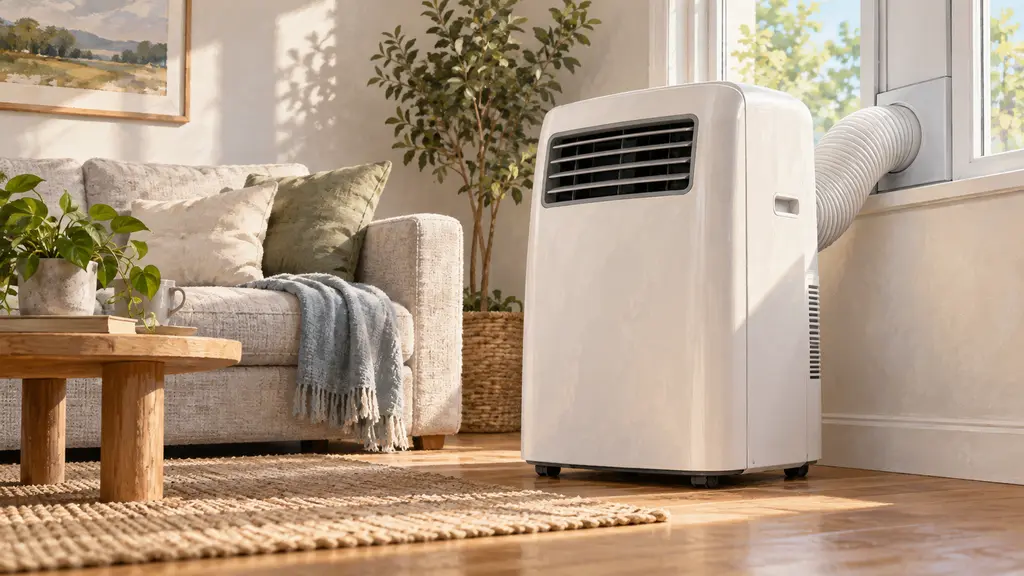
Standing in the cooling aisle in an Egyptian summer, you’ll run into two products that look like they solve the same problem: a portable AC and an evaporative cooler (what most people here just call a “cooler”). They’re priced worlds apart, so it’s tempting to assume the cheaper one is just a budget version of the pricier one. It isn’t. They work on completely different principles, and picking the wrong one for your climate means spending money and still feeling hot. Let’s break it down.
The quick answer
A portable AC uses a refrigerant compressor to actively cool and dehumidify the air, the same core technology as a split AC. An evaporative cooler blows air across a wet pad and cools through evaporation, which adds humidity as it runs. That single difference decides everything else: portable ACs cost far more but work reliably anywhere, while evaporative coolers are cheap and genuinely effective in dry heat, but can backfire in humid conditions.
The key points
- How they work: a portable AC removes heat and moisture with a compressor; an evaporative cooler adds moisture while it cools through evaporation.
- Where each works: a portable AC works in any climate; an evaporative cooler needs dry air to actually help.
- Price: a real evaporative cooler runs around 4,600 EGP, a true portable AC around 20,000 to 21,000 EGP on Amazon.eg.
- Installation: both need an outlet, but a portable AC also needs an exhaust hose vented outside; an evaporative cooler just needs water in its tank.
- Running cost: an evaporative cooler uses far less electricity than a compressor-based AC.
- Who wins: there’s no universal winner, it depends entirely on your local humidity and your budget.
The evaporative cooler: cheap cooling for dry heat
An evaporative cooler, sometimes called a swamp cooler or just a “cooler” in everyday Egyptian usage, pulls warm air through a water-soaked pad. As the water evaporates, it absorbs heat from the air, so what blows out the other side is cooler, but also more humid. This makes it genuinely effective and very cheap to run in dry heat, and models like the Fresh FA-M60W on Amazon.eg carry hundreds of positive reviews and come with large water tanks for long runtime between refills.
Its limits are built into the physics: it doesn’t remove humidity, it adds it. In a climate that’s already humid, that extra moisture can make a room feel muggier rather than cooler, which is exactly why evaporative coolers struggle in Egypt’s coastal cities during peak summer. Good evaporative coolers in Egypt run from around 4,500 to 5,000 EGP. Our full pick from this category is in the best portable AC in Egypt ranking.
The portable AC: real cooling, real price
A true portable AC packs a refrigerant compressor, the same core technology inside a split AC, into a single freestanding unit. It actively cools the air and pulls humidity out of it, then vents the extracted heat outside through an exhaust hose. Because it works on real refrigeration rather than evaporation, it performs reliably regardless of how humid it already is outside, which makes it the dependable choice in Egypt’s coastal cities where an evaporative cooler falls short.
The trade-off is real cost, both to buy and to run: on Amazon.eg, the one true portable AC we found, the Ocean 12,000 BTU, runs ≈ 19,990 EGP, roughly four to five times an evaporative cooler. It also needs a proper exhaust hose setup through a window or wall opening to work at all. Our selected example from this category is in the best portable AC ranking too.
Quick comparison: which for what?
| Criterion | Evaporative cooler | Portable AC |
|---|---|---|
| How it cools | Evaporation off a wet pad | Refrigerant compressor |
| Effect on humidity | Adds moisture | Removes moisture |
| Approx. price | ≈ 4,599 | ≈ 19,990 |
| Best climate | Dry heat | Any climate, including humid |
| Installation | Just fill the water tank | Needs an exhaust hose vented outside |
The simple rule: match the tool to your actual humidity, not your budget alone. If your area runs dry, an evaporative cooler is real value. If you’re in a humid coastal city or you need reliable cooling regardless of weather, the extra cost of a true portable AC (or a split AC, if you can install one) is the money that actually solves the problem.
So which should I pick?
Start from one question: is your local air dry or humid, most of the year?
If you’re inland with genuinely dry heat and your budget is tight, a good evaporative cooler like the Fresh FA-M60W will bring real relief for a fraction of AC money. If you’re in a humid coastal city, or you simply need cooling that works no matter what the weather’s doing outside, spend the extra money on real refrigeration. A working example we point to from this category: the Ocean 12,000 BTU Portable Air Conditioner, the one true portable AC we found in stock on Amazon.eg with early positive reviews. We’re not recommending it for being cheap; we’re recommending it because it’s the one unit on the market that actually delivers refrigerated cooling without a split installation, which is why it’s our top pick in the best portable AC guide. Its current price and Amazon link are in the card below.
See the Ocean 12,000 BTU Portable AC price on Amazon.eg ↗
Read your need in a minute
- Define your climate first: genuinely dry heat? An evaporative cooler is worth considering. Humid or coastal? Go straight to a true AC.
- If evaporative fits, focus on tank size and a brand with local service; picks are in the best portable AC in Egypt.
- If you need real refrigeration, check whether a split AC is installable first, then consider a portable unit if it isn’t; the same ranking covers both.
- Check current price ranges at portable AC prices before you commit, and for the full buying criteria read how to choose a portable AC.
- And to browse every option, see our whole portable AC section.
This analysis is based on published information from Amazon.eg.
Frequently asked questions
Is an evaporative cooler basically a cheap portable AC?
No, and that's the core misunderstanding. A portable AC uses a refrigerant compressor to actively remove heat and humidity from the air, the same technology as a split AC just packed into one box. An evaporative cooler simply blows air across a wet pad, which cools through evaporation while adding moisture to the room. They're built on completely different physics, so an evaporative cooler isn't a discount version of an AC, it's a different tool that solves a narrower problem.
Which one actually works in Egypt's climate?
It depends entirely on where you are and how humid it already is. In drier inland heat, an evaporative cooler can genuinely bring the temperature down and feel comfortable. In Egypt's humid coastal cities, especially at the height of summer, adding more moisture to already-humid air often makes a room feel heavier rather than cooler, so a portable or split AC is the more reliable choice there regardless of price.
How much more does a true portable AC cost than an evaporative cooler?
The gap is large. On Amazon.eg, a real evaporative cooler like the Fresh FA-M60W runs around 4,500 EGP, while the one true portable AC we found, the Ocean 12,000 BTU, sits at ≈ 19,990. That's roughly a four-to-five-times difference, and it reflects genuinely different hardware, not just a brand markup. Prices are approximate at publication and change, so double-check before you buy.
If I can't afford a portable AC, is an evaporative cooler worth buying at all?
Yes, if your climate is dry enough for it to actually help. It's a real, useful product for the right conditions, cheap to run, and simple to maintain. The mistake is buying one expecting AC-level cooling in humid weather; that's the scenario where it disappoints people and gets returned or ignored in a corner.