
 UAE
UAE  Saudi Arabia
  USA
USA Is a Cheap Budget Air Purifier Good Enough?
We may earn a commission from purchases through our links, at no extra cost to you. How we choose · Disclosure.
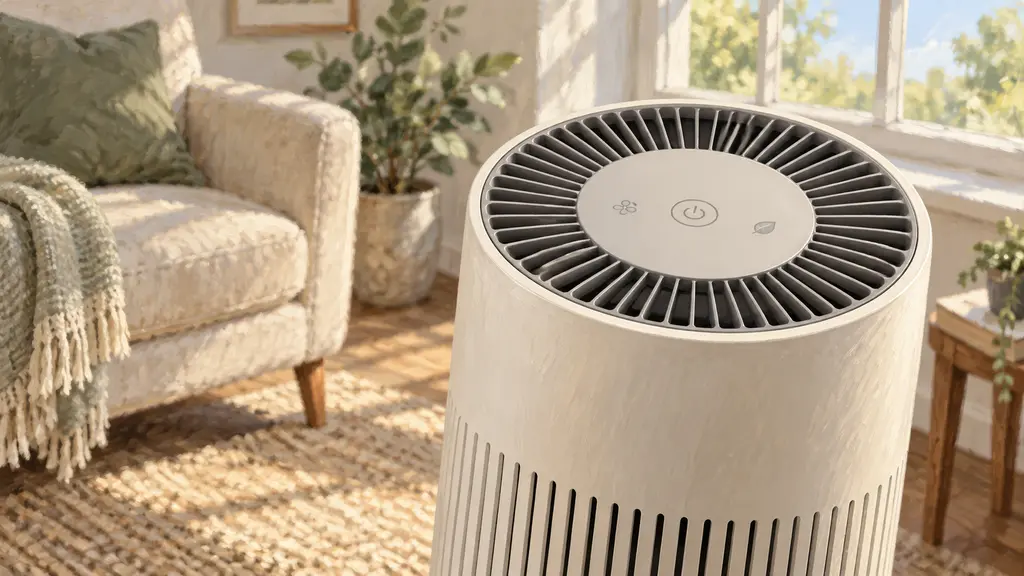
A cheap air purifier does work if it runs true HEPA filtration and fits the room you’re placing it in, and the higher price on pricier tiers usually buys extra features like smart control rather than core filtering power itself. A tight budget doesn’t have to mean more dust in your air, as long as you know what to look for.
The quick answer
A budget purifier catches dust and pollen just as effectively as a pricier one, as long as its filtration is true HEPA rather than “HEPA-type.” The gap between budget and premium tiers is usually extra features (app control, auto-sensing, a bigger coverage area) rather than the filter itself. If your room is small to mid-size and you’re fine adjusting the unit by hand, a budget tier does the core job well.
Key takeaways
- Price isn’t a direct signal of filtering power, but it is usually a signal of extra features.
- True HEPA filtration is the real requirement, whether the unit is budget or premium (HEPA standard definition from US EPA).
- An air purifier works on a simple principle: pull air in, pass it through a filter, return it to the room (air purifier definition from US EPA), and that’s true across every price tier.
- The features that drive price differences: app control, an auto mode, and a higher CADR for bigger spaces.
- A budget unit is usually built for a smaller room, so coverage, not filtration, is the real trade-off.
- Only pay more if you genuinely need bigger coverage or remote control convenience.
The filter is what matters, not the price tag
When you compare a cheap purifier to an expensive one, the first thing to check isn’t the price gap, it’s the filter type. If both run true HEPA filtration, the core filtering of dust and pollen is very close between them, because that’s the filter’s job, not the price tag’s. The real problem shows up only if the cheap unit runs a “HEPA-type” filter or a basic filter alone, which lets fine particles through regardless of price.
So the right question when shopping for a budget unit isn’t “is this too cheap to be any good” but “what exactly is its filter grade.” If the answer is true HEPA, the unit is ready to do its core job well.
So where does the extra money on premium units go?
The real difference between a budget and a premium unit usually comes down to three things: smart app or voice control, an auto-sensing mode that adjusts fan speed on its own based on air quality, and a higher CADR that lets it cover more than a normal bedroom. If you’re happy setting the fan speed once by hand, and you only need to cover a normal bedroom, those features won’t add real value worth the price gap.
Table: which situation is worth the extra money?
| Your situation | The right tier |
|---|---|
| Normal bedroom, happy adjusting the unit by hand | Budget unit with true HEPA filtration |
| A large living room or open-plan space | A unit with higher CADR (pricier tier) |
| Want app control and remote monitoring | A smart unit (mid to premium tier) |
| Tight budget, dust is the core priority | Budget unit with true HEPA filtration |
The simple rule: if your need is basic (a bedroom, true HEPA filtration), a budget unit saves you money without sacrificing the result. Only pay more if you genuinely need bigger coverage or control features you’ll actually use.
A practical example that balances price and filtration
The LEVOIT Bedroom HEPA is a practical example of this balance: true HEPA filtration at a mid-range price compared to the pricier smart tier, sized right for the bedroom, which is the most common need, and it carries thousands of positive reviews on Amazon.eg, easily the biggest track record on this list. We didn’t pick it for being the cheapest, we picked it for the best balance of price, filtration, and buyer trust, which is why it tops our guide to the best air purifier in Egypt. If your budget is even tighter and you want to compare cheaper alternatives too, you’ll find a budget-tier option in that same guide. Its current price is in the card below.
Bottom line
A cheap air purifier isn’t necessarily the wrong call, as long as it runs true HEPA filtration and fits the room you’re placing it in, since the price gap usually buys extra features rather than core filtering power. Only pay more if you genuinely need bigger coverage or remote control convenience. If you’re not sure what size fits your room, read what size air purifier do I need for a small apartment?, or if chest allergies are your specific concern, see the best air purifier for allergies. Before you decide, compare all the options in our guide to the best air purifier in Egypt or browse air purifiers in Egypt, and for the full picture read our how to choose an air purifier guide.
Sources
- US EPA, “What is a HEPA filter”, definition of the HEPA filtration standard and particle-capture precision: https://www.epa.gov/indoor-air-quality-iaq/what-hepa-filter
- US EPA, “Guide to air cleaners in the home”, definition of the air purifier and how it works: https://www.epa.gov/indoor-air-quality-iaq/guide-air-cleaners-home
This analysis is based on published information from US EPA (What is a HEPA filter), US EPA (Guide to air cleaners in the home).
Frequently asked questions
Does a cheap air purifier actually catch dust or does it just run?
If it runs true HEPA filtration (not 'HEPA-type' or just a basic filter), yes, it does catch dust effectively. Price is not always a direct signal of core filtering power, and several budget models offer true HEPA filtration for much less than the pricier smart models, with the price gap usually coming from extra features rather than the filter itself.
What actually separates a cheap unit from an expensive one, besides price?
Usually: app control, an auto-sensing mode that adjusts fan speed on its own, and a higher CADR for bigger spaces. If you have a normal bedroom and are comfortable setting the fan speed yourself, those features won't add much real value, and the core filtering stays just as effective.
What am I giving up if I buy a budget unit?
Usually the smart features (app, auto-sensing) and coverage area (a budget unit is often built for a smaller room than the pricier tier), not the filtering quality itself if the unit truly runs HEPA. If your room is small and you don't need remote control, that trade-off is a very reasonable one.
When is it worth paying more instead of saving?
When your room is bigger than a normal bedroom (a living room or open-plan space), since you'll need a higher CADR that budget models usually don't offer. Or when remote control and auto-sensing genuinely make a difference to your daily use. Otherwise, a budget unit with true HEPA filtration covers the core need efficiently.