
 UAE
UAE  Saudi Arabia
  USA
USA What Size Air Purifier Do I Need for a Small Apartment?
We may earn a commission from purchases through our links, at no extra cost to you. How we choose · Disclosure.
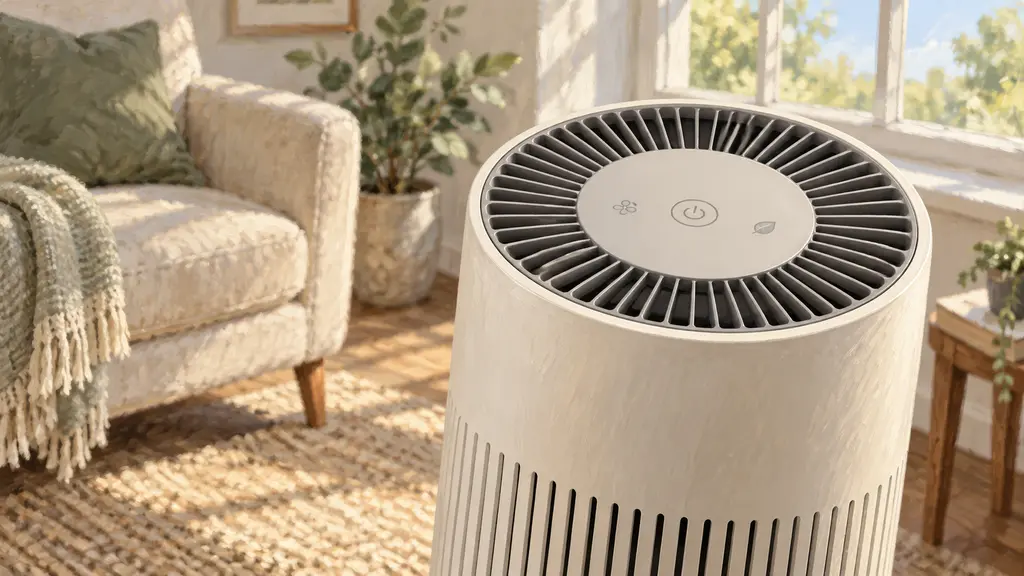
An air purifier is sized to the room it actually runs in, not the whole apartment. If you have a small flat, the right question isn’t “should I buy a big or small unit” but “how big is the room I’m actually placing it in,” because a unit built for a closed bedroom will do its job well there, but it won’t make much difference in a larger open-plan living room, and the reverse is just as true.
The quick answer
Choose an air purifier based on the size of the room it will spend most of its time in, not the whole apartment. For a bedroom or any small closed room, an entry-size unit with mid-range CADR is enough. For a living room or a larger open-plan space, you need a unit with a higher CADR. Buying more power than you need wastes money, and buying less leaves the unit running with no real result.
Key takeaways
- CADR (clean air delivery rate) is the real metric, not the brand name or how the unit looks.
- An air purifier works by pulling room air through a filter and returning it to the same room (air purifier definition from US EPA), so its coverage is inherently limited by design.
- A common rule manufacturers use: a unit’s CADR should match the room’s size, not the whole apartment.
- The bedroom is a higher priority than the living room, since you spend uninterrupted hours there.
- Closed doors limit a unit’s coverage to the room it’s in, so a living-room unit won’t help a closed bedroom.
- A unit stronger than you need isn’t a mistake, just extra cost, but one weaker than you need is a real problem.
Why CADR matters more than the unit’s size
CADR stands for Clean Air Delivery Rate, a number that tells you how much clean air a unit can actually put out per minute. A unit that looks large doesn’t necessarily cover a large area, and the opposite is true too: a compact unit can have plenty of CADR for a normal bedroom. That’s why the first thing to check in any unit’s specs isn’t its looks or brand name, but the CADR number or the recommended coverage area listed in the manufacturer’s catalog.
The common rule manufacturers use is that a unit’s CADR should match the size of the room it will actually run in, not the whole area. A unit with the right CADR for a bedroom will do its job efficiently there, but it will keep running non-stop without clearing a larger open-plan living room at the same speed.
Bedroom versus living room: a different need
A bedroom or any small closed room is where dust and closed-AC air build up the most, and it’s also the room where you spend your longest uninterrupted stretch of time. An entry-size unit with mid-range CADR handles this job perfectly, and you don’t need to pay more for a unit built for a bigger space if your bedroom is the priority.
A living room or any open-plan space is a completely different case, because the volume of air that needs clearing is much larger, and there are no doors to contain it in one place. Here you need a unit with a considerably higher CADR so it can keep up with that larger air volume. A unit built for a bedroom, if placed in a big living room, will run all day without actually clearing the air, simply because it isn’t built for that scale.
Table: what size for what room?
| Space type | Need | Example from our picks |
|---|---|---|
| Bedroom or small closed room | Entry-level CADR, compact to mid-size unit | LEVOIT Bedroom HEPA |
| Larger bedroom or small living room | Mid-range CADR, smart control is useful here | A mid-tier smart unit |
| Large living room or open-plan space | High CADR, airflow is the priority | A high-CADR unit |
The simple rule: identify the room the unit will actually spend most of its time in, not the whole apartment, and compare its size against the recommended CADR in the unit’s specs before you buy.
Small apartment: one unit or more?
If your apartment is small and open-plan (living and dining area with no partitions), one unit sized for that open space may be enough. But if you have separate closed rooms (a bedroom whose door stays shut most of the time), a living-room unit’s effect won’t reach that room, so the more accurate move is to start with a unit in the room you sleep in, since that’s the real priority for your daily air quality, and add a second unit for the living room if budget allows.
A practical example from our picks for the bedroom: the LEVOIT Bedroom HEPA offers true HEPA filtration and a size that fits a small closed room, and it carries thousands of positive reviews on Amazon.eg, easily the biggest track record on this list. We didn’t pick it for being the cheapest, we picked it because it’s the right size for the most common need, which is why it tops our guide to the best air purifier in Egypt. You’ll find its current price in the card below.
Bottom line
Choose an air purifier based on the size of the room it will actually run in, not the whole apartment, and check the CADR number before the design or brand name. The bedroom is a higher priority than the living room since you spend more time there, and a unit built for a closed room won’t do much in a larger open space. If dust isn’t your only issue, see air purifier vs humidifier, or if chest allergies are your main concern, read the best air purifier for allergies. Before you decide, check our how to choose an air purifier guide or browse air purifiers in Egypt for all the options.
Sources
- US EPA, “Guide to air cleaners in the home”, definition of the air purifier and how it draws in and filters air: https://www.epa.gov/indoor-air-quality-iaq/guide-air-cleaners-home
This analysis is based on published information from US EPA (Guide to air cleaners in the home).
Frequently asked questions
What is CADR and why does it matter?
CADR (Clean Air Delivery Rate) is a number that tells you how much clean air a unit puts out per minute. The higher the number, the faster and larger an area the unit can clear. This number matters more than the brand name or the design, because it's what actually tells you whether a unit fits your room.
Does one unit cover a whole apartment?
Usually not, unless the whole flat is a small open-plan space. A unit is built to cover a certain volume of air, so if you place it in the living room and leave doors closed to other rooms, those rooms won't benefit. The more accurate approach is to identify the room you spend the most time in (usually the bedroom) and start there, adding a second unit for the living room if budget allows.
Does a small bedroom need a large unit?
No, not at all. A small or mid-size closed bedroom is well served by a unit sized for a bedroom, not one built for a large living room. Buying more power than you need wastes money without real added benefit, and buying less than you need (an undersized unit for the space) leaves it running constantly without actually clearing the air.
How do I know if a unit fits my space?
Check the CADR number or the recommended coverage area in the manufacturer's specs, and compare it to the actual room you'll place it in, not the whole apartment. If the recommended coverage is equal to or larger than your room, the unit fits. If your room is much bigger than the recommended coverage, look for a stronger unit.