
 UAE
UAE  Saudi Arabia
  USA
USA What Size Water Dispenser Do I Need for a Small Apartment?
We may earn a commission from purchases through our links, at no extra cost to you. How we choose · Disclosure.
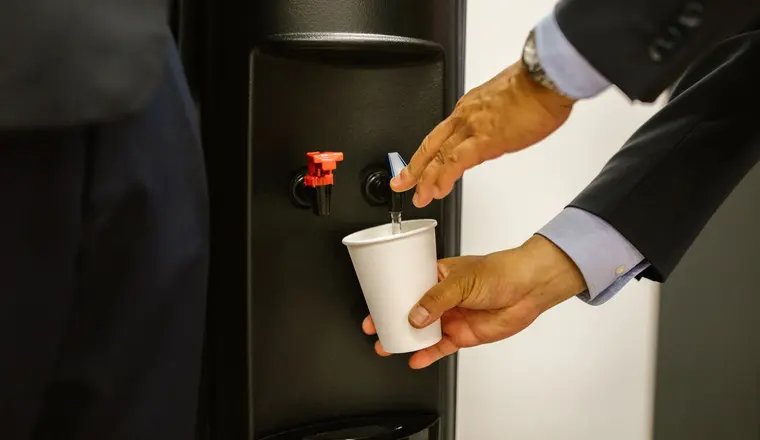
Fitting a water dispenser into a small apartment isn’t really a decision about size in the usual sense, it’s a decision about which kind of space you’re willing to give up: a small patch of floor next to the wall, or counter space you need for other things? Both are practical solutions, but each one takes up a completely different kind of room.
The quick answer
A real water dispenser (bottom-load or top-load) needs a small floor footprint next to a power outlet, not counter space, and neither type requires any plumbing. If you have a small empty floor corner, bottom-loading is the better pick for a small apartment since it keeps your counter completely clear and needs no bottle-lifting over your head. If you have no extra floor space at all, a rechargeable or USB bottle pump is a near-zero-footprint fallback.
Key takeaways
- A water dispenser doesn’t need plumbing at all, since it runs on a standalone 19L bottle rather than a direct connection to the water line (background on the water cooler from ENERGY STAR).
- The space required is a small floor footprint next to the wall, not counter space, which genuinely matters in small kitchens with limited counters.
- Bottom-loading keeps your counter completely clear, since the bottle slots into a drawer at the base of the unit rather than sitting on top.
- A bottle pump (rechargeable or USB) is the smallest-footprint solution of all, since it mounts directly on a bottle you already own with no extra base or body.
- Rented apartments don’t need structural changes, since every solution here is independent of the building’s plumbing.
What actually determines the “right size” for a small apartment
Before you consider a specific model, work out what kind of space you actually have available. If you have a small empty floor corner (roughly the size of a small trash can) next to a power outlet, any real dispenser (bottom-load or top-load) will fit comfortably. If you don’t have a corner like that and all you have is limited counter space, a real dispenser will take up room you can’t really spare, and a bottle pump becomes the logical choice since it mounts on the bottle itself with no extra base.
Bottom-load vs top-load in a small kitchen
Both need roughly the same floor footprint, but the real difference in a small kitchen isn’t square footage, it’s counter space and vertical clearance. A top-load dispenser has the bottle mounted on top, meaning it takes up vertical space and lifting effort, especially if the kitchen ceiling is low or there’s a cabinet right above it. A bottom-load dispenser is the opposite: the bottle sits in a drawer underneath the unit, so your counter stays completely clear and there’s no lifting over your head at all, which helps a lot if the kitchen is tight or shelving sits close overhead.
The bottle pump: the smallest-footprint solution of all
If the apartment is very small and every centimeter counts, a rechargeable or USB-powered bottle pump is by far the smallest-footprint solution. There’s no separate base or body, the pump mounts directly on the 19L bottle you already have, and you press a button for water with no need to stay plugged in. Its limits are clear: no cooling or heating, meaning room-temperature water only. If your use is light or the apartment is rented and you don’t want to invest in a full unit, this is the smartest money you can spend.
Quick comparison: which fits your space?
| Type | Footprint | Needs floor space? | Best for |
|---|---|---|---|
| Bottle pump (rechargeable or USB) | Nearly zero, on top of an existing bottle | No | A very small apartment or studio with no extra space |
| Top-load dispenser | Small floor footprint plus vertical clearance to lift the bottle | Yes | A kitchen with a small corner and enough vertical clearance |
| Bottom-load dispenser | Similar floor footprint, no need to lift overhead | Yes | A small apartment that wants the counter completely clear |
The practical rule: if you have a small floor corner next to a power outlet, a bottom-load dispenser gives you the best balance of comfort and a clear counter. If you don’t have that floor space at all, a bottle pump is the only option that will actually fit your apartment.
So what should I pick for my small apartment?
Start by measuring what you actually have available. If there’s an empty floor corner near a power outlet, pick a real bottom-load dispenser so your counter stays fully clear for everything else. The practical example we used here, the Tornado 3-Tap Bottom-Loading dispenser at ≈ 11,500 EGP, gives three taps and full comfort without eating into the counter space a small apartment needs for other things, and it averaged 4.1 from 77 ratings. Its featured offer was unavailable when we re-checked on 23 August 2026, so treat it as an illustration of the design rather than a buying pick, and take the bottom-load and top-load units that still have a live offer from the guide to the best water dispenser in Egypt. If there’s no floor space at all, fall back to a bottle pump as the practical alternative.
The featured offer was unavailable at the last update.
Bottom line
Picking a water dispenser for a small apartment is a decision about the kind of space you have, not size in the usual sense. If there’s an empty floor corner, bottom-loading is the better balance since it keeps the counter completely clear. If there’s no extra floor space at all, a bottle pump is a practical near-zero-footprint fix. And remember every solution here is independent of the apartment’s plumbing, so it works even in a rented place. If you also want to know how long a water dispenser lasts once you’ve picked one, or you’re weighing loading types in detail, read bottom-load vs top-load water dispenser. Compare water dispenser prices in Egypt, or check our full how to choose a water dispenser guide for every criterion, and browse our whole water dispensers section to see every option.
Sources
- ENERGY STAR, “Water coolers”, background on the water dispenser and its operating principle without plumbing: https://www.energystar.gov/products/water_coolers
- Britannica, “Studio apartment”, background on space constraints in small apartments and studios: https://www.britannica.com/dictionary/studio-apartment
This analysis is based on published information from ENERGY STAR (Water coolers), Britannica (Studio apartment).
Frequently asked questions
What size water dispenser do I actually need for a small apartment?
The space you need isn't counter space, it's a small floor footprint, roughly the size of a small trash can, next to a power outlet. If you don't have that floor space at all and want a temporary fix, a bottle pump mounts directly on the water bottle you already have, with no extra footprint.
Does a bottom-load dispenser actually make a difference in a small apartment?
Yes, in two ways: no lifting a heavy bottle over your head (useful if the ceiling is low or the kitchen is tight), and your counter stays completely clear since the bottle slots into a drawer at the base instead of sitting on top. The trade-off is it needs roughly the same floor footprint as a top-load model.
Is a bottle pump enough for a small apartment?
If your use is light and you already have a 19L water bottle, a rechargeable or USB-powered pump covers the job with no extra footprint beyond the bottle itself. But it has no cooling or heating, so if you need hot and cold water on demand for a full household, a real dispenser earns its footprint.
Does a water dispenser need plumbing work in the apartment?
No, every dispenser and pump discussed here runs on a standalone 19L bottle, with no connection to the building's water line or any plumbing work. That makes them a practical choice for rented apartments where you don't want to make structural changes.