
 UAE
UAE  Saudi Arabia
  USA
USA How Long Does a Water Dispenser Last? Extending Its Life
We may earn a commission from purchases through our links, at no extra cost to you. How we choose · Disclosure.
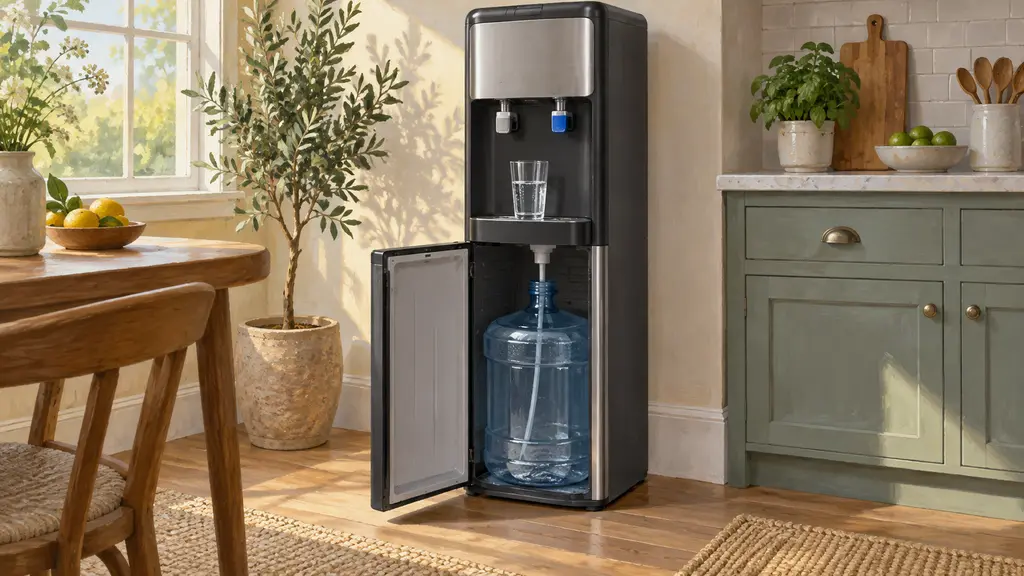
A real water dispenser typically lasts 5 to 10 years with regular maintenance, and the biggest factor shortening that in Egypt is hard tap water, which deposits limescale inside the tubing and tank over time. The good news is that lifespan isn’t fixed, you control most of it through regular descaling and basic upkeep.
The quick answer
A real water dispenser (with two or three taps) lasts 5 to 10 years with regular maintenance, but Egypt’s hard water forms limescale deposits inside the tubing and tank that shorten that span if neglected. Descaling every 3 to 6 months with a diluted vinegar solution or citric acid is the single step that most extends your dispenser’s life. Bottle pumps tend to have a shorter life since they’re simpler electronics with a battery.
Key takeaways
- A water dispenser works on a cooling principle similar to a mini fridge, so its expected lifespan is close to any small refrigeration appliance at home (background on the water cooler from ENERGY STAR).
- Egypt’s hard water specifically is the number-one enemy of a dispenser’s lifespan, since it deposits calcium and magnesium as limescale inside the tubing and heating element (limescale definition from USGS).
- Descaling every 3 to 6 months is the most important maintenance step for extending real lifespan, not the unit’s color or price.
- Bottle pumps (rechargeable or USB) tend to have a shorter life than a real dispenser, since they’re simpler electronics with a battery that weakens over time.
- A brand with widespread service and spare parts in Egypt makes a real difference to the unit’s practical lifespan, not just its original build quality.
What actually determines a water dispenser’s lifespan
A real water dispenser has a cooling cycle similar to any small refrigeration appliance: a pump or compressor cools the water, and a separate heating element heats it for the hot tap. Both parts wear gradually over years of normal use, but that wear speeds up considerably from mineral deposits building up inside the tubing and tank if the water is never cleaned out regularly. In other words, a dispenser’s lifespan isn’t a fixed number printed on the box, it’s a direct result of how much attention you give to cleaning and maintenance.
Why Egypt’s hard water shortens a dispenser’s life specifically
Tap water in Egypt varies in calcium and magnesium content by governorate, and the higher that mineral content, the “harder” the water. As this hard water passes through a dispenser’s internal tubing, it leaves behind a thin layer of deposits (limescale) that builds up over time. That layer narrows the tubing’s diameter, reducing water flow, puts extra strain on the pump, and can coat the heating element so it has to work harder to reach the same temperature. The long-term result: higher electricity use, and parts wearing out before their time.
Signs a water dispenser is nearing the end of its life
- Weak flow from the taps even though the tank is full.
- Water no longer gets properly hot or cold, even after enough time running.
- A strange noise or rattle from the pump or compressor.
- Recurring leaks around the tank or the tap area.
- The unit’s own age: if these symptoms show up on a dispenser that’s seven or eight years old, replacing it is usually cheaper than repeated repairs.
The maintenance schedule that extends a dispenser’s life
| Task | How often | Why it matters |
|---|---|---|
| Clean the taps and the outer drip tray | Weekly | Prevents grime buildup around the drinking point |
| Descale the internal tank | Every 3 to 6 months | Hard water deposits calcium that strains the pump and heating element |
| Check the power cable and plug | Monthly | Prevents electrical hazards as the unit ages |
| Drain and clean the whole tank | Every 6 months | Prevents algae buildup or odors if usage is light |
| Leaving the dispenser plugged in unused for long stretches | Avoid it | Deposits form faster when water sits stagnant in the tank |
Descaling is the step that actually extends the lifespan
If there’s one thing to do to extend your dispenser’s life, it’s regular descaling. The method is simple: unplug the unit, drain the tank, add a diluted white vinegar solution (or citric acid if you have it) into the tank, let it sit for one to two hours, then run the taps until the solution has passed through all the tubing. Rinse with clean water several times until there’s no vinegar smell left, and repeat this every 3 to 6 months depending on how hard the water is in your area. This method works fine with ordinary kitchen ingredients and doesn’t need any special product. If you’d rather skip mixing your own solution, dedicated descaling and cleaning kits for water dispensers exist on the market, but the underlying principle is the same: consistency is what extends the lifespan, not which cleaner you use.
A dispenser worth owning for the long haul
If you’re still shopping for a dispenser, asking the seller what service and spare parts cover the exact model matters to its real-world lifespan almost as much as the build itself, since any appliance will need a part one day, and it lasts longer if that part is actually available. The example we used from our shortlist, the Tornado 3-Tap Bottom-Loading dispenser at ≈ 11,500 EGP, averaged 4.1 from 77 ratings, a reassuring sign about the long-term experience. Its featured offer was unavailable when we re-checked on 23 August 2026, so it stays here as a reference rather than a buying pick, and the units that still have a live offer are in our guide to the best water dispenser in Egypt.
The featured offer was unavailable at the last update.
Bottom line
A water dispenser’s lifespan isn’t a fixed number, it’s a direct result of your maintenance habits, and the biggest one is descaling every 3 to 6 months because of Egypt’s hard water. Watch for the warning signs (weak flow, strange noise, recurring leaks), and clean the taps weekly as a simple habit that makes a difference. If another question is on your mind, like why does a water dispenser smell, or you’re torn between loading types, read bottom-load vs top-load water dispenser. Compare current water dispenser prices in Egypt before committing, or check our how to choose a water dispenser guide if you’re still at the shopping stage, and browse our whole water dispensers section to see every option.
Sources
- ENERGY STAR, “Water coolers”, background on the water dispenser and its operating principle: https://www.energystar.gov/products/water_coolers
- USGS, “Hardness of water”, definition of limescale and mineral deposits caused by hard water: https://www.usgs.gov/water-science-school/science/hardness-water
This analysis is based on published information from ENERGY STAR (Water coolers), USGS (Hardness of water).
Frequently asked questions
How long does a water dispenser actually last?
A real water dispenser (with a cooling pump and heating element) typically lasts 5 to 10 years with regular maintenance, a similar span to any small refrigeration appliance like a mini fridge. Bottle pumps (rechargeable or USB) tend to have a shorter life since they're simpler electronics with a battery that weakens over time, so don't expect the same lifespan as a real dispenser.
Does Egypt's hard water really affect a dispenser's lifespan?
Yes, and it's one of the biggest causes of early dispenser failure in Egypt. Hard water carries a high mineral content of calcium and magnesium, and as it passes through the internal tubing and tank it leaves behind a limescale layer over time. That layer narrows the tubing and strains the pump and heating element, which is exactly what shortens a dispenser's life if it's never descaled.
How do I descale a water dispenser?
Unplug the unit and drain the tank, then add a diluted white vinegar solution (or citric acid) into the tank and let it sit for one to two hours, then run it through the taps so the solution passes through the tubing. Rinse with clean water several times until there's no vinegar smell left, and repeat the process every 3 to 6 months depending on how hard your local tap water is.
What are the signs a water dispenser needs replacing?
If the taps have weak flow, the water no longer gets properly hot or cold, you hear a strange noise from the pump, or leaks around the tank keep recurring, those are all signs the unit is nearing the end of its life. If these symptoms show up on an older unit that's gone without maintenance, replacing it is usually cheaper than repeated repairs.