
 UAE
UAE  Saudi Arabia
  USA
USA What Can a Food Processor Actually Do in Your Kitchen?
We may earn a commission from purchases through our links, at no extra cost to you. How we choose · Disclosure.
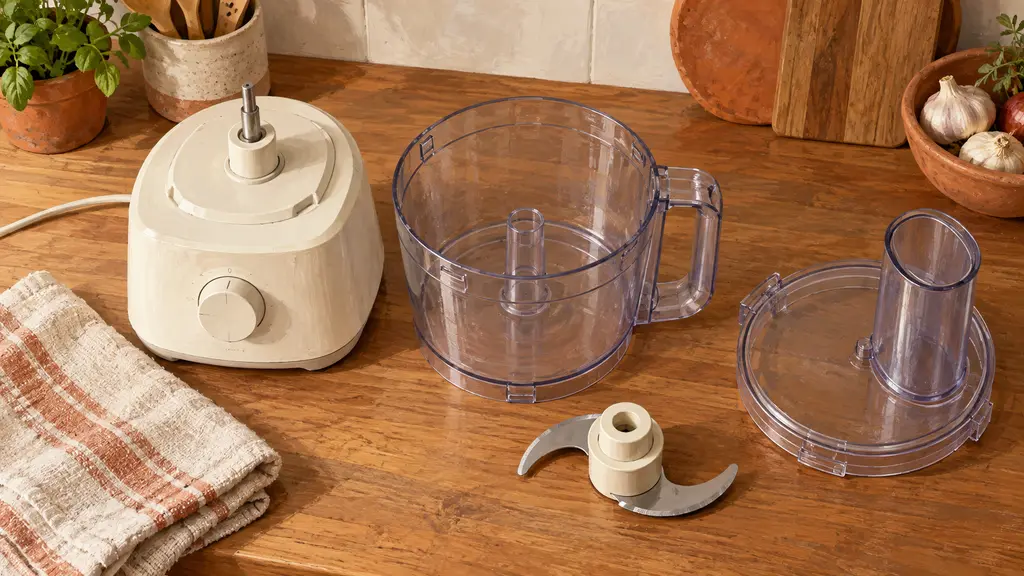
When you first get a food processor, you probably use it for one or two things (chopping onions, mincing meat) and leave the rest of the attachments in the drawer. But this machine is designed to turn fifteen minutes of hand work into a single minute across a lot of kitchen tasks. Let’s walk through what it actually does, tool by tool, so you get the most out of yours.
The quick answer
A food processor is a multi-tasking machine that excels at chopping, mincing, grating, and kneading in a wide bowl. Its biggest real time-savers are chopping vegetables for cooking, mincing meat for kibbeh and kofta, grating and slicing cheese and vegetables with ready-made discs, and kneading dough for pies and pastries. Most processors also include a separate blender jug for liquids, so you get two jobs in one machine.
Key takeaways
- A food processor is not a blender: it works on dry and semi-dry tasks in a wide bowl (chopping, mincing, grating, kneading), while a blender is for liquids in a narrow jug (food processor definition from Britannica).
- The multipurpose S-blade is the core tool, chopping, mincing, and pureeing depending on run time, and it can also make pastry dough and sauces (food processor background).
- Interchangeable discs grate and slice at a consistent thickness in seconds, which is what makes the difference on salad, cheese, and vegetable volumes.
- The dough tool kneads medium batches quickly, but for heavy dough and large quantities a stand mixer is better suited.
- The included blender jug covers juice, smoothies, and soup, so it completes the picture without buying a separate blender (the blender’s role from Britannica).
What does a food processor actually do?
At its core, a food processor is a powerful motor spinning a wide bowl, and you fit a different tool on top depending on the task. The key idea is that food moves around inside a large, flat bowl, which is why it’s excellent at dry tasks that need room: chopping a pile of onions, mincing half a kilo of meat, kneading flour. That’s the opposite of a blender, whose jug is narrow and deep and designed to pull liquids down toward the blade, so it excels at juice and smoothies but fails at dry work (food processor from Britannica).
So instead of standing for fifteen minutes chopping and mincing by hand, you load the ingredients, press a button, and finish in seconds. That’s the real win: time and effort, not just “blitzing” the food.
The attachments and what each one does
Most of a processor’s value comes from the tools you fit on it, not the motor alone. These are the main ones:
| Attachment | What it does | Examples in the kitchen |
|---|---|---|
| S-blade (the core) | Chops, minces, purees by run time | Mince meat for kibbeh, chop onions and tomatoes, pastry dough |
| Grating disc | Fine or coarse grating | Cheese, carrots, potatoes for stuffing |
| Slicing disc | Even slices at set thickness | Cucumber and tomato for salad, potatoes for chips |
| Dough tool | Kneads medium doughs | Pie, pizza, and biscuit dough |
| Blender jug (included) | Liquids and juice | Juice, smoothies, pureeing soup |
| Small mill | Dry grinding | Spices, nuts, breadcrumbs |
One important note: run time matters. A few short presses of the pulse button give you a coarse chop. Leave it running and you reach a fine mince and then a paste. So you control the texture by time, not by anything else.
The tasks it speeds up most
These are the jobs where you’ll genuinely feel the machine’s value, not just a luxury:
- Mincing meat for kibbeh, kofta, and burgers: the S-blade minces meat (with onion and parsley alongside) in seconds, saving you a separate meat grinder.
- Chopping vegetable volumes for cooking: onion, tomato, pepper, and garlic for stuffed-vegetable pots and stews, instead of the slow, tear-inducing hand chop.
- Grating and slicing for salads and trays: the grating disc handles cheese and carrots, and the slicing disc makes even slices for salad, gratin, and homemade chips.
- Kneading doughs: the dough tool combines pie, pizza, and pastry dough in minutes. For the limits of each machine, see food processor vs blender.
- Dry prep: grinding nuts and breadcrumbs, and making garlic paste, basic sauces, and pesto.
What about dough and large batches?
A food processor kneads well, but it has limits. The motor and bowl are built for medium batches, so if you bake daily in large quantities (a kilo of flour or more), you’ll find a stand mixer sturdier and better suited to heavy dough, because it’s designed for long runs. But if you knead occasionally and in reasonable amounts, the dough tool in the processor saves a lot of effort and is perfectly enough.
The same logic applies to blending: if you want a very fine texture or make large juice batches regularly, a dedicated blender or a larger jug is better suited. The processor covers liquids with its included jug, but that’s not its star event (the blender’s role with liquids from Britannica).
A machine that covers most of these uses
To make all of this practical: a machine like the Kenwood FDP65.400WH, with a 3L bowl and 1000W, comes with seven tools in the box, a chopping blade, grating and slicing discs, a dough tool, a 1.5L blender jug, and a mill. That lineup covers most of the uses we walked through above in a single machine, which is what earns it a spot in our guide to the best food processor in Egypt. You don’t have to buy this exact model, but keep an eye on the number of tools, bowl capacity, and motor power when you choose. You’ll find its current price and the Noon link in the card below.
Pick your machine in a minute by how you’ll use it
- Chop and mince a lot? Focus on the S-blade and a large bowl (2.5L and up for family jobs).
- Make salads and trays? Make sure it has grating and slicing discs, ideally with adjustable thickness.
- Knead? Look for a dough tool and at least 800W, and for heavy dough consider a stand mixer instead of the processor.
- Torn between this and a blender? Read food processor vs blender, and check our guide on how to choose a food processor.
- Want to compare models and prices? Browse our food processors section and pick what fits your budget.
Bottom line
A food processor isn’t an “extra” gadget in the kitchen, it’s the thing that cuts chopping, mincing, grating, and kneading from fifteen minutes to one. The more of its tools you use (not just the core blade), the more value you get. Work out your main use first (chopping? dough? salads?), then choose a machine whose tool count, capacity, and power match that use. For the full details, head back to our guide on how to choose the right food processor for your kitchen and our best food processor in Egypt guide.
Sources
- Britannica, “Food processor”, definition of the food processor and its tools (the S-blade, discs, and dough tool) and its core tasks: https://www.britannica.com/technology/food-processor
- Britannica, “Blender”, the blender’s role with liquids and the functional difference between it and a food processor: https://www.britannica.com/dictionary/blender
This analysis is based on published information from Britannica (Food processor), Britannica (Blender).
Frequently asked questions
What are the main uses of a food processor at home?
The biggest time-savers are chopping (onions, tomatoes, and vegetables for cooking), grating and slicing with ready-made discs (cheese, carrots, potatoes), kneading dough for pies, pizza, and pastries with a dough tool, and mincing meat for kibbeh, kofta, and burgers. You can also grind nuts and breadcrumbs and make basic sauces and pastes.
Can a food processor knead dough?
Yes. Most processors come with a plastic or metal dough tool (a dough blade) made for doughs. It combines flour and liquids in minutes instead of kneading by hand. Keep in mind that a processor handles medium batches, so if you bake a lot in large quantities, a stand mixer is better suited to heavy dough.
What is the difference between a food processor and a blender?
A food processor excels at dry and semi-dry tasks in a wide bowl: chopping, mincing, grating, and kneading. A blender excels at liquids: juice, smoothies, and pureeing soup in a narrow, deep jug. Many processors (like the Kenwood FDP65) come with a separate blender jug so you get both jobs in one machine.
How do I clean a food processor quickly?
The fastest way: put some warm water and a drop of dish soap in the bowl and run it for a few seconds so the blade cleans itself, then rinse. The blades and discs are sharp, so handle them by the plastic center, and most parts (bowl, discs, jug) are dishwasher safe, but check your manual to confirm.