
 UAE
UAE  Saudi Arabia
  USA
USA Food Processor Size: How Many Litres Do You Need?
We may earn a commission from purchases through our links, at no extra cost to you. How we choose · Disclosure.
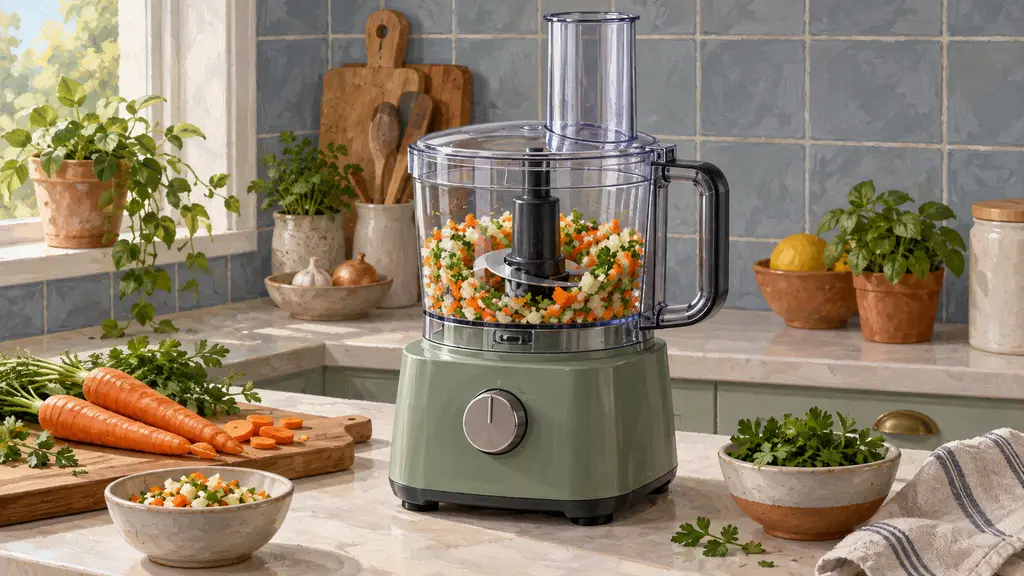
The first question anyone buying a food processor asks is “how many litres should I get?”, and most people answer it on instinct: either grab the biggest bowl to “be safe,” or the smallest one because “the kitchen is small.” Both can be wrong. The right size comes down to just two things: how many people you cook for, and which tasks you actually do. Let’s work through it with the numbers so you choose right the first time.
The quick answer
Food processor size is set by the number of people and the type of tasks, not by a “bigger is better” rule. A 1 to 1.5L bowl suits one or two people, 2 to 2.5L fits a small family, and 3L or more is for a medium to large family and for anyone who kneads dough. And remember that kneading and heavy batches need higher wattage (800 to 1000W), while light chopping is fine on a mid-range wattage even with a large bowl.
Key takeaways
- The stated capacity is larger than the practical capacity. The number on the box describes the bowl filled to its very rim, but with liquids you leave a safety gap at the top so it doesn’t overflow, so the usable amount is less.
- A food processor excels at near-dry tasks (chopping, grating, kneading) in a wide bowl, unlike a blender that excels at liquids, per the food processor definition from Britannica.
- Watts matter more for kneading and heavy tasks than for light chopping. A stronger motor handles stiff dough without stalling or overheating.
- A large bowl isn’t free: it takes up more storage space, is harder to clean, and may not chop a small amount well.
- Look at two numbers, not one: the prep bowl capacity, and the blender jug capacity if the machine comes with one, because a blender works on liquids differently, per the blender definition from Britannica.
Capacity is set by headcount first
The simplest way to choose capacity is to start from “how many people do I usually cook for?”, then add a small margin for guests and occasions. A small bowl (1 to 1.5L) is handy, quick to clean, and takes little space, so it’s ideal for individuals, small kitchens, and quick touches like chopping an onion or making a sauce. But it will fight you if you’re prepping a meal for a whole family, because you’ll end up working in two or three batches, which costs time and makes more mess.
A large bowl (3L and up), on the other hand, makes quantities easy: knead in one go, chop a kilo of vegetables in a single batch, prep a feast without stopping every few minutes to empty it. The reasonable trade-off is that it takes more space on the counter and in the cabinet, cleaning takes longer, and sometimes a very small amount stays below the blade and doesn’t chop well. So a large capacity is an excellent solution for those who need it, and not necessarily best for everyone.
Stated capacity isn’t usable capacity
A point that confuses a lot of people: the number on the box (say 3L) is the bowl’s capacity filled all the way up. But in real use, especially with liquids or runny mixtures, you have to leave a safety gap at the top so food doesn’t escape from under the lid while it’s running. That’s why the practical capacity for liquids is noticeably lower than the stated one, while dry tasks like chopping can get closer to the full capacity.
The practical takeaway: if you’re choosing right at the edge of your need, go up one notch. If you need a useful 2L, a 2.5L or 3L bowl gives you more room than one rated at exactly 2L.
Power (watts): when does it actually matter?
Watts in a food processor aren’t like watts in a vacuum: here they describe the motor’s torque and its ability to drive heavy tasks, not just electricity use. But they still aren’t the whole story on their own, because blade quality, base stability, and bowl design matter just as much. The simple rule:
- Chopping, grating, and light blending: a mid-range wattage (around 500 to 800W) is enough, even with a large bowl, because the task itself doesn’t strain the motor much.
- Dough, heavy and repeated batches: here a strong motor (800 to 1000W and up) genuinely matters, because it handles stiff dough without overheating or stalling, and gives the machine a longer life.
So if your main goal is kneading or heavy daily work, pair a large bowl with high wattage. If your work is light chopping and grating, you can save money and pick a comfortable capacity without paying for watts you won’t use. For the full detail on how watts relate to efficiency, head to our guide on how to choose a food processor.
The sizing table: pick your capacity by need
This table sums up everything above in one line per case:
| Bowl capacity | Best for | Comfortable tasks | Suggested power |
|---|---|---|---|
| 1 to 1.5L | One or two people, small kitchen | Quick chopping, sauces, small amounts | 400 to 600W |
| 2 to 2.5L | Small family (3 to 4 people) | Daily chopping and grating, light blending | 600 to 800W |
| 3L and up | Medium to large family, gatherings | Kneading, large batches, multi-prep | 800 to 1000W and up |
Treat the table as a starting point, not a strict rule: if you knead regularly even with a small family, drop down to the 3L row for the power. And if you love variety and lots of accessories, see food processor uses to learn which tools are worth paying for.
A practical example of the right balance
If you want an example of balanced size and power for most Egyptian kitchens: the Kenwood FDP65.400WH with a roomy 3L bowl and 1000W, meaning it covers a medium to large family and handles dough and heavy chopping, and comes with a 1.5L blender jug, a mill, and 7 tools in the same box, so you cover prep and blending with one machine. We didn’t pick it because its size number is the biggest, we picked it because the balance of a wide bowl, enough power, and varied tools makes sense for daily use, which is what puts it at the top of our guide to the best food processor in Egypt. You’ll find its current price and the Noon link in the card below.
And if you’re still deciding between a food processor and other appliances, read food processor vs blender to understand the difference in function.
Read any processor’s capacity in a minute
- Start from “how many people do I cook for?” and pick the matching row in the sizing table above.
- Go up one notch if you knead or prep batches regularly, because the stated capacity is bigger than the usable one.
- Check the wattage by task type: high for dough, mid-range for light chopping.
- Look at the blender jug capacity too if the machine comes with one, since it’s for liquids differently.
- Browse our food processors section and compare sizes and prices side by side.
And for the difference between a full processor and smaller options for quick tasks, see food processor vs chopper.
Sources
- Britannica, “Food processor”, general background on the food processor and its near-dry tasks (chopping, grating, kneading): https://www.britannica.com/technology/food-processor
- Britannica, “Blender”, definition of the blender and its focus on liquids, to clarify the difference between bowl capacity and blender jug capacity: https://www.britannica.com/dictionary/blender
This analysis is based on published information from Britannica (Food processor), Britannica (Blender).
Frequently asked questions
How many litres are enough in a food processor?
It depends on how many people you cook for. A 1 to 1.5L bowl suits one or two people and quick tasks, 2 to 2.5L fits a small family, and 3L or more is comfortable for a medium to large family or if you knead dough or prep large batches. Keep in mind that the stated capacity is larger than the practical capacity for liquids.
Is a bigger capacity always better?
Not necessarily. A large bowl is convenient for big quantities, but it takes up more counter and cabinet space, is harder to clean, and may not chop a small amount well because the blade sits high above the food. Choose the capacity that fits your actual usage, not the fear of running short.
Do I need high wattage with a large bowl?
If you plan to knead or work with heavy batches, yes: a strong motor (800 to 1000W and up) handles stiff dough without overheating or stalling. But for chopping, grating, and light blending, a mid-range wattage is enough even with a large bowl. Power matters more for the type of task than for bowl size alone.
What's the difference between bowl capacity and blender capacity on the same machine?
Many processors come with a large prep bowl (say 3L) and a separate, smaller blender jug (say 1.5L). The bowl is for chopping, kneading, and grating; the jug is for liquids like juice and smoothies. The two numbers are different, so look at both depending on what you'll use most.