
 UAE
UAE  Saudi Arabia
  USA
USA Food Processor vs Blender: Which One Do You Actually Need?
We may earn a commission from purchases through our links, at no extra cost to you. How we choose · Disclosure.
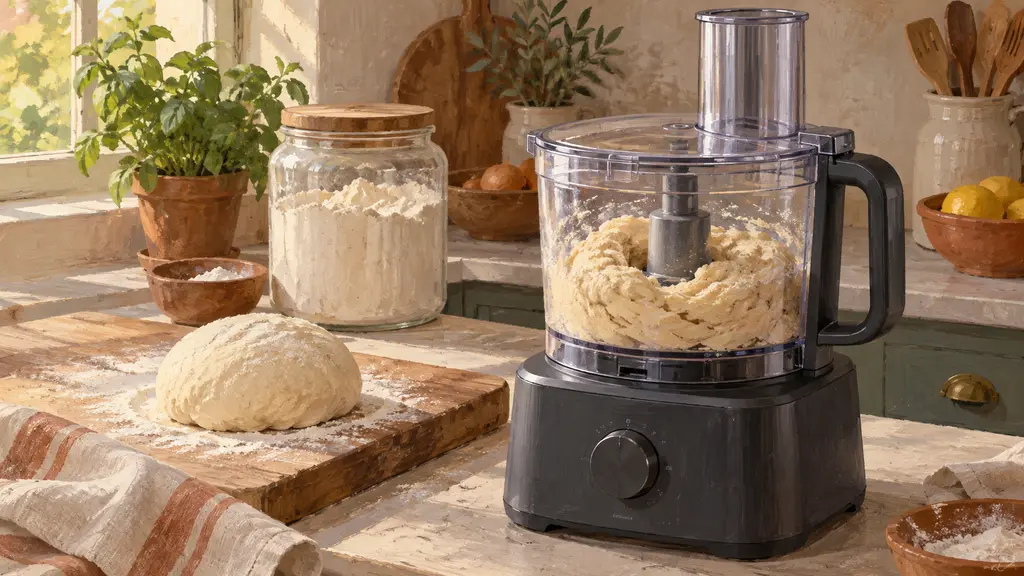
Choose a food processor for slicing, grating and controlled chopping; choose a blender for drinks and smooth mixtures. Start with the job you repeat every week. You do not automatically need both. A processor with a separate blender jug can cover both roles, provided the exact package includes the attachments you need.
Match the attachment to the meal
| Your usual task | Start with | What to check |
|---|---|---|
| Onions for a sauce or kofta mixture | Processor knife blade | Batch limit, pulse control and texture |
| Grated carrots or sliced potatoes | Processor with the correct disc | A chopping blade cannot replace a slicing disc |
| Smoothies and milkshakes | Blender jug | Usable liquid capacity and frozen-ingredient instructions |
| Soup | Suitable blender or hand blender | Temperature limits before adding ingredients |
| Bread dough | Approved processor dough tool or stand mixer | Flour weight, total dough weight and maximum runtime |
KitchenAid’s comparison describes the difference between the tools and their typical jobs. These are task matches, not a test showing that every processor beats every blender. For a small amount of prep, include the time spent assembling and washing the machine in your decision.
A bowl marked 3L does not mean 3L of every mixture
The Kenwood FDP65.400WH listing gives a 3L nominal bowl. The manual linked from its exact-model support page gives separate limits by task: vegetable chopping is 100–500g, while yeasted dough is limited to 600g flour and 1kg total dough, for up to 60 seconds. It calls for rest periods and says not to process hot ingredients.
The blender attachment has a different limit: 1.5L for cold liquids, but 1L for milkshakes. The manual covers several packages and marks attachments as optional, so a picture of a mill or dicing tool does not prove it is in your seller’s box. More on choosing processor size.
When a combination machine makes sense
Write down two columns: prep jobs and drinks. If you use both regularly and have room to store the jug and discs, compare combination packages. The Kenwood FDP65.400WH was about 5,119 EGP on Amazon.eg on 6 September 2026, with an international-warranty title. Its larger nominal bowl is useful to compare, but ask the seller to confirm the blender and any optional mill before paying. An international warranty does not by itself confirm Egyptian repair coverage.
If drinks dominate and you already have a chopper, buying another processor adds cleaning and storage without necessarily solving a problem. If bread dominates, start with a stand-mixer buying guide.
For the available packages and trade-offs, see our food processor picks in Egypt. The processor buying guide helps you check the box contents; the food processors hub brings the related guides together.
We researched the listings and manuals; we have not tested these machines. Prices and sellers can change.
This analysis is based on published information from Amazon.eg, prices and packages for the listed ASINs, Manufacturer sources linked in the article, as of 2026-09-06.
Frequently asked questions
Food processor or blender: which should I buy first?
Choose for the task you repeat: a blender for drinks, a processor with the right discs for grating and slicing. For one onion occasionally, a knife may be enough.
Can a food processor replace a blender?
Only partly. A processor bowl can puree suitable ingredients, but a separate blender jug is useful for drinks. Check the liquid limit and confirm that the jug is included.
Can I blend hot soup or crush ice?
Only when the exact appliance and attachment manual allows it. The Kenwood FDP65 usage chart says not to process hot ingredients. A higher wattage is not permission to crush ice.
Do I need a stand mixer for dough?
For frequent large bread batches, compare a stand mixer. A processor dough tool has recipe, quantity and continuous-runtime limits; it is not permission to knead indefinitely.