
 UAE
UAE  Saudi Arabia
  USA
USA What Size Bottle Sterilizer Do You Actually Need?
We may earn a commission from purchases through our links, at no extra cost to you. How we choose · Disclosure.
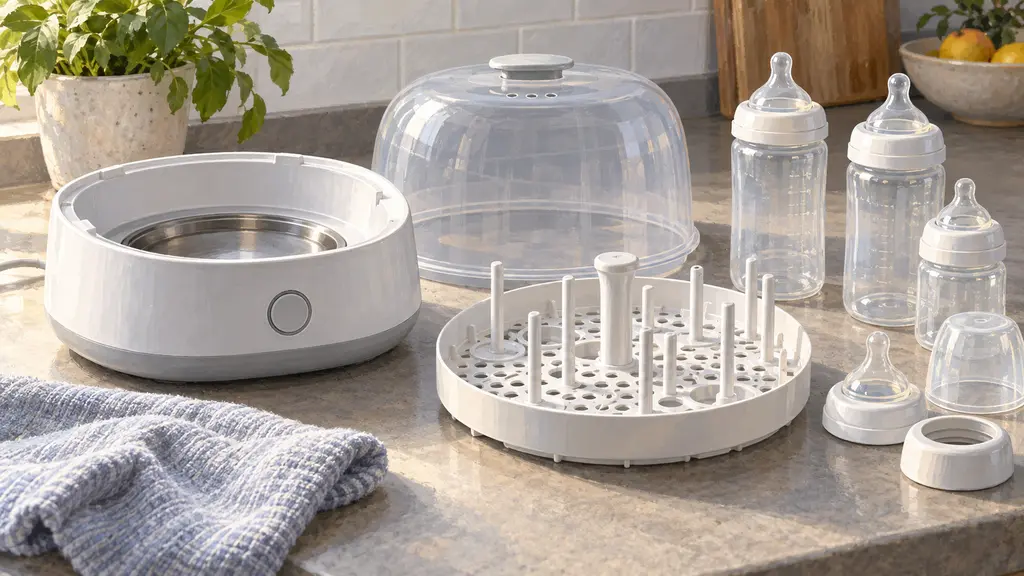
Quick answer: work out how many bottles you actually use per day, together in one cycle, not each bottle counted separately. If that number is small (two to three) and your microwave is usually free, a microwave sterilizer like the Philips Avent pick is completely enough. If you have twins or heavy daily use, a larger-capacity electric unit will save you repeated sterilizing cycles.
The quick answer
The right capacity is set by how many bottles you sterilize together in one cycle, not by the total number of bottles you own. A microwave sterilizer depends on your microwave’s own interior space and suits most homes with a moderate bottle count. With twins or heavy daily use, a unit built for a bigger load cuts down the number of cycles and saves your time.
Key points
- Count the bottles you sterilize together, not your total collection. If you own ten bottles but only sterilize three per cycle, a small capacity is enough.
- A microwave sterilizer depends on your microwave’s own interior space, so there’s no fixed capacity spec the way there is with an electric unit.
- Twins or heavy daily use makes bottles-per-cycle the top factor, more than price.
- Tight counter space makes a microwave sterilizer the sensible choice even with a moderate need, since it adds no extra footprint.
- There’s no need to buy bigger than your actual current need, a microwave sterilizer can just run a second cycle for a small extra time cost.
Work out your real need
Before you look at any sterilizer’s capacity spec, work out two simple numbers: how many bottles you actually use per day, and how many of those you’d like to sterilize together at once rather than one at a time. If you have one or two bottles being washed and reused daily, any small or mid-size sterilizer will cover you, and you can always run a second cycle the same day if needed with no real issue. If your count is higher (multiple bottle sizes, pump parts, spare nipples), how much a single cycle actually fits becomes the main thing to shop for.
Microwave versus electric: the capacity trade-off
A microwave sterilizer, like the Philips Avent Microwave Steam Steriliser, gets its capacity from your microwave’s own interior space, not from an independent capacity spec the way an electric unit has. That means your capacity is really set by the size of your microwave, and it’s enough for most homes sterilizing a moderate number of bottles daily. A standalone electric unit like the Chicco Modular Steriliser (≈ 9,350 EGP) is usually built around a bigger, fixed load, so it fits better if you have twins or more than one baby bottle-feeding around the same time, since it cuts down how many cycles you run over the course of a day.
Quick comparison by need
| Household type | Bottles per cycle | Best fit | Note |
|---|---|---|---|
| One or two bottles a day | Low | Microwave sterilizer (Philips Avent or generic) | Enough even if you run two cycles a day |
| Three to four bottles plus pump parts | Moderate | Microwave sterilizer with a roomy microwave, or a mid-size electric unit | Check your actual microwave capacity first |
| Twins or heavy daily use | High | Standalone electric unit with a bigger capacity | Cuts down repeated daily cycles |
| Very tight counter space | Any | Microwave sterilizer | No extra unit takes up any counter space at all |
If your counter space is tight
If your counter is already narrow and there’s no room for another appliance, a microwave sterilizer solves that directly since it uses something you already own without adding a new piece to the counter. Even if your daily need is moderate rather than small, prioritizing space might mean choosing a microwave sterilizer and simply running it twice instead of shopping for a bigger electric unit that needs its own spot.
Our pick
For most homes sterilizing a moderate number of bottles daily, the Philips Avent Microwave Steam Steriliser (≈ 3,925 EGP) offers good flexibility: it takes on your microwave’s own capacity, and you can run it more than once a day at no extra cost beyond a little time. If your need is clearly bigger (twins or heavy use), our full guide to the best bottle sterilizer in Egypt also covers a larger-capacity electric alternative with a built-in dryer.
Bottom line
The right bottle sterilizer capacity isn’t a fixed number, it’s the result of a simple calculation: how many bottles you actually sterilize per cycle, and how much your counter space allows. For most homes, a microwave sterilizer like the Philips Avent Microwave Steam Steriliser is enough and saves space, and with twins or heavy use a bigger electric unit saves your time by cutting down cycles. If you’re still deciding whether to buy a sterilizer at all, see the best bottle sterilizer in Egypt, and if you’re torn between buying and boiling, read is a bottle sterilizer worth it versus boiling. Once you’ve bought one, our how to clean a bottle sterilizer guide covers keeping it in good shape. For the full buying criteria across baby appliances, read how to choose baby appliances, or browse our baby appliances section.
Sources
- US CDC, “Cleaning and sanitizing baby bottles”, general background on baby bottles and their use: https://www.cdc.gov/hygiene/about/clean-sanitize-store-infant-feeding-items.html
This analysis is based on published information from US CDC (Cleaning and sanitizing baby bottles), US CDC (Cleaning and sanitizing infant feeding items).
Frequently asked questions
What size bottle sterilizer is right for my home?
Work out how many bottles you actually use per day that you'll want to sterilize together, not each bottle counted separately. If that number is small (two to three) and your microwave is usually free, a microwave sterilizer like the Philips Avent pick is enough. If your daily count is higher or you have twins, a larger-capacity electric unit will save you repeated cycles.
How many bottles fit in a microwave sterilizer?
It depends on your microwave's interior space, not a fixed capacity spec like an electric unit has. In practice it fits a limited number of bottles per cycle, so check the current product listing on Amazon.eg for the exact count, and compare it to how many bottles you actually use per day.
I have twins or use a lot of bottles daily, what should I choose?
With twins or heavy use, how many bottles fit per cycle matters more than price. A standalone electric unit built for a bigger load, like the Chicco Modular Steriliser, cuts down how many cycles you run each day, which is a real difference in your time with two babies feeding around the same time.
My counter space is limited, what should I do?
A microwave sterilizer like the Philips Avent pick uses the microwave you already own, so no extra unit takes up counter space at all. If space is a higher priority for you than a bigger capacity, that's the sensible choice even if your daily bottle count is moderate.
Should I buy bigger than I need now in case my needs grow?
Not necessarily. Buy for your actual current need, since a microwave sterilizer can simply run a second cycle instead of one if your bottle count grows, at the cost of a little extra time, nothing more. If you expect a large, permanent jump in count (like twins on the way), it's worth planning for a bigger unit from the start.